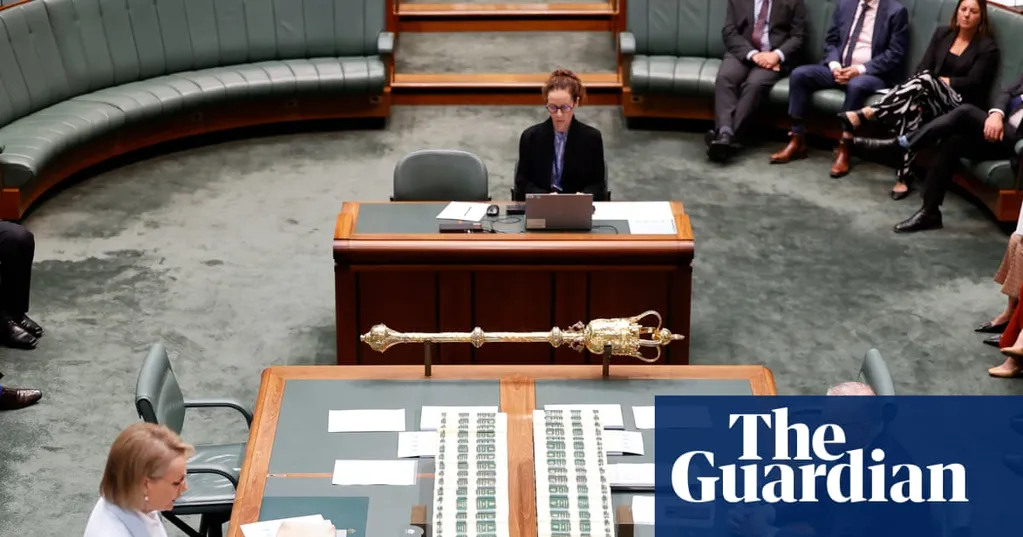
A deal on new hate speech laws is increasingly likely after Sussan Ley's shadow cabinet agreed to work with Labor to pass the legislation in a special parliamentary sitting in response to the Bondi beach massacre.
The opposition leader met the prime minister, Anthony Albanese, on Monday to discuss a compromise after MPs returned to Canberra to mark the 14 December terrorist attack.
The negotiations came after Albanese's decision to split his draft laws amid widespread opposition, shelving a contentious anti-racial vilification provision and carving out gun control measures into a separate bill.
The firearms reforms are guaranteed to pass with the support of the Greens. The laws will establish the biggest gun buy-back since the 1996 Port Arthur massacre, and require intelligence agencies, including Asio, to conduct criminal background checks when individuals apply for a firearms licence.
But the fate of wider changes to tackle antisemitism hinge on a deal between Labor and the Coalition, whose leader described the legislation as "pretty unsalvageable" before Albanese agreed to split it up over the weekend.
The remaining parts of the bill include new powers to ban hate groups, such as neo-Nazi organisations and Islamist organisation Hizb ut-Tahrir, as well as to revoke or refuse visas for people with extremist views seeking to come to Australia.
Shadow cabinet met on Sunday night and resolved to work with Labor on a deal to pass the bill on Tuesday, subject to amendments.
A joint Coalition party room meeting to formalise a position on the legislation was yet to be scheduled as of 2pm on Monday, suggesting negotiations were still under way.
Ley has faced pressure to stall or oppose even the stripped-back version of the bill, including from outspoken backbencher Andrew Hastie.
A senior Liberal source familiar with the latest negotiations said Ley was "conscious of delivering a good outcome" for Jewish Australians, who have in recent days implored the Coalition to agree a deal with Labor.
The source said negotiations between the two leaders had been "constructive" - a characterisation echoed by a senior Labor source.
Ley and Julian Leeser, an opposition frontbencher met families of victims of the IS-inspired shooting on Monday.
The shadow home affairs minister, Jonno Duniam, decried the government's handling of the legislation as "shambolic" but appeared optimistic a deal could be reached.
"What we're doing now should have happened right at the beginning. This is a national response requiring unity, requiring everyone to be on the same page in order to - in a uniform, united way - stamp out antisemitism and extremism," Duniam told Sky News.
"It is excellent that the racial vilification provisions were kicked out ... We are working through, and the government and opposition are working together to try and get the best outcome possible."
In an ultimatum to the opposition, Albanese signalled the laws would not be revisited if the Coalition refused to support them on Tuesday.
"We're not a government that puts things up over and over again to see them defeated," he told ABC Melbourne.
The prime minister used a condolence motion to say an atrocity like Bondi could never happen again, declaring "that responsibility starts with me".
"While the massacre at Bondi beach was cruel and senseless, it was not random," he said.
"Jewish Australians were the target. As we offer our love, sympathy and solidarity to everyone bearing the weight of trauma and loss, we make it clear to every Jewish Australian, you are not alone."