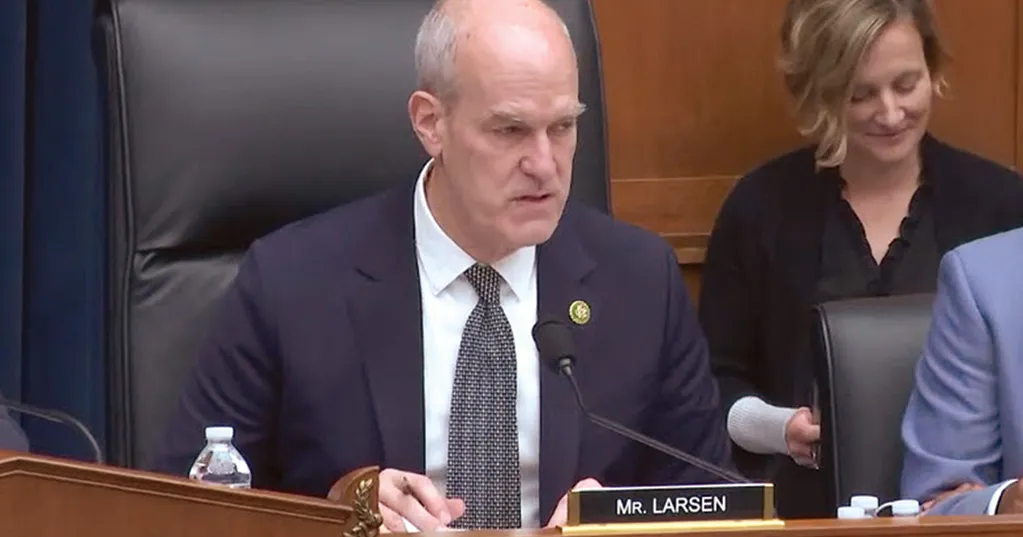
WASHINGTON -- The top Democrat on the House Transportation and Infrastructure Committee said bipartisanship will be essential to advancing a comprehensive surface transportation reauthorization this year.
Rep. Rick Larsen (D-Wash.), the panel's ranking member, said negotiations on a multiyear highway bill are gaining momentum as the Republican-led committee prepares to take up the legislation, potentially as soon as this month. He said the bipartisan measure will focus on improving safety and strengthening connectivity for commuters, transit riders and freight movement.
"On the committee on transportation, we're not in charge of ensuring that people and goods move. We're in charge of ensuring that people and goods move safely," Larsen told stakeholders at a conference hosted by the American Public Transportation Association on April 14. The Washington Democrat pointed to the bipartisan infrastructure law enacted in 2021 as a historic investment in transportation. That Biden-era law, he observed, helped create hundreds of thousands of jobs and contributed to transit ridership levels that have returned to or surpassed pre-pandemic levels in key regions.
Larsen's remarks came as Congress prepares to debate transportation funding amid broader budget constraints. Lawmakers are confronting myriad funding pressures, and the authorization for federal highway programs expires in September.
Larsen is optimistic that the upcoming reauthorization package can attract bipartisan support, pointing to the committee's recent track record of advancing legislation on issues such as pipeline and aviation safety, water resources development and emergency disaster response.
Committee staffers confirm that negotiations are ongoing, with policymakers reviewing thousands of stakeholder submissions and hearing directly from constituents about local transportation needs. Larsen said that maintaining a collaborative approach will be critical as lawmakers work to assemble a bill capable of moving through both chambers.
As ranking member, he explained that preserving the traditional balance between highway and transit funding will be a key priority along with ensuring reliable support for multimodal projects as well as infrastructure designed to withstand severe weather events.
He also cited the American Society of Civil Engineers' latest infrastructure report card, which gave the nation's overall infrastructure a C grade, as evidence of the urgency to invest.
"As we look to make investments to bridge this gap, I'm ... committed to ensuring rail projects continue to have reliable and robust support moving forward," Larsen said. "And safety will always be the committee's top priority."
His emphasis on safety reflects persistent concerns about roadway fatalities, with federal data showing about 40,000 people die each year on the nation's roads.
House Transportation and Infrastructure Committee Chairman Sam Graves (R-Mo.) has said he expects the House to consider a reauthorization bill by Memorial Day, a few months before the authorization for federal highway programs expires.
At an event earlier this year with state officials, Graves said his committee will consider bipartisan provisions totaling about $550 billion to govern the nation's transportation system. Senate transportation leaders are expected to pursue a parallel effort.
As work on the next highway bill is poised to accelerate, lawmakers continue to face a long-standing challenge: the Highway Trust Fund. The fund, which primarily finances the maintenance of the Interstate Highway System and other surface transportation programs, relies on fuel tax revenue that has failed to keep pace with infrastructure needs. The tax was last raised in the early 1990s.
Meanwhile, transportation stakeholders are coalescing around familiar priorities, including safety, stable funding for highways and transit, and the efficient integration of emerging technologies.
The current authorization of federal highway programs was included in the Infrastructure Investment and Jobs Act of 2021, which dedicated billions of dollars to improving the nation's freight and commuter networks.