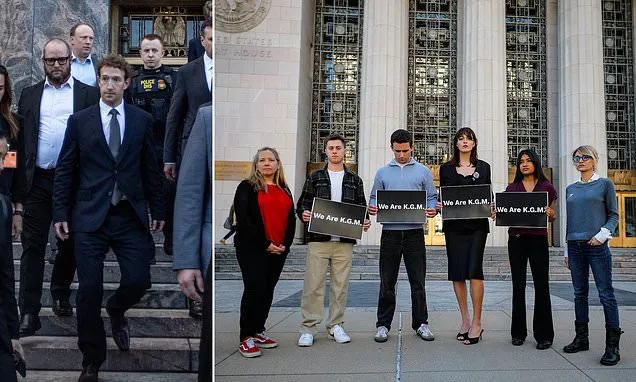
The lead attorney in the $3million social media addiction ruling against Meta and Google has hailed the verdict as a tipping point in the behaviour of technology giants.
The first-of-its-kind lawsuit saw the plaintiff, a 20-year-old woman referred to only as K.G.M. or Kaley, accuse the tech giants of intentionally getting her hooked on their platforms.
Speaking to the Daily Mail's The Trial podcast, Kaley's lawyer Matthew Bergman, founding attorney of the Social Media Victims Law Center (SMVLC) who are representing hundreds of plaintiffs in state and federal proceedings, declared himself 'humbled' by the verdict.
Kaley started using YouTube at six, downloading the app on her iPod Touch to watch videos about lip gloss and an online kids game. She joined Instagram at nine after getting around a block her mother had put in place to keep her off the platform.
After more than 40 hours of deliberation across nine days, California jurors decided the tech giants were negligent in the design or operation of their platforms.
The jury also decided each company's negligence was a substantial factor in causing harm to Kaley, who alleged her use of social media as a child addicted her to the technology and exacerbated her mental health struggles.
Mr Bergman said that the significant damages awarded were the only way to get the attention of social media companies.
'This is how you get their attention. I mean, how many times have their executives been excoriated before Congress?' he said.
He added: 'We have thousands of cases filed, so it starts getting to a point where the companies are going to have to decide, "Is it cheaper for us to keep litigating these case, or is it cheaper for us to actually make our platform safer and actually implement some design changes that we know are easily accomplished?"
'We're hopeful that as we increase the litigation pressure, the platforms will start taking larger and larger steps toward making their platform safer.'
Mr Bergman also paid respect to Ian Russell, whose 14-year-old daughter Molly took her own life after being bombarded with AI content online.
'I keep thinking of Molly Russell, and she really started this. And her father, Ian, really started this across the pond in the UK.
'That was the first time that a social media company had ever been called to account for causing, in Molly's case, such a terrible outcome in a in a beautiful young child. I feel Molly must be smiling right now.
'In Kaley's case a young woman was severely victimized by social media, but thank God she's still with us and she's still able to move on with her life. In so many cases that's not what we have.
'Thinking about what Ian went through for those five years provided me with inspiration and hope that justice can, and not always, but sometimes does prevail.'
Jurors found that both companies knew or should have known their services posed a danger to minors, that they failed to adequately warn users of that danger and that a reasonable platform operator would have done so.
Jurors assigned Meta 70 percent of the responsibility for Kaley's harm - a $2.1 million share of the compensatory award - and YouTube the remaining 30 percent, or $900,000.
The multi-million-dollar verdict will grow as the jury decided the companies acted with malice or highly egregious conduct, meaning they will hear new evidence shortly and head back into the deliberation room to decide on punitive damages.
The landmark ruling comes just one day after Meta was ordered to pay a penalty of $375 million after a New Mexico jury determined the firm knowingly harmed children's mental health and concealed what it knew about child sexual exploitation on its social media platforms.
Mr Bergman sung the praises of the whistleblowers within the tech world that have spoken out about practices within the industry that encourage social media addiction.
'I think the only reason why these platforms were designed the way they are were is because the companies felt that they had no legal accountability,' he said.
'What we've seen in the documents, many of which were presented before the jury, is that within Meta, within YouTube, there are people of conscience that have reached out multiple times to C-suite and said "Look what we're doing to kids." Time and time again, those entreaties are rejected in favor of the almighty buck.
'Nowhere have I seen any document saying, "Well, gee, we might get sued." Now, those documents are being generated. Now they're having to fathom more than just a bad day of press or an embarrassing encounter in front of the United States senator.
'And now they have to look at impacts on their stock price and impacts on their profitability. And that hopefully will lead to some meaningful change.'
The jury was told not to take into account the content of the posts and videos that Kaley saw on the platforms because tech companies are shielded from legal responsibility for content posted on their sites under Section 230 of the 1996 Communications Decency Act.
Despite the victory in court, Mr Bergman insisted this was not a 'dancing in the endzone kind of moment', with Google and Meta both planning to appeal the verdict.
Asked about Kaley's response to the verdict, he said: 'She's very happy. She's not a person who wears her emotions on her sleeve.
'She's a very private person. It was very hard for her to go through this trial and to hear her mother excoriated, to hear her mental health brought in full view of everybody.
'She wishes she didn't have to do this. There's no there's no amount of money that would compensate. I mean, she lost her childhood. What's the cost of that?'
A Google spokesperson said: 'We disagree with the verdict and plan to appeal. This case misunderstands YouTube, which is a responsibly built streaming platform, not a social media site.'
Meta has been approached for comment.