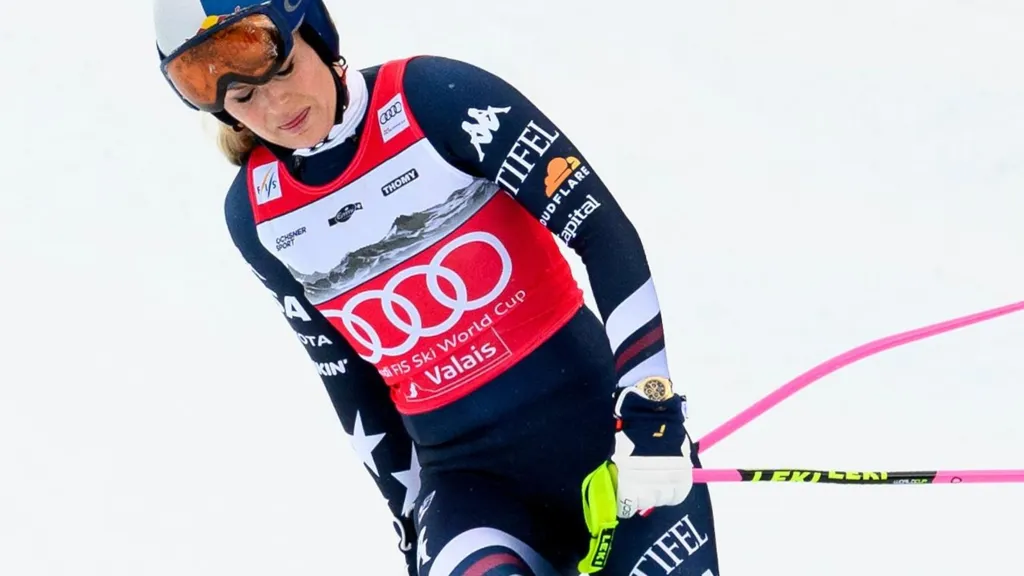
Lindsey Vonn's decision to compete in Alpine skiing at the Milan Cortina Olympics, despite a torn ACL, is risky but not unexpected, experts in orthopedics and sports medicine said.
"It's not unusual for any elite athlete. People will push through with something that us normal folks wouldn't push through because the stakes are a little higher," said Dr. Catherine Logan, an orthopedic surgeon with the Joint Preservation Center in Denver, Colorado, who has worked with U.S. ski, snowboard and lacrosse teams.
Vonn, who came out of retirement to earn a spot on the U.S. Olympic team at age 41, crashed in a World Cup downhill event in Switzerland on Friday. The damage to her left knee included a "completely ruptured" ACL and bone bruising, "plus meniscal damage," Vonn said Tuesday at a news conference.
After physical therapy and on the advice of doctors, she decided to continue.
"My knee is not swollen, and with the help of a knee brace, I am confident that I can compete on Sunday," Vonn said.
By doing so, Vonn risks doing more damage to the knee -- or worse, said Dr. Yana Klein, an emergency and sports medicine specialist at the University of Colorado School of Medicine.
"She might blow out her knee entirely," Klein said. "At these really high racing speeds, the big risk is that the knee is just not stable enough to compete."
Klein stressed that decisions like this are complicated and made with "athlete safety as the top priority."
Here's what to know about the ACL and this type of injury:
- The ACL, or anterior cruciate ligament, connects the femur, or thighbone, to the tibia, or shinbone. A rupture is a tear in the ligament that typically occurs in sports that involve quick changes in direction, such as basketball, soccer and skiing.
- Athletes typically hear a loud "pop" in the knee, which immediately gives out, followed by significant swelling.
- A ruptured ACL plus damage to the meniscus -- a piece of rubbery cartilage that acts as a shock absorber between the femur and the tibia -- is considered a severe injury, said Dr. Mia Hagen, a sports medicine surgeon at UW Medicine in Seattle.
- It's often treated with surgery within months of the injury, according to guidelines from the American Academy of Orthopaedic Surgeons. It can take nine months to a year to recover after surgery.
- Vonn will rely on an external knee brace -- and on her sheer physicality, Logan said.
- If Vonn develops significant swelling or excess fluid in the knee joint, it could affect her power, strength and edge control, or the ability to manage the angle of the skis relative to the snow, Logan said. But if she's able to control those factors, she could still be competitive.
"Some people can return earlier, but others never return to their sport of injury," Hagen said.
"Skiing is possible with a ruptured ACL," she said. "It really relies on our quad strength, our hip strength and our neuromuscular control."
"For an elite alpine skier like Lindsey is, to perform at an Olympic event, it's still possible," she said.