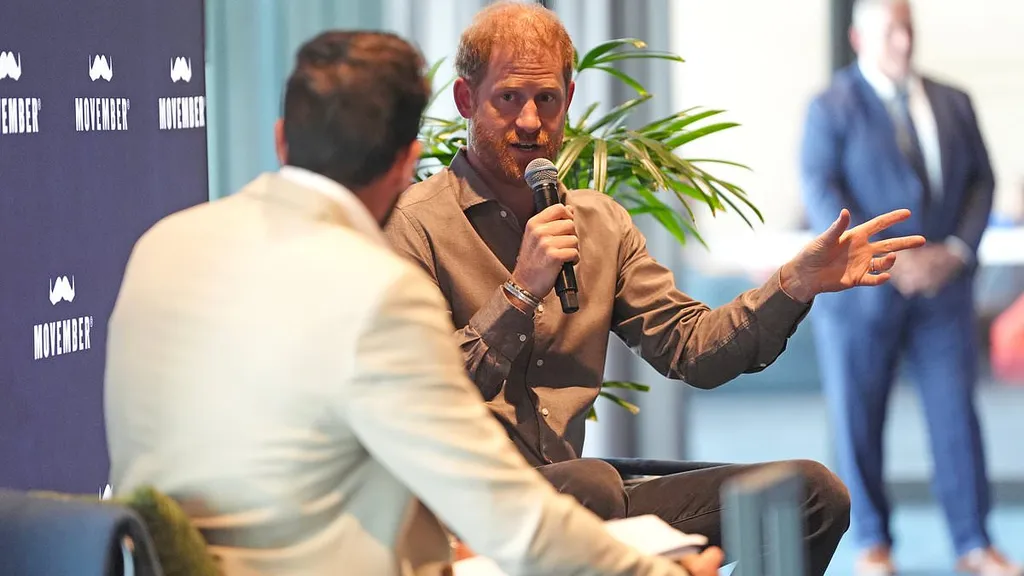
Just two days into his unofficial grand tour of Australia and Prince Harry has already managed to give yet another speech about his own mental health and childhood struggles.
Speaking at a panel discussion with men's mental health charity Movember in Melbourne, he said: 'Each generation needs to improve on their own experience of growing up.' While he was careful to stress that he's not 'pointing the finger' at his own parents, he added that new parents need to be an 'upgrade' from their own.
Harry has previously spoken about the need to break his own cycle of 'genetic pain', adding that he 'had stuff from the past that [he] needed to deal with' before having children.
And in Melbourne Harry spoke about what a 'transformative experience' fatherhood has been for him, recalling how important therapy has been in helping him overcoming challenges.
But the question is this: how can Harry claim he's 'cleansed' himself of the trauma of his childhood, while giving speeches that fixate on his past and demonstrate how he is truly stuck in it?
'I can empathise with Harry (pictured during the Movember talk in Melbourne today). But talking about his pain does not give him the ability to help others,' writes Liz Jones
Of course I have sympathy for those like Harry who can't seem to shake off the past, because I know what it's like.
After I was made bankrupt in 2017, I became a different person because I learned that the worst can and will happen. I developed complex post-traumatic stress disorder which leaves me living with a constant, slow-burning anxiety.
And the anxiety impacts not just the way I deal with my finances but every area of my life. I can't even enjoy simple activities like walking my dogs without the fear that they will be run over or shot.
Like Harry, I've been treated by numerous therapists - hypnotherapy, neurofeedback, EMDR, meditation, hugged by butterflies, cognitive behaviour therapy - but sadly, nothing worked.
People assume that if you survive a traumatic experience - as Harry did after the loss of his mother at such a tender age and as I did after losing everything - you should be grateful to be so lucky and live life to the fullest.
Sadly, the opposite is true. Once you go through something so earth-shattering, you become all too aware the world is not a safe place.
So I can empathise with Harry, who is yet again digging up his unshakeable childhood trauma. But the problem is that he believes talking about his pain gives him the ability to help others. It doesn't.
What struggling families need is practical, tangible help because, let's face it, they don't have time to listen to speeches.
Showing up at a hospital, bending down to smile at a tot in a bed, standing at a lectern or kicking a rugby ball is merely window dressing. And the fact that Harry has clearly not been able to move on - forgive his father, be magnanimous, enjoy his life - sends out a clear message: With all his wealth, security and access to the best help imaginable, nothing seems to work.
So, if even he remains stuck, you can bet you will be too! Defined forever by your upbringing. Which is exactly the opposite of his well-meaning but hopelessly misguided intentions.
I am starting to feel that Harry really isn't helping himself or others with his endless word salads.
He is enormously privileged. What about all those fathers who leave the house every day at 7am, work hard to make ends meet, worry about not just the security of schools but even if it's safe for their child to play in a park or attend a dance class?
His latest utterings? Extremely hard to swallow.