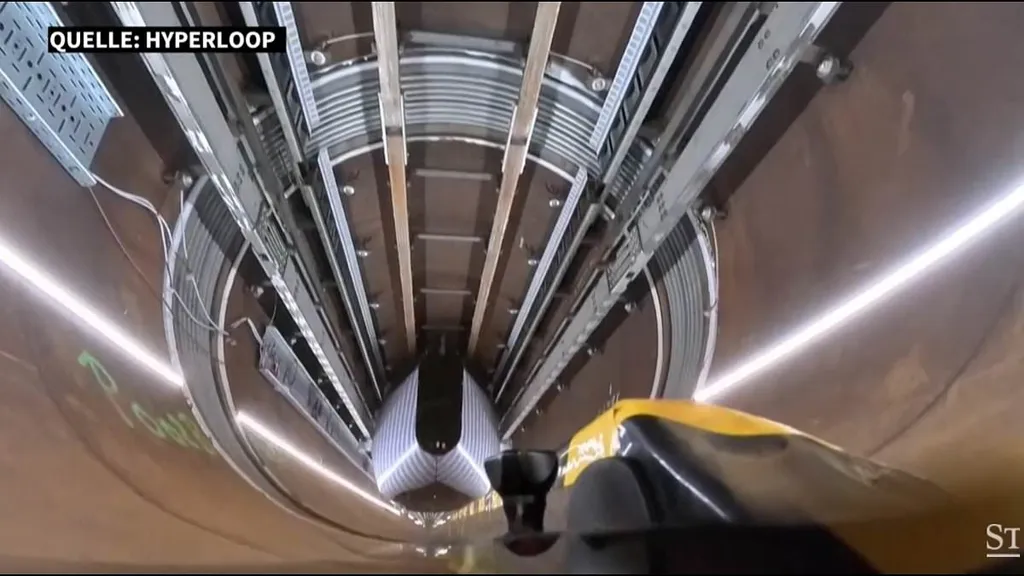
A futuristic hyperloop journey from London to Paris could slash travel time between London and Paris to just under 30 minutes.
The concept involves passenger pods travelling at more than 600mph through low-pressure tubes, which could further link London with Brussels in 20 minutes, Amsterdam in 22 minutes and Berlin in just over an hour.
Though it's been an engineering pipe dream for several years, the idea gained global attention in 2013 when Elon Musk published a white paper on it.
According to supporters, magnetic levitation - similar to maglev trains - would allow pods to glide without physical contact, reducing friction and energy use.
Theoretically, most of the energy normally lost to air resistance would disappear in the vacuum-like environment.
Europe has become a key testing ground for the innovative system with the 2024 opening of the European Hyperloop Center in Veendam, the Netherlands.
Engineers recently demonstrated a 'zero-moving parts' lane switch, which allowed pods to change routes without mechanical track changes - a major step toward building a real network.
Gavin Haines, travel writer for The Telegraph, recently visited the Dutch site, where he saw firsthand how the system operates.
A futuristic hyperloop journey from London to Paris has the potential to cut travel time between London and Paris to between 20 and 28 minutes
The system utilises magnetic levitation that allows pods to glide through tunnels without physical contact
Testing is currently underway at the European Hyperloop Center in Veendam, the Netherlands
The center's managing director, Kees Mark, told Haines that he has ridden in the test system himself, and describes the experience as closer to flying than traditional rail travel.
He said: 'To think that we could be having coffee in Paris in under an hour from now is a huge mindset shift.'
'It's more like flying. That's one of the benefits of hyperloop - there's no wear from moving parts.'
However, the project faces significant hurdles. Maintaining a vacuum in large tubes is technically difficult, and funding full routes would require billions in investment.
In the United States, Virgin Hyperloop ended passenger operations in 2023 amid safety barriers, a complicated regulatory process and extensive financial challenges.
Richard Branson, one of the project's early investors, pulled out after the company failed to reach its goal of 700mph speeds - only reaching 107mph in its first human trial.
Capacity on the proposed hyperloop network is another concern; critics noted early passenger pods carry far fewer people than standard train carriages.
For now, hyperloop is still in the testing phase, with no confirmed construction dates.
The hyperloop, though still in the testing phase, is said to currently face a number of hurdles concerning maintenance, funding and capacity
According to industry experts, limited commercial routes could be introduced in the 2030s, but a 30-minute rail journey between London and Paris remains an ambitious future goal rather than a set plan.
Elsewhere, Japan is building what could become the world's fastest train, with speeds potentially reaching 603.5kmh.
The impressive new vehicle is still under development and will be known as the L0 Series - a Japanese maglev train.
The train uses magnetic levitation to lift off the track, while an electric motor will help to propel the carriages onwards - leading to groundbreaking speeds. So far, the project has reportedly cost a whopping £52 billion.