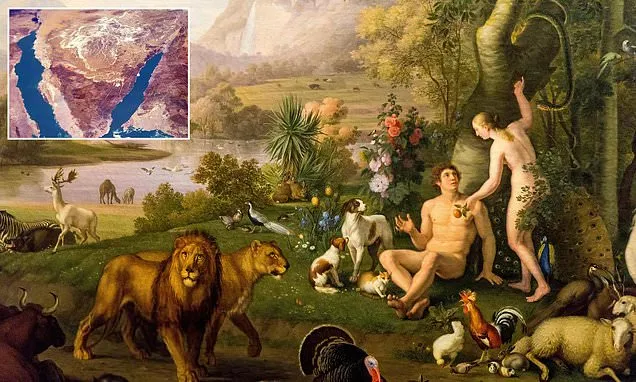
For centuries, the Garden of Eden has been a symbol of paradise in the Bible, a lush, perfect world where Adam and Eve once walked.
Many have dismissed it as a myth, but now, resurfaced satellite images have suggested that the story may have a very real geographical basis.
A series of orbital scans has revealed an ancient, now-dry riverbed in Saudi Arabia that some scholars believe aligns with the biblical description of Eden's main river, the Pishon.
The Book of Genesis describes Eden as a paradise watered by a single river that split into four: Pishon, Gihon, Tigris, and Euphrates.
While the Tigris and Euphrates are well-known rivers in modern-day Iraq, the Pishon and Gihon have long been lost to history, until now.
The dry riverbed, called Wadi al-Batin, stretches from the western highlands of Hejaz near Medina northeast to the northern Persian Gulf near Kuwait.
Its winding course corresponds closely with the biblical description of the Pishon, which Genesis states 'compasseth the whole land of Havilah, where there is gold; and the gold of that land is good: there is bdellium and the onyx stone.'
Modern satellite imagery spotted Wadi al-Batin's delta near the Gulf, with dunes and depressions marking the river's former grandeur.
Complementing this, Iran's Karun River, a twisting waterway flowing through the Zagros Mountains, may correspond to the Gihon. The Hebrew word 'sabab,' meaning to circle or twist, aptly describes the Karun's meanders.
Many have dismissed the Garden of Eden as a myth, but now, resurfaced satellite images have suggested that the story may have a very real geographical basis.
The Garden of Eden was described in the Book of Genesis as a paradise where the first humans, Adam and Eve, once walked before committing the first sin.
Historically, the river ran through the Kassite territory, identified by some scholars as the land of Cush mentioned in Genesis.
The discovery of Wadi al-Batin as a potential Eden riverbed dates back to the early 1990s when Boston University geologist Farouk El-Baz analyzed radar images from NASA's Space Shuttle Endeavor.
However, the images were revisited on Patheos this month, reigniting attention to what had been lost for thousands of years.
The data revealed a fossilized river up to three miles wide, active during a wetter Holocene era before drying between 2000 and 3500 BC due to climate shifts.
'These satellite images give us a window into landscapes that have vanished over millennia,' said Dr El-Baz.
'We can now trace rivers that once shaped human settlement and perhaps even inspired ancient biblical narratives.'
The alignment of these rivers with biblical text is striking, as together with the Tigris and Euphrates, Wadi al-Batin and the Karun would have converged into the Persian Gulf, forming a fertile cradle of civilization.
A series of orbital scans has revealed an ancient, now-dry riverbed in Saudi Arabia that some scholars believe aligns with the biblical description of Eden's main river, the Pishon.
Complementing this, Iran's Karun River, a twisting waterway flowing through the Zagros Mountains, may correspond to the Gihon.
James A Sauer, a biblical archaeologist who analyzed the satellite data, said that the dry riverbed's features best match the biblical description of the Pishon, though he stops short of declaring this proof of Eden itself.
However, according to archaeologist Juris Zarins, satellite imagery showing ancient riverbeds near the Persian Gulf corresponds with descriptions from Genesis, suggesting the Eden narrative may reflect real ancient geography even if its spiritual elements remain interpretive.
Environmental data has also supported this theory, showing Arabia's arid transformation after the last Ice Age and rising sea levels that may have submerged parts of Eden's delta.
Not all scholars agree, however. Some argue the land of Cush may refer to regions in Africa, connecting the Gihon to the Nile instead.
Others cautioned that biblical texts blend spiritual allegory with historical memory, making precise mapping speculative.
Despite these debates, the discovery has reignited interest in the geography of Genesis.
Satellite maps of the Fertile Crescent, including Wadi al-Batin's path, reveal a landscape that once supported early human settlements.
This area is where the Tigris and Euphrates rivers merge to form the Shatt al-Arab, which then flows into the Persian Gulf.
The ancient rivers' courses align with archaeological evidence of early farming communities and trade networks providing a tantalizing glimpse of a pre-flood world described in biblical texts.
There have been many theories about where the Garden of Eden was located, with a recent suggestion putting it in Africa.
Mahmood Jawaid, a chemical engineer based in Texas, argued Eden was actually in Bahir Dar, a fertile region in northwestern Ethiopia near the southern end of Lake Tana, where the Blue Nile begins.
Jawaid based his research on a careful reading of both the Bible and the Quran, analyzing descriptions of Adam and Eve, the rivers and the garden itself.
The 2025 study, which has not been peer-reviewed, noted the Blue Nile could correspond to the Biblical Gihon, and Lake Tana’s outflows divide into multiple waterways, potentially forming the four rivers described in Genesis.
Early human evolution also played a role in this theory, proposing that Adam may have evolved from Homo habilis or a late form of Australopithecus in the East African Rift Valley near Olduvai Gorge, a region considered a cradle of humanity.
From there, Adam and Eve could have been 'placed' in the highlands of Bahir Dar, a paradise at a higher elevation, before descending—what the Quran describes as 'habata'—to settle in the Rift Valley.
This is because the region sits about 6,000 feet above sea level; boasting lush vegetation; abundant wildlife; and flowing Blue Nile—features that align with both Biblical description of Eden’s rivers and Quranic concept of a garden on Earth.