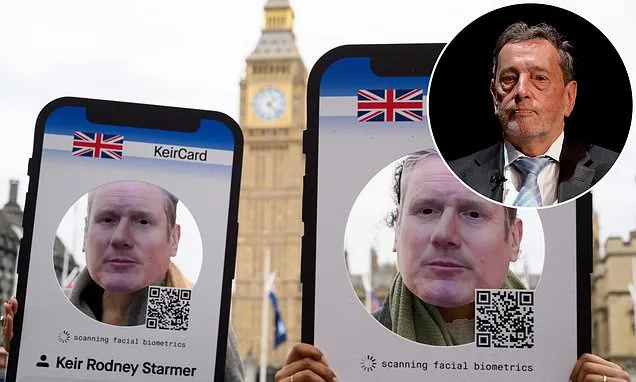
The latest volte-face by the government on the introduction of digital ID, ditching the requirement to make it mandatory by 2029 for anyone wishing to work in the UK, has left me bewildered.
In one sense, I'm not surprised. The announcement last September came out of the blue.
The Prime Minister made a speech to an international audience. And then there was media silence.
Ministers did not appear to have a narrative to follow, nor a plan to explain. Without that, they had no way to win people over to the idea behind digital ID, for an easy-to-use and all-purpose way of identifying ourselves. It was a recipe for failure.
No one pretends, least of all me, that government is easy. If it were, challenges from Left and Right would be easily dealt with and every long-standing problem could be resolved.
The truth is that governing today is more difficult than it's ever been. The issues facing society are ever more complex, and social media threatens to turn every minor matter into a crisis. In addition, we face international turmoil unprecedented since the Second World War.
As a result, Prime Minister Keir Starmer and those close to him have to spend an enormous amount of time and energy on dealing with the day-to-day challenges. This has never been truer than the first two weeks of the New Year.
But voters make few allowances for that. If Labour isn't to be wiped out in the elections in Scotland and Wales this May, or in England in the local elections, or faced with meltdown in three years' time at a General Election, something has to change.
I'm a Labour peer and a former Labour Cabinet minister - a lifelong Labour man. I support this government and will do everything I can to help it succeed. But the digital ID debacle is only one example from the past 18 months of how Keir and his ministers are launching policies without fully appreciating the harsh politics of an issue or the impact it has on electoral fortunes.
Almost always, there are rational reasons for these policies. In every case, there's a good argument for what is being proposed... but only if you discount the political price you will have to pay in the real world.
After all, most people use digital ID on almost an hourly basis. Every possible aspect of life requires some sort of ID verification, from banking and payment systems through to boarding cards for travel.
But if politicians don't explain what they are doing, it won't be surprising when (as in this case) opponents make mischief. Misunderstanding about digital ID was fostered, to the point where 3 million people signed an online petition against it.
The government, and especially the Treasury, have repeatedly made the same mistake.
Removing the winter fuel allowance from pensioners caused worry and upset to 10 million people, yet resulted in just a quarter of the savings originally envisaged.
Then came the perfectly rational suggestion that capital tied up in farmland might actually, in some circumstances, be treated like other investments when it came to inheritance. But the Treasury's failure to understand the impact this could have on small family farms, and the belated change of mind that followed, was another demonstration of a policy badly thought through.
I'm a strong believer that we need to fix our welfare system, and I have written extensively about the importance of reducing the exponential rise in spending. We are wasting billions by propping up systemic failure instead of giving people independence and self-reliance.
Once again, the government had to step back as their own backbenchers in the Commons revolted. If there was ever a case for the Prime Minister taking charge and getting a grip, welfare has to be top of the agenda.
It is the job of Prime Ministers to harness the historic power of the Treasury and put it to work with the political instincts of the government, to win a second term in office. Short-term thinking cannot achieve this. But right now, there is no political strategy even for the medium term. Each step forward is at constant risk of an immediate reverse.
That prevents the government from getting coherent messages across to voters. And the consequences for our democracy could be dire.
For it will not be Kemi Badenoch and the Conservatives who replace the present government, should they fail to turn things round in the next three years, but Nigel Farage and a bunch of individuals with the political sophistication of primary school children driving a JCB.
This week was supposed to see a major announcement on the investment and future development of rail and connectivity in the North of England. That was dislocated by the U-turn on digital ID.
And before that happened, we had another three-point turn, reversing the Budget announcement relating to hospitality: specifically pubs. The government had to balance the withdrawal of subsidies - which were put in place to mitigate the worst of the Covid pandemic - with the adjustment of business rates. It’s a complex issue, and it was comprehensively fumbled. Once again, the hand of the Treasury appeared to be on the tiller.
I’m sure those who briefed the Chancellor were convinced of their logic. The problem was the politics and the economics didn’t match.
None of these examples were due to the whims of the President of the United States, the malign influence of Vladimir Putin, or the bullying online threats of Elon Musk. These are problems of Labour’s own making.
Politicians urgently need to get a grip and start showing some coherence. I believe in Labour values and this government has to let them shine through. Everybody, supporters and opponents alike, needs to see where the country is going and how individual policy announcements fit into that jigsaw.
In other words, Labour needs a plan. Keir Starmer and his Cabinet must never make announcements without first thoroughly thinking them through.
Ministers must always be prepared to argue their case with genuine enthusiasm instead of equivocating. And once a decision is made, they must stick to it short of some dramatic global event which makes a change of heart unavoidable.
Clear decisions strongly advocated; powerfully and rapidly implemented; clearly explained must be the resolution for the years ahead. If the government is to succeed (and I’m willing them to do so) then the lessons - not just of 2025 but of the past 14 days - must be taken on board.
This is a turbulent world. The government has to guide us through the storms safely.
We need direction, and we deserve leadership... not two steps forward, one step back, U-turn and disillusionment.