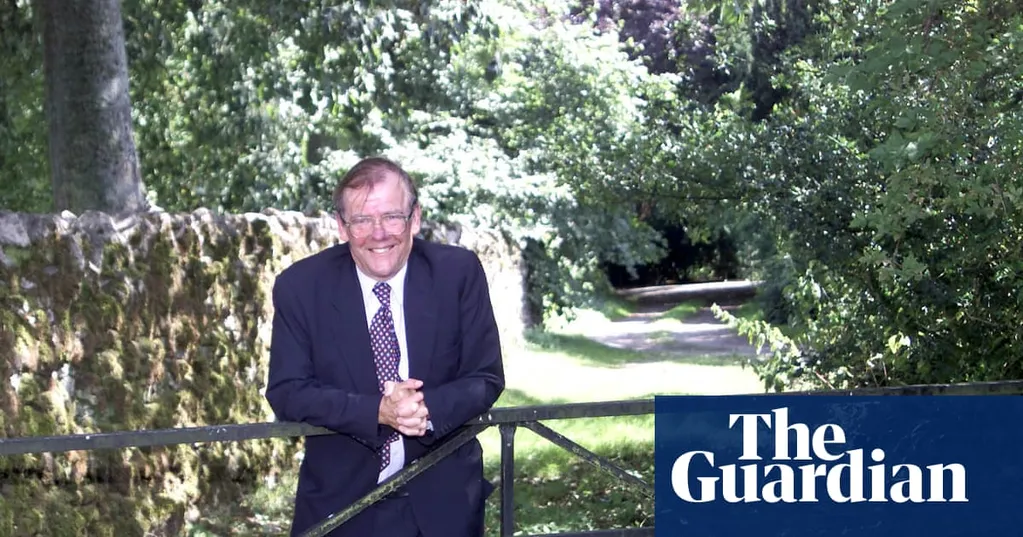
Chris Haskins, Lord Haskins, was perhaps the most prominent business supporter of Tony Blair's New Labour project, brought in to Downing Street at the start of his administration to advise on cutting red tape, and later as "rural tsar" in the wake of the devastating foot and mouth outbreak of 2001. What Blair would praise as Haskins's invaluable "no nonsense approach" was honed during 40 years building up Northern Foods into Britain's leading food manufacturer. There he was credited with developing the chilled food techniques that have made possible today's enormous growth in ready meals and convenience foods.
Haskins, who has died aged 88, combined the acumen of an entrepreneur and enlightened business manager with a socialist conscience. Alongside it went a compulsion to tell the truth as he saw it, which could sometimes get him into difficulties. He distanced himself from the Labour government after what he called the "disgrace" of anti-terrorist legislation in the early 2000s, and the Iraq war, and in a typically unguarded New Statesman interview, he said of Blair: "He wants everyone to love him." And of David Blunkett, the former home secretary: "You have to watch him like a hawk."
He was outspoken in the causes he supported, such as European monetary union, English regional devolution, and the cutting of subsidies to British agriculture (for which Country Life would dub him Villain of the Year in 2003); his political activism was first sparked by the Campaign for Nuclear Disarmament's Aldermaston marches in the 1950s and 60s.
An Irishman, born in Dublin to a Wicklow dairy farmer, Robin Haskins, and his wife, Margaret (nee Mullen), Chris attended a Protestant public school, St Columba's college, where "genial anarchy" reigned and as head boy he smoked and refused to continue the practice of beating. At Trinity College Dublin, studying modern history, he had a reputation as a radical and, with thoughts of becoming a journalist, he persuaded the Irish Times to pay for him to cover the second Aldermaston march, which his girlfriend, Gilda Horsley, had encouraged him to join.
He described it as "a compelling moment - democracy was alive and well". He had changed "from a conventional right of centre boy in the 50s to a radical disrespectful at the end of the 60s". He continued his association with CND, becoming baggage master on later marches.
In 1959 he travelled to England, and married Gilda, whose father had founded Northern Dairies in Yorkshire. He had hoped to join the Irish Times, but his mother, who did not approve, had failed to pass on a message from the editor. Haskins, who loved writing, would call it the greatest regret of his life.
He was bored at his first job, with the banknote printing company De La Rue in Manchester, but then joined Ford at Dagenham, a noted training ground for young managers; providing earlier responsibility than most British companies. Haskins would always complain that British companies paid less attention to skills and training than elsewhere; relying too much on government.
After two years, in 1962 he accepted an invitation to join his father-in-law at Northern Dairies (later Northern Foods) in Hull, which was now branching out into other food products. Haskins was crucial in its development; the key being the establishment of what became a symbiotic relationship with Marks & Spencer.
It had started accidentally on a flight to Belfast when Haskins sat next to an M&S manager establishing a store. He negotiated a contract to supply milk; and later other products including the first M&S fresh trifle.
The connection would eventually lead to annual sales of half a billion pounds to the high-street store and the setting up of separate factories to supply different chains; gammon and parsley meals for M&S; Goodfella's pizzas for Tesco; salmon in watercress dishes for Waitrose. At one stage the company had 21 different businesses with separate management teams reporting to a small head office. Haskins disliked hierarchical management and his open style and self-deprecating leadership was popular with staff. He would argue that they must be allowed to make mistakes, as the only way to learning.
When he stepped down as chairman in 2002 the company had gone from an annual turnover in 1979 of £300m and a profit of £30m to a peak in 1998 of a £2bn turnover and £140m profit.
He maintained his own agricultural interests with sizable farms in both Ireland and the East Yorkshire village of Skidby where he lived, run with the participation of his wife and sons. He claimed to be a businessman only by default: "I am a much better farmer than a business person."
Some of his strong views on the direction of agriculture saw light in his 2003 rural recovery report for Defra after the foot and mouth epidemic. Its 57 proposals, mostly accepted, included a shift towards environmental concerns and a long-term reduction in subsidies. He lived modestly and dressed down, more usually seen in a jumper than jacket and tie, buying his suits, appropriately, at M&S, and driving battered cars. When Northern Foods was first quoted on the FTSE in 1984, his salary was the lowest of his contemporaries. He complained that executive salaries in Britain and the US were out of control.
Haskins reluctantly accepted a life peerage in 1998 while he was heading the Better Regulation Task Force, even though he supported the abolition of the Lords. But his relations with the government cooled from the time in 1999 when he declared himself as "a (nearly) fully committed supporter of the Blair project". His proposals for Whitehall changes upset some cabinet ministers and he was genuinely bewildered when, a Labour donor, he was expelled from the party in 2005 for also funding the rival election campaign of an old acquaintance, Danny Alexander, a Liberal Democrat.
He sat as a crossbench peer thereafter, retiring from the Lords in 2020. In his later years he threw himself into local affairs. He was a passionate advocate of regional devolution and took an active role in various Yorkshire economic bodies. But he faced disappointment as governments wound down bodies such as the Yorkshire Development Agency and the Humber Local Enterprise Partnership, which he chaired.
He wrote feelingly about the decline in the social spirit of business, linking it to the distancing of companies from the communities where they originated. In Hull he founded Maritime Hull to promote its nautical heritage. But he abandoned an attempt to secure a vote for devolution for Yorkshire people because, he said, he found them so uninterested. "My over-riding issue was business and political indifference to devolution. Local politicians didn't take devolution too seriously. They spent much more time thinking about where they were going to sit."
He once wrote in the Guardian: "Most of the campaigns of my life have failed, largely, I comfort myself, because I have been ahead of my time."
He is survived by Gilda; their five children; David; Gina; Paul; Danny and Kate; nine grandchildren and a great-granddaughter.