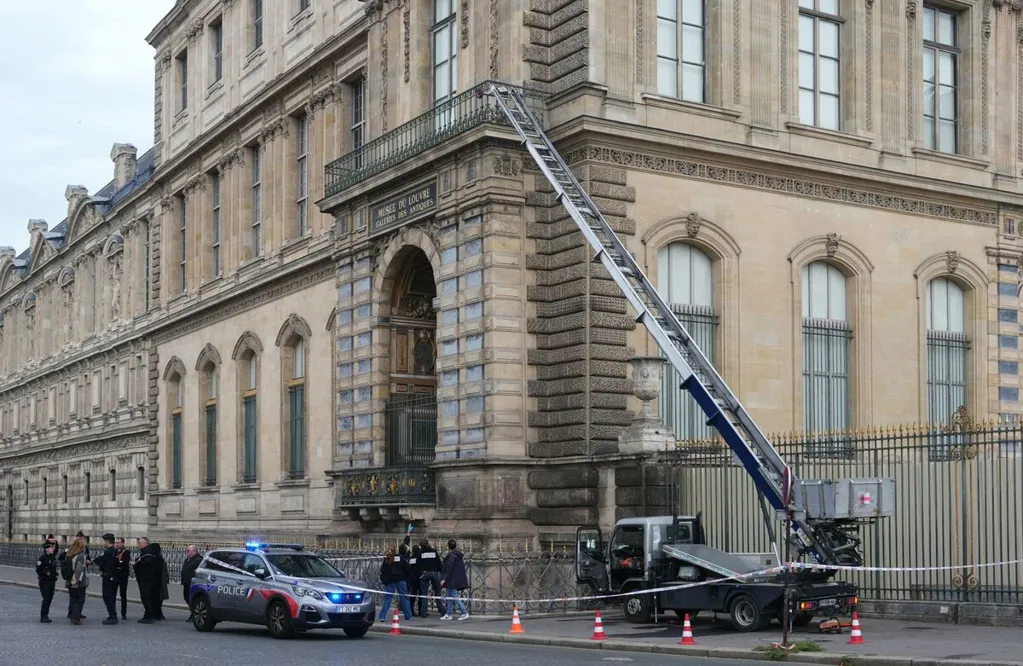
French President Emmanuel Macron accepted Louvre president Laurence des Cars' resignation Tuesday, saying it was an "act of responsibility" after a brazen heist at the renowned museum in October.
Robbers armed with disc grinders stole royal necklaces, tiaras, and earrings from the Louvre museum in a spectacular burglary that lasted just seven minutes.
Cars' exit comes at a time "when the world's largest museum needs calm and a new strong impetus to carry out major security projects," the Elysee said in a statement Tuesday.
JPMorgan Chase & Co. Chief Executive Officer Jamie Dimon, asked about fierce competition across the financial industry, said he's starting to see parallels to the era before the 2008 financial crisis, when a rush to make loans ended disastrously.
"Unfortunately, we did see this in '05, '06 and '07, almost the same thing -- the rising tide was lifting all boats, everyone was making a lot of money," Dimon told investors on Monday. While JPMorgan isn't willing to make riskier loans to boost net interest income, he said, "I see a couple people doing some dumb things. They're just doing dumb things to create NII."
Dimon, who led the largest US bank through the 2008 financial crisis and scooped up two major competitors that collapsed, said he expects the credit cycle will eventually sour again -- though he is not sure when. The CEO has been warning for months about the potential deterioration in credit quality. When auto lender Tricolor Holdings and car-parts supplier First Brands Group imploded last year, he said that seeing one "cockroach" meant more would likely crop up.
In recent weeks, various industries have confronted the artificial intelligence "scare trade," as investors weigh how the new technology could disrupt markets.
"There's always a surprise in a credit cycle," Dimon said, adding that the surprise has often been which industry. "This time around it might be software because of AI."
While that may prompt JPMorgan to scrutinize certain lending, Dimon expressed doubt it would have a major impact on credit losses.
Private Credit
Dimon's lender largely stayed on the sidelines early in the private credit cycle. His own comments have threatened the delicate detente between rapidly growing private credit firms that have taken some business from banks' leveraged loan desks, but have also become some of their biggest clients as well as occasional partners. The cockroach quip sparked a war of words over whether banks or private credit firms are better positioned to weather a broader downturn.
At the same time, JPMorgan has also been flexing its muscles, winning business from private credit managers and Wall Street rivals with substantial financing packages to win coveted debt deals that included a $20 billion check to back the acquisition of Electronic Arts Inc., the largest-ever commitment by one bank for a leveraged buyout.
The financial industry, like many others, has also suffered stock declines in recent weeks because of AI concerns. Dimon said Monday that he sees his bank as a winner in the AI race.
"At the end of the day in 100 areas, we'll be a winner in 75 and a loser in 25," Dimon said.
In the wide-ranging question-and-answer session at what the bank called a "company update" for investors, Dimon inevitably got asked about succession. He's run JPMorgan for 20 years, building it into the biggest and most profitable US bank along the way. The question of when he might retire -- and who might succeed him -- has for years been a source of intrigue across Wall Street.
This time, his answer was broadly in line with recent responses: He'll be at the bank for "a few years" as CEO, and "maybe a few after that" as executive chairman, he said, adding that it's ultimately up to JPMorgan's board of directors.