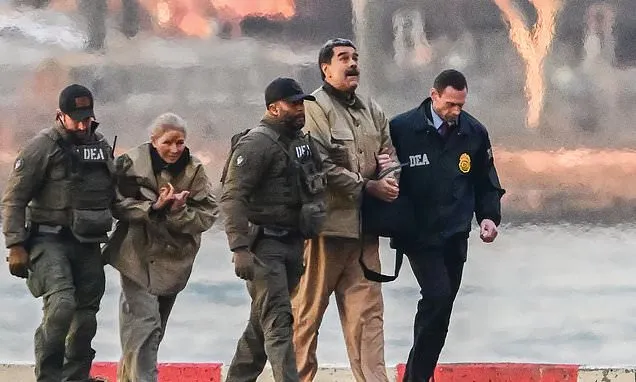
Ousted Venezuelan strongman Nicolas Maduro returned to court today alongside his wife after spending nearly three months locked up at a grim federal prison. It marks Maduro, 63, and former first lady Cilia Flores's first appearance before a New York judge since their arraignment, having been held at the notorious Metropolitan Detention Center in Brooklyn after their dramatic arrests in January. Dressed in prison-issued pants and top, with leg shackles, the socialist leader looked noticeably thinner in the face as he entered the courtroom. He smiled politely and greeted his team in English, telling his lawyer Barry Pollack he looked 'elegant'.
Court Battle Centers on Funding for Maduro's Legal Defense
Wife Cilia Flores, 69, meanwhile, appeared to have fully recovered from her reported injuries sustained during the couple's capture - no longer wearing bandages or sporting any visible bruises on her face. Maduro's attorneys sought to have his drug trafficking indictment thrown out over a geopolitical dispute over legal fees. The hearing kicked off with the defense and prosecution arguing over whether Maduro should be allowed to use Venezuelan government funds to pay for his defense.
Defense Claims Sanctions Violate Maduro's Legal Rights
The defense has insisted that the US is violating the deposed leader's constitutional rights by blocking government money from being used for his legal costs. US District Judge Alvin Hellerstein seemed skeptical of the reasons for denying Maduro and his wife funds from the Venezuelan government to pay for their legal fees. The couple cannot use money from Caracas because they are under sanctions from the US government which have been in place since the second Obama administration. Despite requests from the defense, the US Treasury Department's Office of Foreign Assets Control (OFAC) has declined to grant them a waiver to use the funds.
Prosecutor Kyle Wirshba said that the case was 'unique' but the sanctions were valid due to national security and foreign policy reasons. At one point, Maduro's lawyer claimed the solution was simply to throw out the case. The judge retorted: 'I'm not going to dismiss the case.' Judge Hellerstein pointed out that since Maduro had been captured, the US was 'doing business with Venezuela.' Wirshba said that just because there was 'limited relations' with Caracas, the sanctions were necessary and Maduro and Flores should not have access to the funds.
Judge Hellerstein seemed to suggest that the success of the Trump administration's operation to remove Maduro and the war in Iran had rendered the sanctions irrelevant. The judge said: 'We are doing business with Venezuela. The oil interest in Venezuela has become vital particularly because of the shortages arising from the Strait of Hormuz. 'The defendant is here. Ms Flores is here. They present no further national security threat. I don't see that'. Judge Hellerstein said that Maduro and Flores's right to defend themselves in a complicated case that would involve extensive investigations was 'paramount.'
He said that the government of Venezuela was no longer involved in the kinds of human rights abuses that led to the sanctions in the first place. 'We (the US) corrected that', the judge said. Wirshba argued that Maduro was accused of 'plundering the wealth of Venezuela' and that the sanctions were 'justified'. But the judge seemed unconvinced and asked what remedies could potentially be available. Wirshba said that the best he could do was to go back to OFAC and ask them to reconsider. Maduro's lawyer Barry Pollack said that since his client's arrest, Venezuela had earned more than $18 billion from oil sales, meaning that any money used for his defense would be 'untainted' by the alleged criminal conduct.
The judge said he would decide later on. During the hearing, Flores's lawyer Mark Donnelly also requested medical assistance for his client, revealing she's in need of an echocardiogram due to a mitral valve prolapse. The condition, which is common, occurs when the valve between the left heart chamber does not close properly. The judge said he would help to make it happen. During one tense, awkward moment, Donnelly tried to address Flores as 'first lady' but was swiftly corrected by the judge who said there were 'no titles' in his courtroom.
Judge Hellerstein also ruled that Maduro and his wife could not share information about the case with other co-accused who have not been arrested, including Diosdado Cabello, the Venezuelan interior minister. The judge left it up to lawyers for both sides to come up with the exact wording. No next date was set. Maduro and Flores had spent more than a decade enjoying an opulent life as Venezuela's president and first lady, but have been forced to adjust to life in the troubled prison whose former inmates include R Kelly , Diddy , and Ghislaine Maxwell . MDC has been described by former inmates as 'hell on earth' and Maduro and his wife are likely to spend 23 hours a day in solitary confinement in a cell. In the past MDC prisoners have complained about unsanitary conditions and inedible food that was microwaved into the plastic container it came in.
During Maxwell's detention at the MDC before her 2021 trial for child sex trafficking, she claimed that her hair was falling out from the stress of the conditions. Earlier, a convoy of dark SUVs and law enforcement vehicles were spotted leaving the MDC before dawn Thursday morning, believed to be carrying Maduro and Flores to court. It's a stark contrast to their first high-profile court hearing, when the two were dramatically flown by helicopter from a soccer field near the jail to a helipad in Manhattan and then taken to court in armored vehicles. A heavy police and security presence was at the Daniel Patrick Moynihan United States Courthouse as supporters of the dictator gathered outside ahead of the hearing. A group of around 50 protesters were seen holding up signs reading 'Free Nicolas Maduro' and chanting he was a 'prisoner of war'.
US District Judge Alvin Hellerstein heard from both sides about the progress to trial but it risks turning into another spectacle. During his initial appearance before the court in January , Maduro got into a shouting match with a man in the public gallery and claimed he was 'kidnapped' from Caracas by US Special Forces on January 3 in an audacious raid approved by Donald Trump . As he left the court Maduro shouted at the public gallery that 'I'm a man of God' and claimed he was a 'prisoner of war'. Maduro and Flores are charged with a conspiracy to traffic drugs from Venezuela to the United States. Prosecutors allege that involved the kidnappings and murders of those who stood in their way including a drug boss in Caracas.
They face life in jail if convicted. Their arrest came after months of pressure on Maduro and his allies by the Trump administration which imposed a blockade on ships leaving the country. Since then Trump has bragged that he is ' running' the country under the leadership of Delcy Rodríguez , Venezuela 's acting president . She has released political prisoners and reorganized the country's leadership , however Maduro's party remains in power . Venezuela has also re-established diplomatic relations with the US for the first time in seven years . During their first appearance in court in January , Maduro and Flores were flown by helicopter from Brooklyn to Manhattan and taken by armored vehicle to the court . Flores’s lawyer Mark Donnelly asked that she be given an X-ray because she had sustained ‘significant injuries’ during her apprehension.