British YouTuber James Bruton wanted to build a giant walking robot from Star Wars - and ride around on it on his friend's tennis court. "My goal is to have something people would click on," he says.
To make it happen, he needed to build four powerful legs for the so-called At-At - which famously first appeared in The Empire Strikes Back - that he could control with some precision.
"I don't want something that's massive and wobbly," he explains, justifiably.
And so Bruton came up with an intricate system of motors and gears, to function as servos, moving parts whose position can be monitored and controlled.
Once finished, he filmed himself dressed as a Stormtrooper, riding the At-At around. "It's pretty slow," he admits.
Now, he's working on a two-legged version that will require even more responsive legs to keep its balance while lugging Bruton around.
Some of the components he designs are like "variable springs," he explains - motion-controlling parts able to go into reverse and soak up some impact from the ground below, say. "It can dynamically absorb load as you need it to."
To bring a robot to life, motion-activating components, or actuators, are essential. Generally speaking, actuators can either go in and out, or spin around in a circle, and there are many different ways of doing this.
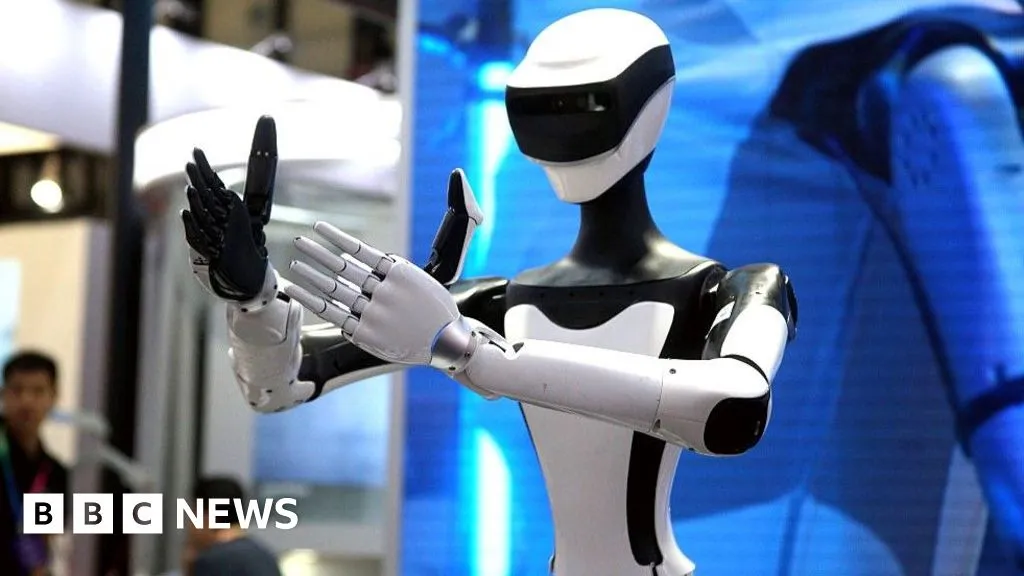
Combining actuators with artificial bodies or limbs allows you to create things like a robot arm, a robot dog - or a humanoid.
If robots are to become more sophisticated, they will have to have more efficient, more precise and more intelligent actuators.
Relatively few firms today can manufacture actuators at scale with a high level of precision, and these components are still a long way from the incredibly engineered muscles that allow animals to move with such grace and efficiency.
A new generation of actuators could in theory enable the transition from stumble-bots to far more balletic machines.
"For a long time, roboticists have used DC [direct current] motors to make robots move," says Mike Tolley at the University of California San Diego.
Such a motor is great if you want to spin a fan, for example, because it functions well at high speeds with low torque.
Torque is the measure of a twisting or rotating force that can move something, like a wheel, around an axis.
However, Tolley points out that humans don't move the way fans spin, at all. "We want to be able to lift things, and push things, and do things that require a lot of force and torque."
And, if a robot arm were to swing out towards you, for safety reasons you would want to be able to immediately stop it and push it back without harming yourself, reverse that motion instantly. For one thing, that requires a back-driveable actuator.
Simple actuators without this capability are a bit like manual transmission cars that need to be shifted into reverse.
"Another problem with today's robots is they rapidly run out of batteries," adds Jenny Read, programme director in robot dexterity at Aria, a technology funding agency. "Electric motors are terrible at that."
Finally, really small actuators made using traditional electric motors tend to get too hot for their own good at such scales - another headache.
Germany-headquartered firm Schaeffler is currently working on actuators for British robotics company Humanoid. Schaeffler's goal is to develop components that allow for highly energy efficient, well-controlled movement which is essential for competent bipedal robots to move and work safely alongside humans.
Part of the approach involves developing actuators that output lots of data about their current position and function so that computers can adjust their operation in real-time. But the hardware also needs to step up, too.
"We have to try and test to find this optimisation of friction, of back-driveability," says David Kehr, president of humanoid robotics. "It's really a big puzzle."
Schaeffler is hoping to use robots in its own factories - for example, to load freshly made parts from conveyor belts into washing machines, prior to packaging them for shipment. "We are already experiencing a labour shortage," says Kehr. I ask whether humans who currently are doing this task will be retrained for other roles in the factory and Kehr says, "Absolutely."
Leading robotics company Boston Dynamics, based in the US, has turned to South Korean firm Hyundai Mobis - predominantly a maker of automotive parts - for a new generation of actuators.
"The actuator is composed of a motor controller and reduction gears. It is very similar to an electric power steering system," says Se Uk Oh, vice president leading the robotics business division at Hyundai Mobis. He notes that this will be the first time his firm has supplied actuators for humanoid robots.
"The quality and reliability is very important for human safety. We have a lot of technology for that and a lot of experience for that."
Today's actuators, even the state-of-the-art ones, are still largely made from metals, hard plastics and electronics. But there are other ideas around. Tolley and his colleagues have been working on a very different approach.
"We have soft robots powered by air that can walk on land and then walk into water - we don't have to worry about what happens when things get wet," he explains. In one case, a six-legged robot devoid of electronics moves its legs to walk when air is pumped in and out of a tube.
Tolley's team has even tried driving over one of their robots in a car. "We wanted to show it was soft and squishy enough. It can really suffer a lot of different abuses."
Read's agency is currently funding various pioneering approaches to robotics, some of which involve actuators made of elastomers - like rubbery plastics. Such material might be sandwiched between electrodes so that they contract or expand as voltage is applied and removed, for example. Not unlike an animal muscle.
"It's been investigated for many years," says Read, acknowledging that elastomers have yet to revolutionise actuator tech. "Often with these technologies, you have to keep pushing."
The ultimate goal, she says, is robots that are far more "graceful" than those of today. "Robots [...] have this clunkiness and heaviness," she says, "which is so different from the way we move."