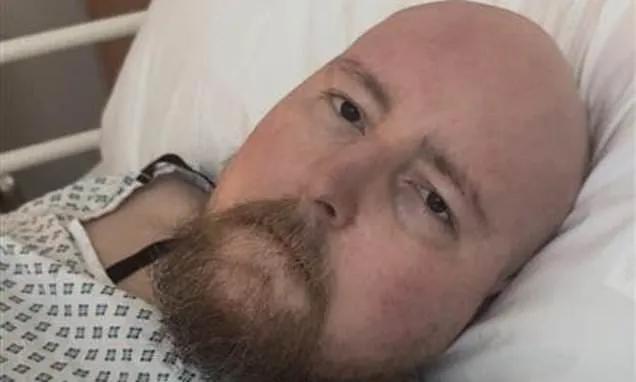
After suffering from stomach pain and sickness, Michael Armishaw thought he was experiencing a gallbladder attack - a condition caused by gallstones blocking bile ducts.
His sister, Claire, said: 'At first we thought it was just a stomach bug, gallstones or issues with his liver, which he has previously had trouble with. But after a couple of weeks, his symptoms got worse.'
The pain persisted, leading Michael to attend A&E in September, where doctors also agreed gallstones were the most likely cause but ran some tests to rule out anything more sinister.
Instead of being home with pain medication or a simple course of antibiotics, Michael, from Nottinghamshire, was dealt the devastating diagnosis of pancreatic cancer at just 43 years old.
'We were all in shock,' said Claire. 'You're not expecting to be diagnosed with cancer as he wasn't really that old and he was devastated when he found out.'
The family were told the cancer was the most advanced stage, where the cancer has spread from its original site to distant organs or tissues. He was given a prognosis of 12 months.
'We were numb,' said Claire. 'They call it the silent killer as symptoms don't appear until late on.
'It's unbelievable really - to go from showing symptoms to being diagnosed with stage four cancer in just weeks.'
Michael Armishaw, from Nottinghamshire, visited A&E in September last year after suspecting he had gallstones.
Pancreatic cancer typically develops silently, with few clear warning signs, and is all too often only discovered once it has already spread.
The most optimistic estimates suggest just 12 per cent of patients survive more than five years after diagnosis.
Michael's diagnosis came just a year after his father died from lung cancer, which Claire described as another 'blow to the system'.
She said: 'Michael felt guilty about getting cancer because of what we'd been through as a family.
'He kept apologising, saying he didn't want us to go through all again. But we, of course, told him it wasn't his fault and we loved him.'
What followed was six gruelling rounds of chemotherapy and radiotherapy.
Unfortunately, Michael's body did not respond to the treatment and the disease spread to his liver and lymph nodes.
By November, the disease had reached his brain, leaving him with a very poor prognosis.
Then, on April 18, he suffered from a seizure, which left him bedbound and unable to speak.
He was put in end-of-life care and died surrounded by family in the hospital a week later, on April 26.
'We're devastated by losing both Michael and my father in such a short space of time,' said Claire.
'Our mum is housebound too and she's really struggling to come to terms with these two huge losses.
In the UK, pancreatic cancer is the tenth most common cancer, with around 11,500 new cases every year.
Although nearly half of cases occur in the over-75s, there is growing evidence rates may be rising in younger people, with the most aggressive form, pancreatic ductal adenocarcinoma, driving the increase. Experts say part of this may reflect better detection of smaller tumours.
The NHS says symptoms of pancreatic cancer can include: jaundice, loss of appetite or losing weight without trying to, feeling tired or having no energy, a high temperature, or feeling hot, cold or shivery.
Other symptoms include feeling or being sick, diarrhoea or constipation, pain at the top part of your tummy and your back as well as symptoms of indigestion, such as feeling bloated.
Claire is now fundraising for her brother's funeral costs after previously struggling with their father's recent funeral and Michael's treatment costs.
Claire added: 'We want to give Michael the send-off he deserves.'
'I am worrying about the inevitable cost and where it's going to come from.'
'He didn't realise how much we all loved him so I'm hoping in death he certainly does now.'