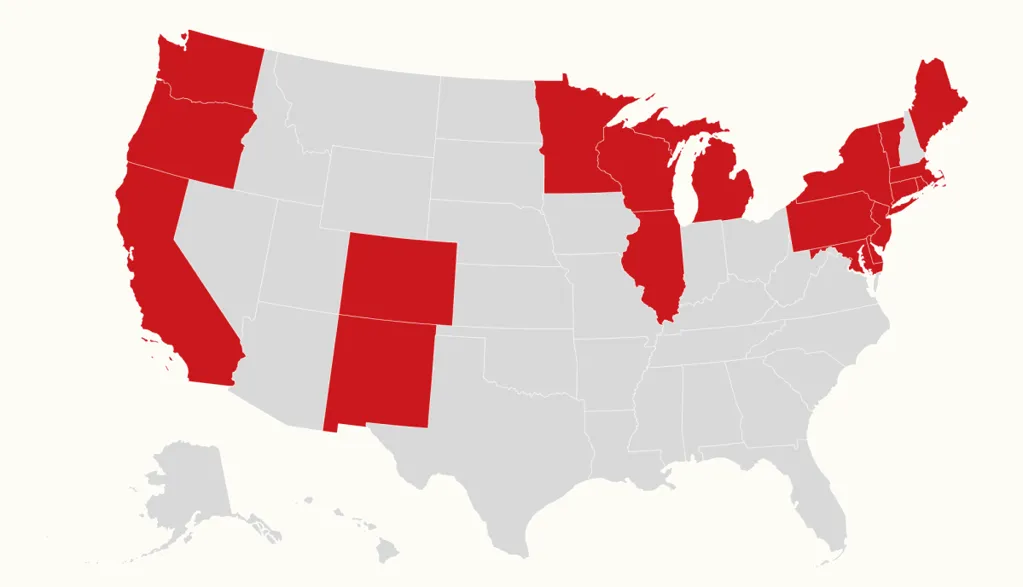
A coalition of 19 states and the District of Columbia sued the U.S. Department of Health and Human Services (HHS), its secretary Robert F. Kennedy Jr., and its inspector general on Tuesday over an announced plan which could put an end to gender-affirming care for young people across the nation.
Newsweek contacted the HHS by email on Thursday outside of standard working hours for comment.
Last Thursday, Kennedy announced that the department would cut off all Medicaid and Medicare payments to any hospitals and facilities providing gender-affirming care to minors.
He called treatments like puberty blockers, hormone therapy and surgeries unsafe and ineffective for children and teens experiencing gender dysphoria -- the distress felt when their personal sense of their own gender does not reflect with their biological sex.
Kennedy also said that doctors providing this kind of care could be excluded by federal health programs like Medicare and Medicaid.
For the states suing the department, the declaration is unlawful and an attempt at a government overreach.
Gender-affirming care, as described by the World Health Organization (WHO), provides a combination of social, psychological, behavioral, or medical interventions, including hormonal treatment or surgery, "designed to support and affirm an individual's gender identity."
For minors who are undergoing significant hormonal changes while experiencing gender dysphoria, this kind of treatment can offer precious extra time as well as meaningful support.
But the Republican leadership across the country has been cracking down on trans rights over the past few years, including gender-affirming care for minors. In his first days back in office this year, President Donald Trump called such care for children and teens "a stain on our nation's history."
Despite the fact that trans rights have become a crucial topic of the so-called culture wars, a study published in JAMA Pediatrics in January found that fewer than one in 1,000 U.S. adolescents with commercial insurance, or less than 0.1 percent, received gender-affirming medications between 2018 and 2022.
On Tuesday, a coalition of 19 Democratic-led states filed a lawsuit in the U.S. District Court in Eugene, Oregon, alleging that Kennedy's declaration that gender-affirming treatments "fail to meet professional recognized standards of health care" is inaccurate and unlawful.
The 19 states suing the Trump administration over its plan to strip federal funding from hospitals providing gender-affirming care for minors are California, Colorado, Connecticut, Delaware, Illinois, Maine, Maryland, Massachusetts, Michigan, Minnesota, New Jersey, New Mexico, New York, Oregon, Pennsylvania, Rhode Island, Vermont, Wisconsin and Washington, as well as the District of Columbia.
All these states have a legislature dominated by the Democratic Party or a Democratic governor, or both.
Kennedy's statement that gender-affirming care treatments are, essentially, "malpractice," as he said last week, was based on a report issued by his agency last month.
The peer-reviewed study, called "Treatment for Pediatric Gender Dysphoria," concluded that the benefits of medical intervention on minors experiencing the conditions are uncertain, while the risks are better known.
The lawsuit makes the point that the HHS is trying to force doctors and hospitals to stop offering gender-affirming care, circumventing legal requirements for policy changes, including asking the public for their opinion. It asks the court to block the declaration's enforcement.
The HHS claims it has a right to exclude hospitals from federal health care programs for failing to meet new declared standards, while the attorneys general of the 19 states suing the agency claim regulating medical practices should be the states' prerogative, not that of the federal government.
New York Attorney General Letitia James, who led the lawsuit, said in a statement Tuesday: "Secretary Kennedy cannot unilaterally change medical standards by posting a document online, and no one should lose access to medically necessary health care because their federal government tried to interfere in decisions that belong in doctors' offices."
Her office added in a statement: "By attempting to impose a single nationwide standard and threatening to punish providers who adhere to well-established, evidence-based care, HHS is unlawfully interfering in decisions that should be made by doctors and their patients."
Health Secretary Robert F. Kennedy Jr. said of gender-affirming treatments for minors at a news conference last Thursday: "This is not medicine, it is malpractice."
Dr. Mehmet Oz, the administrator of the Centers for Medicare and Medicaid Services, said at the same news conference last Thursday: "We want our hospitals returning to healing, not harming, the patients entrusted in their care, or they're going to pay a very steep price."
Jim O'Neill, the deputy secretary of the Health Department, said at the news conference: "Men are men. Men can never become women. Women are women. Women can never become men."
Kelley Robinson, president of the Human Rights Campaign, said last week of the declaration: "These rules are proposals, not binding law. Community members, health care providers administrators and our allies should be vocal in pushing back by sharing the ways these proposals would be devastating to their families and the health care community at large.''
Dr. Susan Kressly, president of the American Academy of Pediatrics, said in a statement last week: "Allowing the government to determine which patient groups deserve care sets a dangerous precedent, and children and families will bear the consequences."
If the Trump administration was to cut off federal funding to hospitals providing gender-affirming care, the consequences will be significant on health providers.
According to KFF, a nonprofit health policy research group, Medicare and Medicaid account for nearly 45 percent of spending on hospital care in the U.S.
Together with Kennedy's declaration, the HHS has also proposed two new rules which would change the requirements for hospitals to take part in Medicare and Medicaid, effectively prohibiting gender-affirming care for minors.
These rules cannot be finalized until after a 60-day period allowing for public comment has passed.