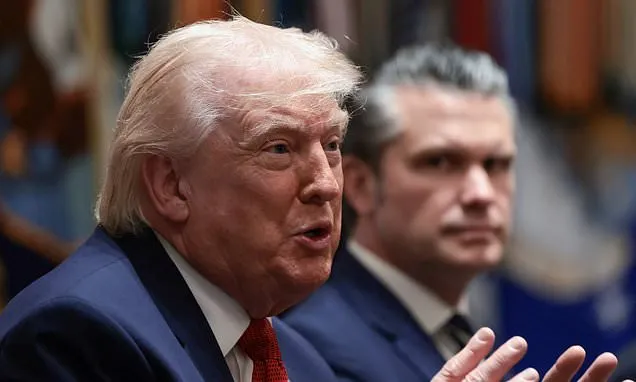
We now know what happens when TV presenters decide to wage an international war. Both Donald Trump, a former host of The Apprentice, and his Defence Secretary, ex-Fox News anchor Pete Hegseth, are obsessed with optics - not strategy.
The rescue of two American airmen, shot down over Iran and stranded deep inside enemy territory, is a remarkable coup for the US military, one that makes good on its pledge to 'leave no man behind'.
The operation might have supplied a winning flourish for the White House if there was a genuine will to end the war. But this success seems to have had the opposite effect. High on adrenaline-charged footage of explosions and firefights, Trump has doubled down on his threats.
After warning on Saturday that Iran had '48 hours before all Hell will reign [sic] down on them' if the Hormuz Strait were not reopened, Trump yesterday issued an extraordinary message seething with expletives, threatening to obliterate power stations and bridges: 'There will be nothing like it!!! Open the Fn' Strait, you crazy b*ds, or you'll be living in Hell - JUST WATCH!'
Later, he told a reporter: 'If they don't make a deal and fast, I'm considering blowing everything up and taking over the oil.'
What will Iran do next? The regime's immediate goal is to survive the American onslaught, which is being made easier by increased income from oil exports to friendly nations such as China.
Beyond clinging on to power, the Islamic Revolutionary Guard Corps (IRGC) is prepared to wreak vengeance on its enemies in any way possible. Their opponents now include not only Israel but the Gulf states that gave muted support to the US, such as Saudi Arabia, Kuwait and the United Arab Emirates.
Just as Trump is targeting Iran's transport links and power generators, the Iranians are likely to keep hitting crucial infrastructure in the Gulf: Airports, oil refineries, desalination plants and so on. Much of this equipment is highly specialised and will take years to rebuild.
Some senior US figures are saying, in all seriousness, that Trump appears to be unhinged.
Despite Trump's bluster, many analysts believe Iran still has more than half its missile arsenal intact. And as more air defences and radar stations in the Gulf are knocked out, severe damage will be done to the basic apparatus that makes life possible for millions in the Middle East.
Deprived of electricity, air conditioning and water, many thousands could die this summer. It's easy to imagine a scenario where a refugee crisis erupts that would dwarf the exodus during the Syrian civil war a decade ago.
Meanwhile, Iranian forces may use the situation to try to develop new nuclear warheads. As a result of the current storm of bunker-busting bombs and precision missiles, Russia has announced it is withdrawing its 200 engineers from the Bushehr nuclear plant in southern Iran.
The atomic power station will now be operated by Iranian staff, who will take possession of the radioactive fuel rods.
The energy cycle in a nuclear generator produces a small excess of plutonium, which could be used to arm a warhead. Iran's previous ruler, Ayatollah Ali Khamenei, was strongly against the development of such weapons, issuing fatwas or edicts that declared the apocalyptic devices 'haram', or forbidden under Islamic law.
But he was killed by a US strike, with power ostensibly passing to his son, Ayatollah Mojtaba Khamenei - who may well take a different view. For the West, severe consequences are already starting to be felt. In Australia, hundreds of petrol stations have run dry. In Italy, air fuel rationing has begun, with a drastic reduction of short-haul flights from many airports looming.
As fuel prices soar, going abroad could become unfeasibly expensive for many in Britain. The 'staycations' market is likely to boom.
Yesterday, Trump extended his 48-hour deadline until Tuesday. No one can truly know what will happen until the time comes, perhaps not even the President himself.
Since the war in Iran the Strait of Hormuz has remained closed, blocking off global supplies of oil, leading to inflation and turmoil in the markets.
One option is to cut off Iran's cashflow by seizing control of its main oil export point, Kharg Island, north of the Strait.
America has the troops and ships in place to do it. But casualties will be high. With mid-term elections looming, Trump might fear the death toll.
Instead, he could intensify the mainland bombing, pounding Tehran and other cities, taking out their pumping stations and electricity grids. But with supplies of precision-strike missiles running low, he might have to resort to 'dumb bombs', inevitably causing far more civilian casualties.
However many innocent Iranians die, it is unlikely Trump will ever face charges of war crimes. The US is a permanent member of the UN's Security Council, with the power to veto arrest warrants.
But he could nonetheless face a direct challenge from within his own government. Senators on both the Republican and Democrat sides are appalled by his foul-mouthed belligerence and his insults to allies such as Britain.
His latest outburst ended with a jeering, 'Praise be to Allah' - an apparent mockery of Islam that will enrage Middle Eastern allies such as Saudi Arabia.
Some senior US figures are saying, in all seriousness, that he appears to be unhinged.
Running a war is an immense strain on anyone. Some rise to the challenge by showing calm determination. Others lose their balance as their responsibilities become unbearably heavy. Trump and Hegseth have both lashed out at Press questions recently suggesting that they were not on top of their tasks.
The US Constitution has provision, the 25th Amendment, for the cabinet to vote the removal of a President too unwell to function properly.
If this were invoked, Donald Trump's chaotic war to inflict 'regime change' may well achieve its goal - not in Iran but in the United States. As its 250th birthday looms, will the US face a humiliating disaster?
Mark Almond is director of the Crisis Research Institute in Oxford.