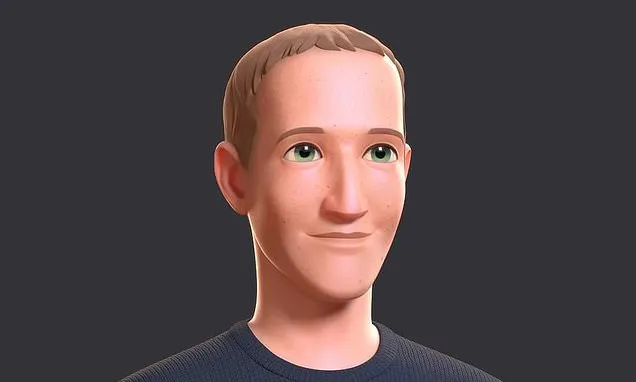
Meta CEO Mark Zuckerberg has found a rather unusual way of avoiding tedious meetings - by sending in an AI clone instead.
According to a report from the Financial Times, Meta's engineers are racing to build an AI-powered copy of the billionaire Facebook co-creator.
This chatbot will engage with employees on behalf of the real Zuckerberg, so that 'employees might feel more connected to the founder through interactions with it'.
The animated clone's responsibilities could include meeting the $1.6-trillion-company's human employees for conversation and feedback, according to one source.
Meta has already disclosed its attempts to develop the next generation of photorealistic, AI-powered 3D characters that can speak with people in real time.
However, according to sources familiar with the company, engineers have been told to prioritise creating Zuckerberg's own 3D replacement.
The chatbot is being trained on the CEO's mannerisms, tone, publicly available statements, and his recent thinking on company strategies.
The bot will be based on pictures and voice recordings of Zuckerberg, who is reportedly personally involved in the training process.
The report comes as Meta continues to funnel vast resources into AI development, in an attempt to catch up with industry leaders OpenAI and Anthropic.
Zuckerberg himself is reportedly taking a personal interest in the company's AI projects.
According to one source, the CEO now spends five to 10 hours a week coding on different AI projects and sits in on technical reviews.
The Mark Zuckerberg clone is separate from the attempt to make a 'CEO agent', which will be an AI designed to help Zuckerberg in his role by retrieving information.
However, sources familiar with the company say that Meta's race to develop 3D chatbots is facing unexpected technological hurdles.
Engineers are reportedly struggling to overcome the vast amount of computing power required to make the AI clones realistic and reduce delays to human conversational levels.
The company is also trying to improve AI voice interactions, having recently acquired two voice companies, PlayAI and WaveForms.
If the AI Zuckerberg experiment is a success, Meta may allow creators to start making AI clones of themselves, according to the report.
In 2024, Meta demonstrated what an AI clone might look like as it showcased an AI 'video call' feature.
In a presentation, Zuckerberg spoke over the phone with an AI bot trained on the mannerisms and appearance of a real human content creator.
While the AI certainly looked realistic, there were still noticeable delays, and the clone only offered simple, formulaic responses to questions.
Meta also started letting content creators make AI versions of themselves to respond to Instagram comments.
The company rolled out an 'AI Studio' that allowed users to create their own AI characters to chat with or respond to fans on their behalf.
However, the feature soon faced controversy when it emerged that users were generating overtly sexual characters, and Meta blocked teens from using the AI Studio in January.
Last Wednesday, Meta unveiled 'Muse Spark', the first product of a new AI team assembled last year at enormous expense.
Meta hired AI superstar Alex Wang, CEO of Scale AI, in a $14.3 billion deal and hired coders with pay packages stretching into the hundreds of millions of dollars to form its 'superintelligence' team.
The model will initially be available only on the Meta AI app and website, before being rolled out to WhatsApp, Instagram, Facebook, and Meta's smart glasses.
Independent evaluations show that the new AI tool is close to top models from Google, OpenAI, and Anthropic in areas like language and visual understanding, but lags behind in coding ability.
Meanwhile, the company is increasingly pushing for its employees to use more AI tools in their own work.
Staff are being encouraged to automate tasks using the open-source AI software OpenClaw and to design their own AIs to take over parts of their job.
This comes as rival firm Anthropic sparked serious AI safety concerns by revealing it had created a model, dubbed Mythos, deemed too dangerous to release to the public.
In a chilling analysis, the company admitted that its creation could easily hack into hospitals, electrical grids, power plants, and other pieces of critical infrastructure.
During testing, Anthropic says that Mythos 'found thousands of high-severity vulnerabilities, including some in every major operating system and web browser.'
The model will be released to a group of more than 40 companies, including Amazon, Google, Apple, Nvidia,CrowdStrike,and JPMorgan Chase ,as part of an initiative called 'Project Glasswing'.
The Daily Mail has contacted Meta for comment.