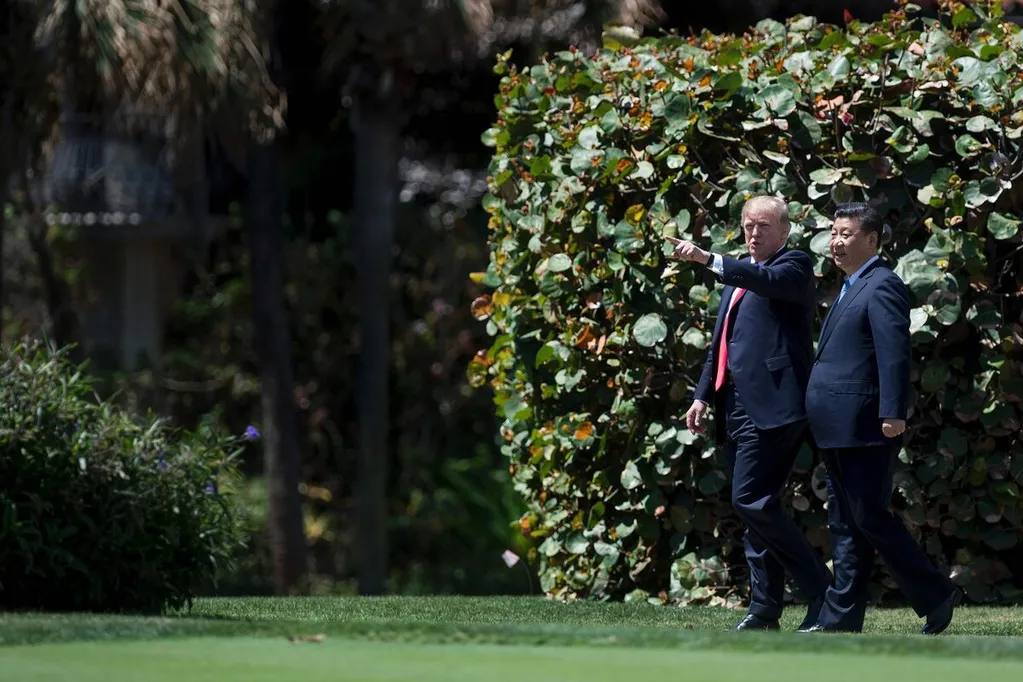
When Donald Trump visits his Chinese counterpart in Beijing next month, "President Xi will give me a big, fat, hug," the American president predicted the other day. "Doesn't that beat fighting??? BUT REMEMBER, we are very good at fighting, if we have to -- far better than anyone else!!!"
Big fat hugs and military threats in the same post: That's par for a POTUS who, for example, claims that America has already triumphed in its war against Iran while simultaneously fuming that the Iranians won't submit and take his conditions. Or who promises to end the fighting while also threatening to erase an entire civilization.
How does Xi Jinping read these confused signals, and the upcoming visit? And should the American leader even go to China at all?
Trump already postponed the summit once because he was too busy with the war he launched in Iran. (He'll probably be just as occupied with it next month.) Moreover, that adventure in the Middle East has left America weaker relative to China, so that Trump can't ask Xi to concede anything big, whereas Xi will demand a lot more, and Taiwan could be the loser.
In some narrow ways, China also loses from the Iran war and the de facto closure of the Strait of Hormuz -- it gets much of its oil through that passage. That's why Xi, in a call with the Saudi Crown Prince, called for the strait to reopen.
But Xi's government has also spent years preparing for such a crisis, stockpiling oil and diversifying energy sources, with an emphasis on the renewables that power its many electric vehicles, for example.
Zack Cooper, a China expert at the American Enterprise Institute, told me that Xi believes that China's Asian rivals, such as South Korea and Japan, are suffering more, leaving China relatively stronger. Xi also feels that America has committed a huge own goal that accelerates China's geopolitical advance.
Xi and the leaders around him have long felt that the East, meaning China, is rising while the West, formerly led by the United States but now splintering, is declining. The Iran war seems to speed up the trend.
First, it confirms that the US, which has for 15 years promised and failed to "pivot" from Europe and the Middle East to East Asia, will never be able to concentrate its military and diplomatic resources in China's neighborhood, Cooper argues. That cedes the regional advantage in the Indo-Pacific to Beijing.
Moreover, Xi has also espied a rare opportunity to attempt a role reversal with the US on the global stage. America, which for eight decades claimed to lead and police a "rules-based" international order, nowadays sows chaos instead, allowing authoritarian China to pose as a stabilizer.
Meeting with the Spanish prime minister, who is outspoken about opposing Trump's war, Xi opined that "the international order is crumbling into disarray." Hosting the crown prince of Abu Dhabi, he warned about the world reverting "to the law of the jungle" if certain powers -- one wonders who -- keep mocking international law.
Trump, of course, has violated international law from the Caribbean to Iran. "I don't need international law," he has gloated, because "the only thing that can stop me" is "my own morality, my own mind." In effect, the White House is writing Zhongnanhai's script, with America playing the rogue state and China the responsible hegemon-in-waiting.
In the bilateral relationship, Xi believes he already got the better of Trump in 2025. When the White House declared economic war with tariffs and other measures, Zhongnanhai applied its own torture devices, including an embargo on rare earths. The US and China declared a tentative truce, which Trump doesn't want to break.
This constraint means that Trump can't demand, or hope for, any breakthroughs. He won't, for example, get China to send warships to open the Strait of Hormuz, as he suggested at one point to much Chinese amusement. Nor will he open talks on nuclear disarmament.
Trump may collect some small hongbaos, such as a promise to buy more American soybeans or sorghum. And he'll have photo ops with a world leader amid pomp and circumstance, which is what he may crave most.
Xi, for his part, is playing a longer game. He's noticed that Trump and his administration have been equivocating on America's support for Taiwan, wanting to reduce US dependence on microchips made on the island, for instance. Trump has also said that he's "talking to" Xi about American arms sales to Taiwan and will "make a determination pretty soon."
Trump was almost certainly unaware that he thereby diluted the "six assurances" the US has made to Taiwan since the administration of Ronald Reagan; these include the proviso that Washington will not consult with Beijing on weapons shipments to Taipei.
Xi is now hoping to turn US arms sales to Taiwan into a bargaining chip. He also wants to prod Trump into a subtle change of language. For example, POTUS could let slip that the US "opposes" Taiwanese independence as opposed to merely "not supporting" it. Beijing reckons that Trump wouldn't care about the subtlety -- asked about a Chinese invasion of the island, Trump has said that "that's up to him," meaning Xi. But Beijing's intended audience in Taiwan would get the message.
In return, Xi, having observed how the Gulf emirates have been flattering Trump, may offer a vague but huge Chinese investment in the US, knowing that it may never pan out.
The upshot is that Trump's trip to Beijing, slated for mid-May, amounts to the wrong meeting at the wrong time. The president, after a series of strategic miscalculations, has weakened the US and himself too much and left China too strong.
If he goes to Beijing hoping to dazzle his home audience with international summitry, he risks giving the appearance of kowtowing instead. Worse, he might accidentally sell out Taiwan, a long-standing partner of the US and one of its most vital interests.