Recently, the Trump administration offered $20 billion to provide re-insurance coverage for vessels sailing through the Strait of Hormuz amid conflict in the Middle East. Yet, closer to home, there is an immediate public health threat posed by the resurgence of measles, a serious disease once under control that needs federal support.
Measles outbreaks are a medical and systems issue, emerging from vaccination behavior, public trust, health policy and the capacity of the public health infrastructure to handle increasing demands. One can rightfully ask whether the idea of federal support for emergency economic issues should also apply to the costs associated with measles.
In 2025, the U.S. had more than 2,000 cases of measles. As of March 2026, there are more than 1,200 cases. Measles occurs overwhelmingly in unvaccinated individuals. To protect the population, a vaccination rate of at least 95 percent is needed, as this virus is highly contagious.
As vaccination rates continue to fall, we will inevitably see more measles outbreaks. Projections show a 10 percent decrease in vaccination rates will result in more than 11 million new measles cases in the U.S. over the next 25 years. We are beginning to see this cause and effect now, as measles outbreaks are increasing in under vaccinated communities, with more than 100 cases in 18 different states last week alone.
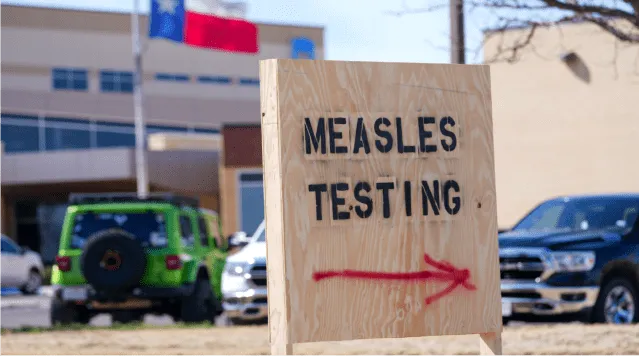
Along with the disease, the economic burden of measles is blossoming in several areas. First, at the public health level, responding to measles requires a considerable workforce to control the spread of the disease. For every case of measles, contract tracing costs can exceed $16,000. Funds are also required for community-based and regional vaccination activities, and public health efforts will be necessary for months. The 2025 Texas outbreak, which spread to neighboring states, took more than seven months to control and cost $18 million.
A second major expense of the outbreak is health care costs and hospitalizations. As many as 20 percent of individuals with measles will need hospitalization. For an outbreak involving 1,000 individuals, these costs will exceed millions of dollars. A small percentage of individuals who have measles will also develop severe neurological involvement, which can result in long-term care needs and be devastating to the child and family.
Recent estimates show that a 1 percent decline in measles vaccination rates will result in the U.S. incurring more than $41 million in direct medical costs. If vaccination rates fall to 90 percent, in the next two decades we can expect billions of dollars in health care costs from the 11 million forecasted new measles cases.
Another major effect is on workforce productivity and on education. If an individual is exposed to measles and has not received a vaccination within three days, they must quarantine for three weeks. For children, this means the inability to attend school in person. Likewise, an unvaccinated, measles-exposed worker may not be able to provide meaningful labor for in-person work. It has been estimated that these costs could top $500 million.
Federal policy is also impacting detention centers. Measles outbreaks have been recently seen in the federal detention center in New Mexico, and at Immigration and Customs Enforcement's massive Camp East Montana detention center, located at the Fort Bliss Army base in Texas. Because migrant vaccination rates can be variable and low, more such outbreaks can be anticipated.
In addition to the human toll, the costs and workforce to control measles outbreaks in large congregate settings are considerable. In 2024, there was a measles outbreak in a Chicago migrant shelter that took three months to control.
Complicating matters further, overall funding for public health departments and health care is being slashed. The Center for Disease Control and Prevention's cut nearly $5.8 billion from local and state health departments. Last year's federal spending bill will cut $1 trillion from federal Medicaid and Medicare programs over the next decade, disproportionately impacting rural health care programs. We are in an increasingly weaker position to respond to infectious disease outbreaks.
The federal government could turn these unpleasant predictions around by encouraging vaccination, as major medical societies advocate. We also find that parents are taking increased liberties in claiming religious and personal exemptions from vaccination, which can be ended at the local legislative level. Yet we see the opposite.
Without a robust vaccination program, vaccination rates will fall, and outbreaks will rise. Now is a good time to reflect on the value of preventative medicine, of which vaccination is a critical element.
If the federal government can subsidize oil tankers to keep gasoline prices low, why not support efforts to address increasing rates of the most common vaccine-preventable illnesses, especially when current federal policy causes higher levels of illness?