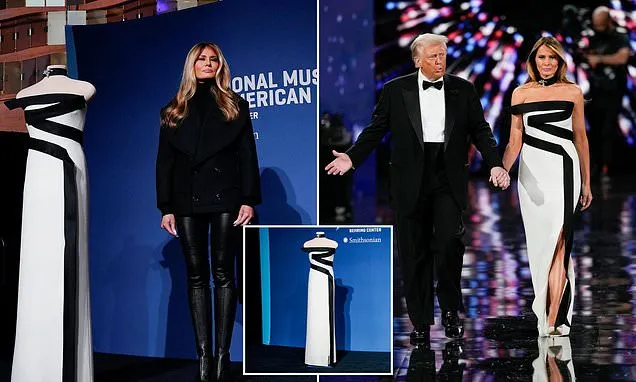
Melania Trump claimed her second inaugural ball gown is 'not a dress' but a 'courageous act of self expression.'
The first lady delivered five-minute remarks for the installation of her gown's exhibit at the Smithsonian National Museum of American History where she said the piece of fashion captures the 'human condition.'
Visitors will now be able to get a close look at the dress she wore to celebrate her husband's second inauguration on January 20, 2026.
It represents a drastic increase in her public appearances since she went on tour to promote her new film Melania: Twenty Days to History.
Most recently she held a public event at the White House where she met with freed Israeli-American hostage Keith Siegel and his wife Aviva. In a rare moment she took a few questions from the press.
Now, she is emerging to donate her 2025 inaugural gown to the Smithsonian museum, where access is free for all visitors.
The black Z shape on the front of the mostly white gown, Melania said, 'embodies decades of my early memories, life experiences and influences' - but did not expand on any specifics of that inspiration.
'This is more than 50 years of education, experience and wisdom realized with each thread, each stitch, each sharp edge,' she noted.
First Lady Melania Trump delivered remarks as she donated her 2025 inaugural ball dress to the American History Museum
Melania wore the white dress with black Z sash at President Donald Trump's second inaugural ball on January 20, 2025
The gown will now sit at the center on display at the First Ladies Gallery at the Smithsonian National Museum of American History in Washington, DC
She appeared in her remarks on Friday to provide a piece of advice to young girls. She said those who take care of themselves 'from inside out with precision every morning, leave for school with a more confident step and a steady gaze.'
The gown, designed by Hervé Pierre, is a strapless black-and-white floor-length dress. It's constructed with a white silk crepe bodice and features two very distinct bands of black silk gazar down the front.
It appeared to be a contrast of her controversial swearing-in outfit, which was mostly black and included a wide-rimmed hat that concealed her face for most of the event. Critics online called the look 'menacing' and 'sombre.'
Melania said at the American History Museum on Friday that 'the human condition is captured within every stitch' of her gown, which she wore to dance with Trump at his inaugural ball.
'The idea to endure and rise above mediocracy to reach the highest level - America's destiny,' she went on.
'This black and white masterpiece showcases America's pure spirit of originality, superior engineering and boundless creativity,' Melania said. 'It's a statement as to why America's fashion industry can lead the rest of the world.'
She then plugged her new film, which hit screens last month, saying that if people watched it they would see the behind-the-scenes process 'it took to bring this technical marvel to life.'
'We must take pride not only in the small rituals of self care, but in the courageous act of self expression, our outward appearance to the world. The art of presenting oneself can be cultivated over a lifetime,' Melania said.
The black Z shape on the front of the mostly white gown, Melania said, 'embodies decades of my early memories, life experiences and influences'
Melania and designer Hervé Pierre admire the 2025 inaugural gown
Melania in her five-minute remarks said that 'the human condition is captured within every stitch' of her gown
Melania also donated her first inaugural gown - a vanilla silk crepe off-the-shoulder number also designed by Pierre - to the American History Museum in October 2017.
It has been on display at the museum since then.
The National Museum of American History, part of the Smithsonian Institution, will now house both dresses in its First Ladies Collection. It continues a long tradition dating back to 1912 of first ladies giving their dresses to the museum.
Helen Herron Taft was the first to donate her inaugural ball gown from the 1909 inauguration. It remains a cornerstone of the collection.