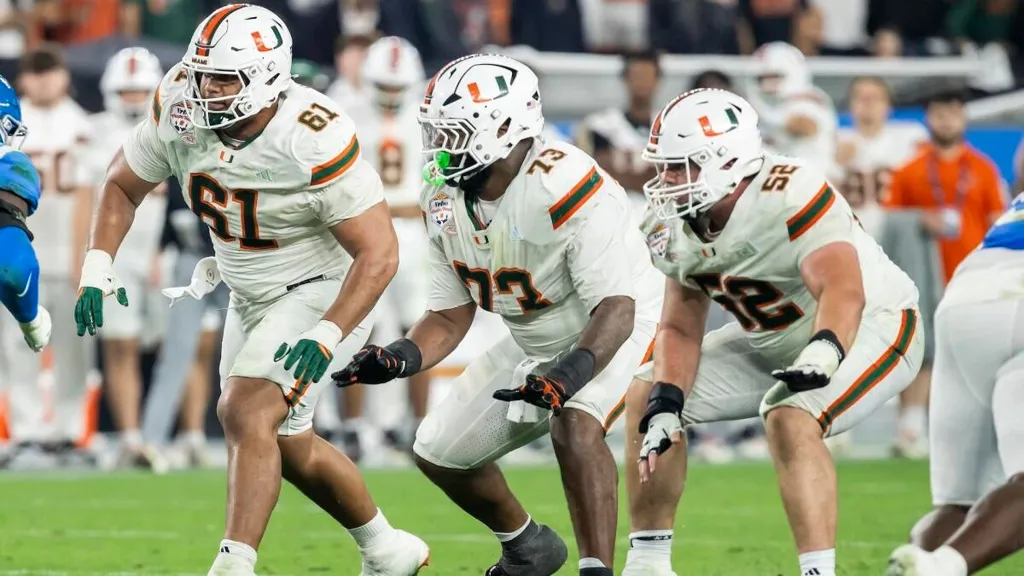
No. 1 Indiana and No. 10 Miami reaching the College Football Playoff National Championship marks a watershed moment for the sport. Both programs have embraced the transfer portal aggressively under their respective coaches and have now built championship-caliber rosters.
But while key position groups on both teams from quarterback to defensive line have been augmented with transfers, there's one position group where both staffs have stayed close to home: Offensive line.
Out of the 10 offensive linemen starting in the national title game, seven were on campus during the 2024 season. One exception, Indiana right tackle Kahlil Benson, was a bounce-back after spending four of his first five seasons in Bloomington. So essentially, only two total starters across the units were newcomers.
Ironically, both players were centers, Indiana's Pat Coogan (Notre Dame) and Miami's James Brockermeyer (TCU). Each was a high-level transfer that started for major programs and had success the year prior. Coogan even went on to become the first offensive lineman to win a Rose Bowl MVP since 1944. Indiana left guard Drew Evans also started his career at Wisconsin but played three years in Bloomington after transferring.
With the relative stability along the offensive line, both teams have been able to build bruising offensive line units. During their respective runs to the national title game, the offensive lines have taken center stage.
"I think the benefit of being in one spot is you get to work on the same skills, the same techniques, the same fundamentals over a period of time," Miami offensive line coach Alex Mirabal told CBS Sports in April. "Hopefully, it's the same position coach working with you. I think continuity is beneficial in anything in life; why would offensive line play be any different, you know?"
Mirabal is hailed as one of the top offensive line coaches in all of college football and a right-hand man to head coach Mario Cristobal. Cristobal previously was a standout offensive line coach as well. During their run through the College Football Playoff, Miami has bulldozed its competition. In three playoff wins, Miami faced elite defensive lines and came away with more than 170 yards rushing per game.
Indiana has similarly leaned on its running game, including 400 total yards against Alabama and Oregon on the ground. They've also kept quarterback Fernando Mendoza essentially untouched, helping him throw eight touchdown passes to only five incompletions in two games.
Across the sport, many teams have attempted to backfill offensive lines through the portal. They've failed to hold up against elite competition.
Oregon, for example, added three standout transfers in tackle Isaiah World (Nevada), guard Emmanuel Pregnon (USC) and tackle Alex Harkey (Texas State). All three came with NFL-caliber frames and major experience. In playoff games against the No. 1 and 2 rushing defense, their offensive line graded 53.4 in run blocking grade according to PFF.
Needless to say, most teams that filled multiple offensive line slots through the portal are even worse off. Florida State again missed a bowl game after flipping multiple spots. Colorado flipped four starters around tackle Jordan Seaton and fell to the cellar of the Big 12. Kentucky started three transfers; coach Mark Stoops eventually got fired.
Granted, feeding the beast is difficult. After the 2025 season, three Indiana offensive line starters are likely off to the NFL (Carter Smith, Coogan and Benson). The Hurricanes could lose as many as four (Francis Mauigoa, Anez Cooper, Mark Bell and Brockermeyer). There's no guarantee that similar talents are waiting in the wings.
With the level of turnover across college football, maximizing offensive line windows is taking center stage. Indiana and Miami's understanding of their timelines has helped put them right on the edge of winning elusive national championships.