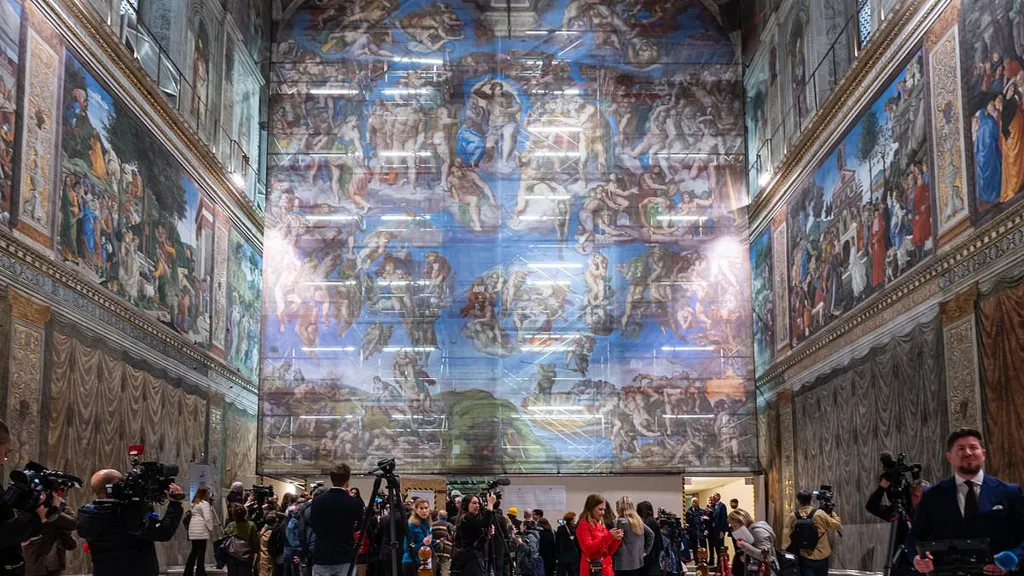
Michelangelo's 'The Last Judgement' in the Sistine Chapel is getting a facelift that will be ready just in time for Easter.
The Vatican today showed off its cleaning operation that aims to remove a chalky white film of salt that has accumulated over the Renaissance masterpiece since its last major renovation three decades ago.
Floor-to-ceiling scaffolding has now obscured the imposing fresco of heaven and hell that dominates the front of the chapel.
You can still visit 'The Last Judgement' but visitors will have to make do with a reproduction that has been superimposed on a screen that covers the scaffolding until the works are completed in the first week of April.
Vatican Museum officials explained that the cleaning was necessary because of the high number of people who visit the museum every day.
'The salt is created because, above all, when we sweat, we emit lactic acid and unfortunately lactic acid reacts with the calcium carbonate present on the wall,' said Fabio Moresi, head of the scientific research team that is overseeing the cleaning.
Some 25,000 people pass through the Vatican Museums each day.
The museum chief Barbara Jatta described the salty film as a 'cataract' that is easy enough to remove.
The Vatican today showed off its cleaning operation that aims to remove a chalky white film of salt that has accumulated over the Renaissance masterpiece.
Vatican Museum officials explained that the cleaning was necessary because of the high number of people who visit the museum every day.
You can still visit 'The Last Judgement' but visitors will have to make do with a reproduction that has been superimposed on a screen that covers the scaffolding.
Restorers will dip sheets of Japanese rice paper into distilled water and apply them to the fresco and then carefully wipe away the white film.
The cleaned sections of the fresco are reportedly markedly more vibrant and colourful than the areas that have not been cleaned yet.
On the figure of Jesus at the centre of the fresco, for example, you can now see how Michelangelo painted his hair and the wounds of his crucifixion.
The Sistine Chapel is named after Pope Sixtus IV, an art patron who oversaw the construction of the main papal chapel in the 15th century.
But it was a later pontiff, Pope Julius II, who commissioned Michelangelo to paint the famous ceiling, the 'Creation of Adam' showing God's outstretched hand, between 1508 and 1512.
A later pontiff, Pope Clement VII, commissioned Michelangelo in 1533 to return to paint 'The Last Judgement'.
The other frescoes of the Sistine Chapel, which is where Pope Leo XIV was elected in May, undergo yearly cleaning with restorers working at night on cherry-pickers that can be removed each morning before public arrives.
But such machines cannot access all of 'The Last Judgement', since the fresco is located behind the altar, which is itself raised on marble steps.
This meant that fixed scaffolding was required to clean the entire fresco.
The Sistine Chapel underwent a complete restoration between 1979 and 1999, when centuries of smoke, grime and wax build-up was removed.
The Vatican has left small patches of the pre-restored fresco intact to show the difference, which are now visible on the upper floors of the scaffolding and show a nearly blackened wall.
Rather than radically reduce the number of visitors who can access the Sistine Chapel, the Vatican is studying ways to address humidity levels through filtration systems and other technologies to prevent the salty film forming again.