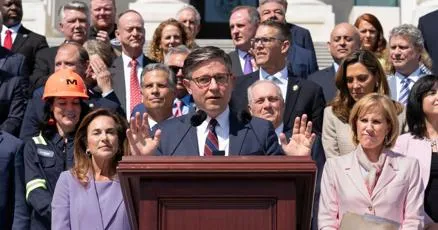
WASHINGTON -- Usually April 15 is greeted with frowns, if not outright dread.
But for Republicans, not so this year.
"What a beautiful day it is in America. Isn't this a great day?" House Majority Leader Steve Scalise, R-Jefferson, said Wednesday.
He was referring to Tax Day rather than the cloudless blue skies.
Scalise spoke at a news conference on the Capitol steps for Republicans to tout tax breaks from the One Big Beautiful Bill Act, signed into law July 4.
Scalise and his GOP colleagues say millions of taxpayers saved money on OBBBA features like exemptions for some tips, overtime, state and local taxes, increased deductions for seniors, interest on certain car loans, and more.
"I've heard from Louisianans throughout our great state who are getting bigger refunds, helping them plan a vacation, save for their children, invest more, or cover day-to-day expenses," Scalise said.
The GOP sees the One Big Beautiful Bill Act, which Republicans have rebranded as the Working Family Tax Cut, as their most significant legislative win during the roughly two years holding the majority in the House and Senate.
Their governing dominance is threatened in November's congressional midterms -- Louisiana's party primaries are May 16 -- as polls show voters are souring on other GOP policies, such as aggressive immigrant deportations, tariffs, and a war with Iran that is driving up prices.
"While Republicans are cutting taxes for families for lower- and middle-class hardworking Americans, Democrats are trying to raise those taxes," House Speaker Mike Johnson, R-Benton, said at the press conference.
He later released statements from accountants in his district, listing only their first names and parish.
For instance, Randy of Beauregard Parish said: "Waiters and waitresses with tips, employees from industrial plants with overtime -- all are experiencing a much lower tax burden, which is allowing their hard-earned dollars to flow back to them. The OBBBA and its tax provisions are delivering as promised!"
The White House reported Thursday that the average refund of more than $3,400 is 11% higher than last year. Roughly 70% of filers received refunds, up from 62% last year.
Six million taxpayers claimed "No Tax on Tips"; 25 million used the "No Tax on Overtime"; and the increased standard deduction was available to about 30 million seniors, according to the White House.
In total, about 53 million taxpayers used at least one of OBBBA benefits, the White House says.
That's about 45% of people filing taxes by April 15.
Perhaps that helps explain a poll that found 38% of taxpayers said they didn't notice a difference from last year and about 25% said the new law increased their tax liability, according to a survey by Bipartisan Policy Center, a Washington-based think tank founded in 2007 by Democratic and Republican senators.
Other polls also show some taxpayers are lukewarm despite the Republican tax breaks.
About 59% of those surveyed in April by The Economist and YouGov said they felt the economy was getting worse. A FoxNews poll counted 70% of voters saying taxes are too high -- 59% in a separate Gallup poll; the worst numbers since the 1990s.
Part of the reason could be a slight disconnect between rhetoric and reality. In general, President Donald Trump and his Republican allies claim "no tax" on revenues from tips, overtime and for seniors.
But the new law isn't "no tax," it's a lower tax burden for some people meeting certain conditions, such as income limitations.
For instance, taxpayers taking advantage of the "No Tax on Tips" provision can only deduct "qualified" tips up to $25,000 if an individual's gross income is less than $150,000. Qualified means working in a business that relied on tips to augment wages in 2024 and the deduction only applies to tips left voluntarily by the customer. That means service fees, which are increasingly included on bills, don't qualify.
Still, there's no denying many taxpayers saw relief under OBBBA.
"They came up with a new name for it because they didn't like the old name, but I kind of like the old name," Sen. John Kennedy, R-Madisonville, said on the Senate floor. "The average American who normally gets a refund and who's already filing is going to get an extra -- what works out to be an extra -- $250 to $300 a month, so that's going to help them deal with the higher prices."