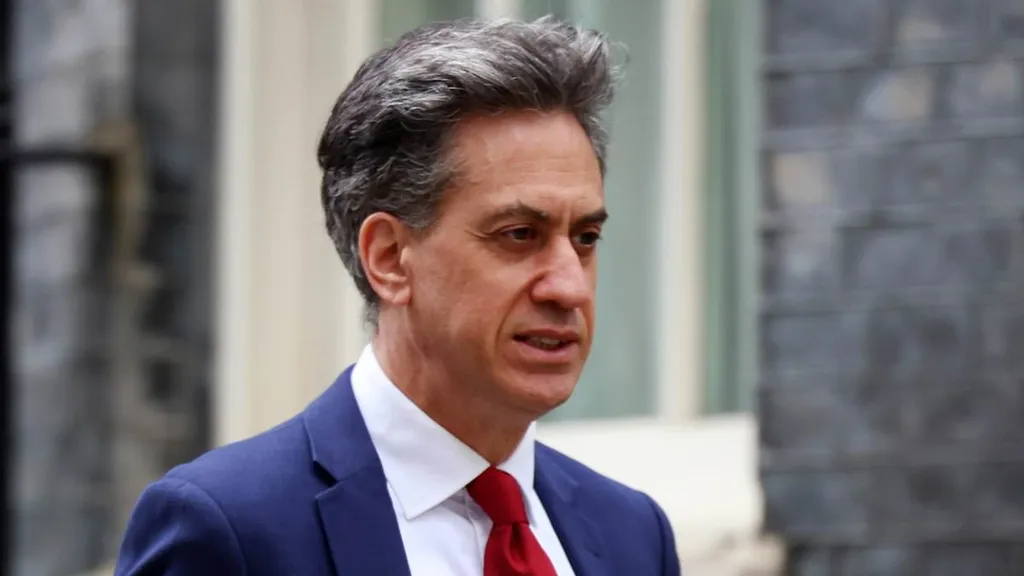
Ed Miliband's 'mad dash' to Net Zero has been blamed for an AI giant shelving a multi-billion-pound investment in Britain.
OpenAI, the company behind ChatGPT, said soaring energy prices as well as red tape were behind the decision to pause its Stargate UK project.
It leaves Keir Starmer's ambition to turn the UK into an artificial intelligence 'superpower' in tatters.
Critics said OpenAI's decision was the latest evidence of the burden crippling British industry and blamed Energy Secretary Mr Miliband's drive to abandon North Sea oil and gas in favour of wind and solar power.
'Industry has been warning about the damage from the UK's eye-watering industrial energy costs dominoes to fall.'
It comes as the Iran war exposes Britain's vulnerability to surging global energy prices, as a major importer of oil and gas.
Labour's painful windfall taxes on North Sea operators are blamed for making the situation worse by killing off investment in homegrown energy sources.
Tory business spokesman Andrew Griffith said: 'Ed Miliband's suicidal energy policy has just cost us another huge investment.'
'The UK has top AI talent and labs but ruinously high energy costs because of Labour's mad Net Zero agenda. If Labour let us fall behind on AI, Britain will lose even more jobs for young people.'
Ed Miliband has been blamed for an AI giant shelving a multi-million-pound investment in Britain, due to his 'mad dash' to Net Zero
Mr Miliband was on Thursday night under growing pressure to change course as the Tony Blair Institute - the former prime minister's think-tank - urged Labour to open up the Jackdaw gas and Rosebank oil fields in the North Sea to address the energy crisis.
And amid Labour splits over the policy, Sir Keir signalled his openness to the idea, telling ITV: 'I'm not fighting the principle. I want oil and gas to be part of the mix for many years to come.'
OpenAI's Stargate UK project, announced last September, formed part of a series of investments totalling £150billion unveiled during Donald Trump's state visit.
The company, led by Sam Altman, is best known for being behind ChatGPT, the world's most popular AI chatbot.
Its Stargate project involved the building of vast new data centres that house the computer chips which power AI.
Stargate UK, in partnership with US chip giant Nvidia and British firm Nscale, aimed to deploy up to 8,000 AI chips - which can carry out a huge number of calculations in a split second - by early this year, with the possibility to expand to 31,000 over time.
It was expected to be based across several sites in the UK, including in Cobalt Park near Newcastle upon Tyne.
The idea behind the UK project was that users such as public services, financial firms, researchers and national security operatives could run AI models on 'sovereign' infrastructure in Britain.
However, data centres are heavily energy-intensive. And industrial electricity prices in Britain are the highest in the developed world, more than double those paid by US manufacturers.
OpenAI said on Thursday it still saw 'huge potential for the UK's AI future', adding: 'We continue to explore Stargate UK and will move forward when the right conditions such as regulation and the cost of energy enable long-term infrastructure investment.'
Julian Jessop, economics fellow at the Institute of Economic Affairs think-tank, said: 'There was always a lot of hype around this particular project, but Ed Miliband's mad dash to decarbonise the grid was the final straw.'
It is the latest damaging blow to British industry under Labour, coming after UK pharmaceuticals giant AstraZeneca axed a vaccine plant in Liverpool and other global drug firms paused investments amid a row over medicine pricing policies.
And the Daily Mail revealed that Rolls-Royce could build a new generation of aeroplane engines outside Britain unless it received backing from the Government.
Shadow Chancellor Sir Mel Stride said OpenAI's decision was a 'damning verdict' on Chancellor Rachel Reeves' 'economic mismanagement'.
'Britain should be leading the AI revolution,' he said. 'Instead, Labour are delivering high costs and lost opportunity. The message to investors is clear: under Keir Starmer, Britain isn't open for business.'
Sam Richards, boss of pro-growth campaign group Britain Remade, said: 'OpenAI halting their flagship British investment is a stark warning: Britain is becoming too expensive to build in.'
'You cannot deliver growth or become an AI superpower with some of the highest industrial electricity prices in the developed world.'
A government spokesman said:'We are continuing to work with OpenAI and other leading AI companies to strengthen UK compute capacity.'