Caroline Cummings is an Emmy-winning reporter with a passion for covering politics, public policy and government. She is thrilled to join the WCCO team.
To watch Zach Wegner work is like taking a trip back in time.
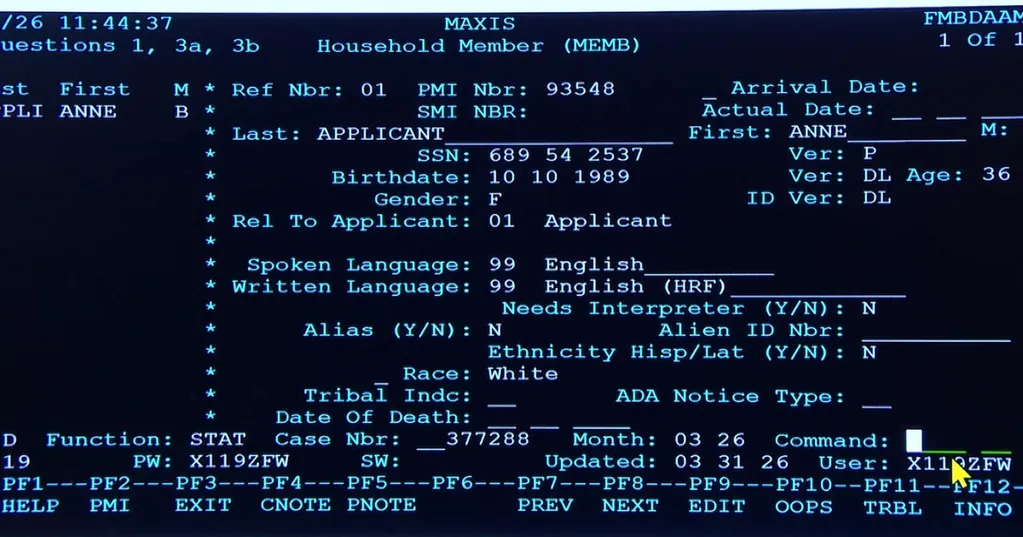
When he powers up his laptop and opens software used to enroll thousands of Dakota County, Minnesota, residents for food assistance, there is a reminder on screen of how long it's been since there was an upgrade: "Copyright 1994."
But the program MAXIS is even older than that, first launching in 1989, only a few years after the "Oregon Trail" game was widely available.
Upgrading this software and other outdated programs used to administer critical social services is a top priority for all of Minnesota's 87 counties, which manage enrollment and case management for Medicaid, SNAP and other assistance. Local officials are pushing the Legislature this year to shore up support to bring these IT systems into the 21st century.
"You start out really getting into human services work wanting to help people, and you end up seeing a black screen, a green screen. And it's a shock," said Wegner, a program trainer specialist with Dakota County.
He has worked in the county for five years and in that time he has become more adept at using the software that is not compatible with a mouse, the backspace key or the "copy and paste" function that anyone with a computer is familiar with navigating.
It takes him an hour to fill out all the necessary information to check their eligibility and enroll someone in SNAP, but the expectation for a new employee, he said, is one application per day.
"We're all trying to make the lives of Minnesotans better, and we are having to use outdated systems to do that," Wegner told WCCO. "We're doing our best, but we would really love to have just some better tools to be able to do it better and more efficiently."
And other states are doing this more efficiently, said Matt Hilgart with the Minnesota Association of Counties. In Wisconsin, one person doing human services work can handle 900 cases. In Minnesota, that same person can only manage 300 cases.
"At a certain point, the ship has too many holes in it to keep afloat. We need to replace it instead of just patching our way through this," Hilgart said.
It's hard to unite all of Minnesota's geographically, politically and economically diverse counties on much of anything, but on this issue, there is no daylight between them, Hilgart said. And in a politically divided Legislature, Republicans and Democrats alike hear the need loud and clear.
"We know that these systems aren't just IT systems up in the cloud. They actually are impacting people's day-to-day lives. And so they deserve better; the workers deserve better; and frankly, the property taxpayers deserve better," Hilgart said.
MAXIS is not the only outdated system, either. Among the other programs needing upgrades include PRISM for child support that dates back to 1997 and SSIS from 1994, which is used for social services. The newest system launched in 2013 for health care benefits.
How much it will cost remains to be seen -- Higart estimated a total system replacement could cost hundreds of millions of dollars -- but there are more immediate needs that would have a lower price tag.
Rep. Paul Torkelson, the Republican Ways and Means chair in the House, said recently he puts the initial figure at $15 million to keep things afloat in the near term while allocating more money down the road. He agrees with Hilgart that many of the investments in the IT area could see a federal match, meaning the state would have to spend fewer funds to maximize the impact.
"Some of it is kind of unknown because this technology is changing so fast that the needs in the future are much harder to put a dollar amount on. That's why setting up a fund that's available in the future to fund these efforts at technology modernization is so important," he said.
A proposal moving through the DFL-led Senate would earmark $70 million over four years for these upgrades. A separate measure backed by Sen. Scott Dibble, a Democrat from Minneapolis, is a constitutional amendment that would allow the state to borrow money like it can for infrastructure projects, known as "bonding," for this IT modernization. If passed by the Legislature, voters would need to approve the changes this fall on the ballot.
"Just to wait for the one-off appropriation every year from the general fund of a few million dollars, $50 million, even $100 million -- that's just not enough to really get ahead of the game, which is what we need to do," Dibble told WCCO. "It will take us another 50 years to improve the 50-year-old legacy system that we have."
In the final weeks of session, legislative leaders and the governor are beginning negotiations about what a supplemental budget will look like. The backdrop is the state's finances are tight and state budget officials are urging caution when it comes to spending additional money this year in order to stave off a potential deficit in the future.
But Hilgart said if lawmakers don't throw counties a lifeline this year, there could be costly consequences.
As a result, counties would need to shift more cost burdens to local homeowners who have already seen their county levies soar by 7.6% on average this year, according to an analysis by the Minnesota Department of Revenue.
"[The systems] are to a tipping point to where functionally, they are unworkable at a certain point," he said.
Changes coming soon from the federal government that Congress approved in H.R. 1, the so-called "one big beautiful bill," will compound the problems if the issue is left unresolved, Hilgart explained.
Among the provisions in that new law include more frequent eligibility checks for SNAP and more people in the program having to meet work requirements. There are also new work, education or community service prerequisites in order to qualify for Medicaid
All of this means more information for workers to keep track of and more time spent on the outdated systems. Wegner with Dakota County said switching from an annual to a biannual eligibility screening for some on Medicaid will double his workload.
Another federal change to SNAP specifically would shift more administrative costs to states -- or, in Minnesota's case, counties tasked with delivering these services -- and hit them with a penalty of 6% of payments made in error. Minnesota's error rate in 2024 was nearly 9%.
"As long as you have humans doing human work, you will have human errors. It's just honest mistakes that can be made to cause this," Wegner said.
He showed WCCO just how easy it is to accidentally overpay someone's benefits, leaving them on the hook to pay back hundreds of dollars. Because the software is so clunky and workers have to input information many times over, it's easy to type in the wrong data which will miscalculate payments.
Both Republicans and Democrats at the capitol believe investing in upgrades will also make the programs vulnerable to fraud, a top priority for all four caucuses in both chambers this year.
"We've already talked about the bad situation that we're in now that's going to be further exacerbated in terms of additional wait times for clients, in terms of more levy dollars to spend on staffing up for the new mandates in these laws, and just bad outcomes in terms of the programs themselves -- in terms of program integrity and in terms of the shortcomings that we know a 1980s system inherently has," said Hilgart.