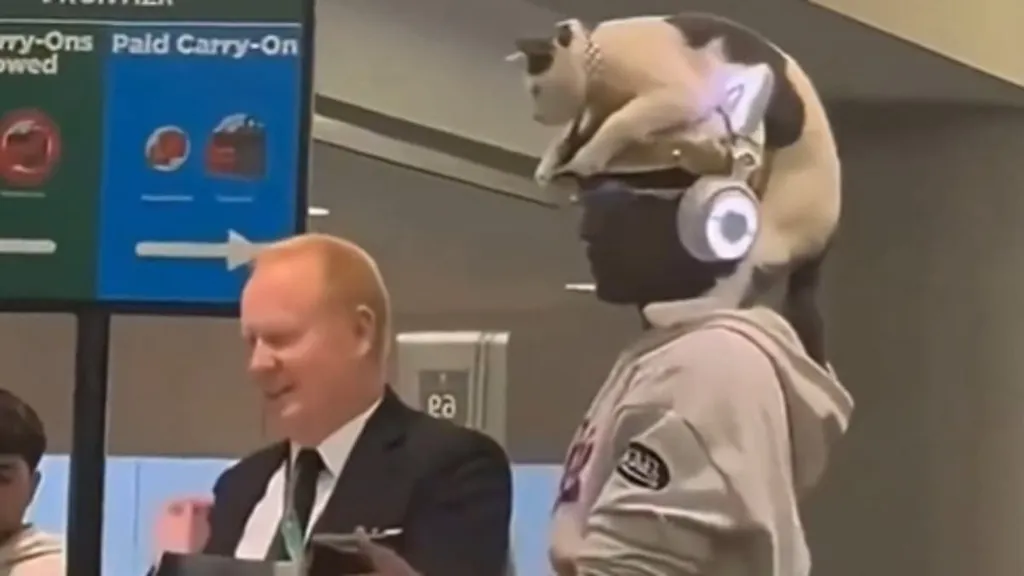
A traveller at a US airport recently turned heads by wearing a rather unexpected fashion accessory: his pet cat.
Footage of the bizarre sighting emerged on social media, showing the tabby cat perched comfortably on its owner's head at Tampa International Airport.
Far from keeping a low profile, the male Frontier Airlines passenger was captured collecting his boarding pass at check-in before nonchalantly navigating the terminal as stunned travellers looked on.
In one scene, he can be seen readjusting his pet into a more snug position atop of his cat-eared headphones. The feline appeared to remain calm and largely unfazed throughout the clip.
The traveller has since been identified by the online community as Atlanta resident Jeremy Smith, also known as 'Beltline Cat Guy'.
According to reports, Jeremy - who was born deaf - paid a stranger at Piedmont Park $100 (£76) to adopt a stray cat, who has been named Whisker.
He's since taught the cat to sit calmly on his shoulder as he cycles through the city, finding 'purpose' in the joy his unconventional riding partner brings to passersby.
The footage has since raised questions regarding proper pet travel procedures in airports.
A Frontier Airlines passenger, identified online as Jeremy Smith, who was born deaf, has been spotted navigating a terminal at Tampa International Airport with his cat Whiskers perched atop of his head.
While cats are not as commonly seen as emotional support dogs, they are permitted on planes under specific guidelines.
Generally, cats can travel either in the cabin under the seat or in the cargo hold across major airlines, with options determined by the airline's policy, the cat's size and destination regulations.
According to Redditors who had commented on the post, Jeremy likely paid an additional fee to travel with the cat.
A person continued: 'When passing TSA though, the cat needs to be out and visible. Most of people just hold on the cat extra tight because most cats usually get startled by people and loud noises. This person just has a super chill cat.'
Another said: 'United, JetBlue, etc. all have the option. Back when I did across states in 2017, it was $100 add-on. Not sure if they raise the price but I am pretty sure it is still available.'
Information regarding pets on Frontier's website reads: 'Domesticated dogs, cats, rabbits, guinea pigs, hamsters, or small household birds may be carried on flights within the United States.
'A one-way, directional charge will apply and may be paid in advance during booking. If you do not pay in advance, you'll need to pay when you check-in your pet.'
A cat owner added: 'PSA: If you have a particularly skittish cat, you can request they be inspected by TSA in a separate room. I didn't know this until after my cat almost ran off at Logan Airport.
.'She got startled and tried to jump out of my arms and I had to hold on to her with all my might as she fd me up with her claws in the security line. I still have scars from it, although I now treasure those as she passed a few years ago.'
One user said of Jeremy: 'He always has the cat ear headphones on, doesn't talk and can communicate with sign language and gestures. Super chill guy that will let people say hi to his cat on his head.'
As a growing number of pet owners plan trips with their four-legged friends, nutrition experts recently broke down the dos and don'ts of travelling with dogs on planes - along with what they should and shouldn't eat before take-off.
While UK-based airlines typically do not allow animals in the cabin, there are exceptions for registered assistance dogs.
On the other hand, several European and international airlines allow small dogs to fly in their cabins, including: KLM, Royal Dutch Airlines, Lufthansa, Air France, Vueling Airlines, Aegean Airlines, Iberia, Air Canada, Turkish Airlines, and Qatar Airways.
However, it's worth noting that there are a number of strict requirements pet owners must follow in order for their dogs to fly.
Dogs must travel in an approved soft carrier, usually weigh around 8kg or less (including their carrier), remain under the seat for the duration of the flight and be booked in advance as spaces are limited.
Policies can vary by route and aircraft, so it's best to check the rules for individual airlines well in advance.