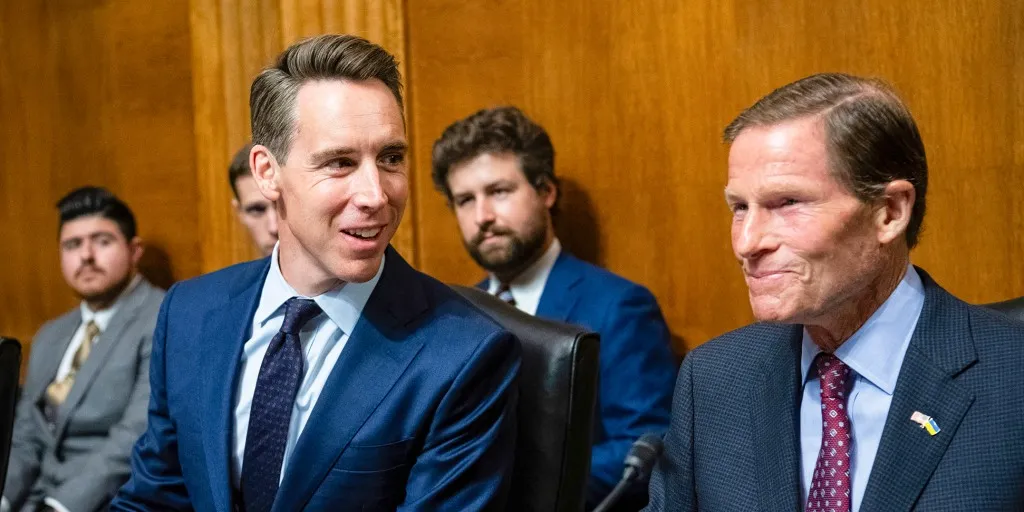
Sens. Josh Hawley and Richard Blumenthal speak before a Senate Judiciary subcommittee hearing on artificial intelligence at the Capitol on July 25, 2023.Graeme Sloan / Sipa USA via AP file
The effort to ban AI chatbots for minors is picking up steam in Congress.
On Thursday, the Senate Judiciary Committee unanimously voted to advance a bill from Sens. Josh Hawley, R-Mo., and Richard Blumenthal, D-Conn., that would require AI companies to implement an age-verification process and ban them from providing AI companions to minors, according to a summary of the legislation, dubbed the Guidelines for User Age-verification and Responsible Dialogue Act, or GUARD Act.
The legislation would also mandate that AI companions disclose their nonhuman status and lack of professional credentials for all users at regular intervals. It would also introduce criminal penalties for companies that design, develop or make available AI companions that solicit or induce sexually explicit conduct from minors or encourage suicide.
"No amount of profit justifies the DESTRUCTION of our children," Hawley, who has taken a skeptical view of tech, posted on X. "Time to bring this bill to the Senate floor."
Additionally on Thursday, Reps. Blake Moore, R-Utah, and Valerie Foushee, D-N.C., introduced a companion bill in the House.
In separate statements, Moore said, "Parents and policymakers alike need to ground our children's development in real-world interactions rather than push them further into the unaccountable black hole of frontier technology," while Foushee said AI chatbots "continue to put the lives and mental health of children at risk, and it is critical for Congress to act immediately."
The bills followed complaints from parents who blamed the AI companions for pushing their children into sexual conversations and even suicide.
ChatGPT, Google Gemini, xAI's Grok, Meta AI and Character.AI all allow kids as young as 13 years old to use their services, according to their terms of service.
The effort has faced criticism from privacy advocates who see age-verification mandates as invasive and a barrier to free expression online, while some tech companies have argued that their online services are protected speech under the First Amendment.
The legislation comes as AI chatbots proliferate on the internet, whether from chatbot-focused programs such as ChatGPT or on social media sites that are adding interactive AI features. But teenagers' use of AI chatbots has drawn scrutiny, with particular focus on self-harm. AI companies have said that their products include safeguards and that they are continually working to improve them.