Text abbreviations first emerged back in the 1990s as texters tried to find sneaky ways around character limits.
Most people remember the classics from this era, such as LOL (laugh out loud), BRB (be right back), and TTYL (talk to you later).
But fast-forward to today, and text abbreviations have escalated, with thousands now used across social media.
Now, the team at Unscramblerer.com have analysed Google Trends to uncover the acronyms that leave Brits the most confused.
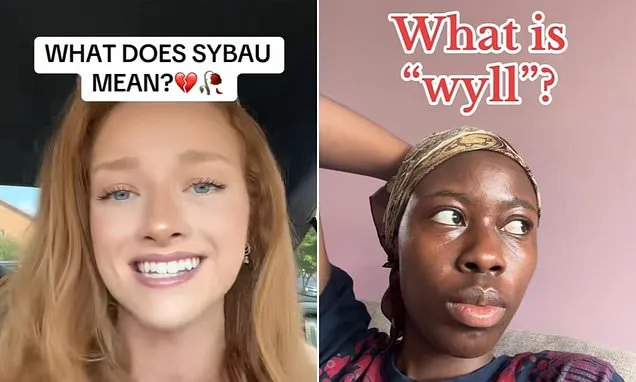
Topping the list is SYBAU, which is searched for 49,400 a month.
While many kids maintain to their parents that this stands for 'stay young, beautiful, and unique', it actually means 'shut your b a up'.
'The list of the most confusing UK texting acronyms is always changing,' a spokesperson for Unscramblerer.com said.
'In 2026 our research found many new top acronyms and even some change in meanings for older ones. It is fascinating that social media trends can easily change the mainstream meaning of an acronym within a short frame of time.'
The team used Google Trends to discover the top trending texting acronyms before feeding them into Ahrefs to find the number of monthly searches.
While SYBAU tops the list, this is followed by WYLL, which has 40,300 searches every month.
This stands for 'what you look like', and is frequently used to ask someone for a photo or a description of their appearance online.
POV (point of view) is next on the list, followed by SMH (shake my head), HMU (hit me up), and OTP.
Instead of 'one-time passcode', this actually stands for 'one true pairing', referring to a fan's favorite fictional couple or pairing.
One of the most confusing acronyms on the list is ASL, which doesn't stand for three words beginning with a, s, and l.
Instead, it means 'as hell', and is used to emphasise an adjective, such as 'funny asl' or 'slow asl'.
Further down the list, FML (f* my life) has 21,300 monthly searches, ahead of the classic BTW (by the way), which was searched for 20,500 times.
The team used Google Trends to discover the top trending texting acronyms before feeding them into Ahrefs to find the number of monthly searches.
Meanwhile, at the bottom of the top 30, we have ICYMI (in case you missed it), and WYO (what you on?).
Unscramblerer.com describes acronyms as an 'effective, lazy and cool way to communicate'.
However, it stipulates that 'context truly matters'.
'Should you use texting shortcuts for friends, a family member, a work colleague or an online forum?' the spokesperson asked.
The team highlighted a 2024 study published in the Journal of Experimental Psychology, in which 5,300 participants' conversations were analysed across eight experiments.
Analysis revealed that people who used texting abbreviations such as 'FWIW' - instead of spelling out 'for what it's worth' - were perceived as more insincere.
They were also less likely to receive a response because they were seen to be making less effort in text conversation.
'In daily interactions, we often encounter people who could be considered good texters or poor texters,' lead researcher David Fang said.
'We thought texters might like abbreviations because it would convey an informal sense of closeness, so we were surprised that abbreviations elicited negative perceptions about people who use them.'
Overall, text abbreviations are fine for messages with your family or friends - but if it's a serious message to a colleague, it's best to spell out what you want.
The Unscramblerer.com expert added: 'Spelling words out shows that you are invested in the conversation. People notice this!'