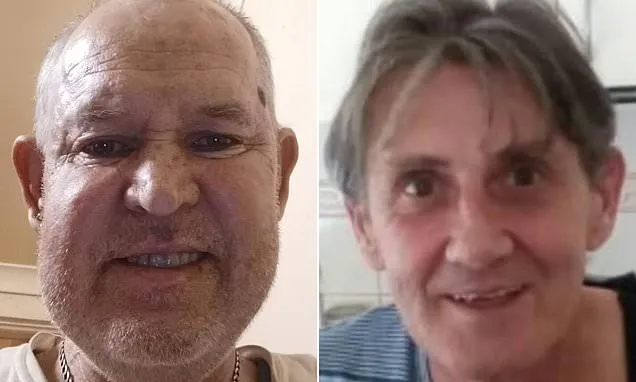
A man who claimed he didn't hear his housemate get bludgeoned to death because he was listening to John Farnham's 'You're the Voice' has admitted to murder.
On Monday, John Sheffield's outrageous lies to police were laid bare as he finally accepted responsibility for pounding his mate Kenneth Magee's head in with a hammer.
The former diesel mechanic, 56, was stared down by his victim's loved ones as he faced a pre-sentencing hearing at the Supreme Court of Victoria.
The deranged killer had claimed he found his mate 'on the couch with his head smashed open' inside their Werribee home, in Melbourne's west, on December 2, 2024.
Mr Magee had acted as Sheffield's unofficial carer.
When detectives asked Sheffield what he'd been doing at the time, he told them he'd been blasting John Farnham tunes in his bedroom.
He maintained the lie up until last month when he agreed to plead guilty to murder after being provided with a sentence indication by Justice Rita Incerti.
The court heard Mr Magee, 63, died from catastrophic head injuries caused by repeated blunt‑force blows with a hammer.
A forensic examination found multiple skull fractures and brain injuries consistent with at least five impacts.
Emergency services were called after Sheffield rang triple-0, claiming an intruder had attacked his friend.
'Someone just broke in, he hit me mate on the head with a hammer, I don't know who it was, they've left the front door open,' he claimed.
'I just walked out there to get a drink and I seen him on the couch with his head smashed open. I don’t know how long ago, I’d been in me room listening to music.'
Police found no signs of forced entry.
Mr McGee was discovered on a couch with fatal head wounds, while Sheffield was uninjured.
He was arrested later that evening, with Mr McGee succumbing to his injuries at hospital at 11.20pm.
During sentencing submissions, the court heard CCTV footage tracked the pair’s movements throughout the day, including shopping and medical visits, and showed no one else entering the house.
Sheffield later altered his account, telling police he had pulled the hammer from Mr McGee’s head and moved it.
Mr Magee’s daughter Christine Magee told the court her life ‘imploded’ after receiving a phone call saying her father would not survive, followed minutes later by confirmation of his death.
She described years of panic attacks, depression, extreme weight loss, an eating disorder and being forced to leave her career as a chef.
‘His life was stolen by someone he once called a friend, in the safety of his own home,’ she said.
Mr Magee’s sister, Alison Menzies, told the court she learned of her brother’s death by seeing his photograph on the evening news.
She described severe grief, recurring nightmares, anxiety, financial strain and the compounded trauma of losing three siblings in four years.
‘Ken was given a death sentence. I have been given a life sentence,’ she said.
Sheffield’s barrister, John Desmond, attempted to push blame on Mr McGee, describing him as a violent thug.
No reason was given by Sheffield as to why he decided to murder Kenneth Magee.
‘There was violence and overbearing conduct by the deceased directed to the accused,’ he told the court.
Mr Desmond claimed Mr McGee had been violent toward his client for ‘a long time’.
‘Sometimes he beats the hell out of him ... punches him in the head, stomach and face,’ Sheffield had previously told a doctor.
Mr Desmond claimed his client had been a long-term victim of domestic violence and therefore deserved a discount on his sentence.
‘This is not a case where the accused was the oppressor over many years... it is the other way around,’ he said.
‘We’re not minimising the seriousness - it’s the most serious crime in the country - but the relationship is relevant to moral culpability and offence gravity.’
While the prosecution acknowledged the relationship between the pair was 'complex', it argued there was no evidence of a struggle or immediate provocation on the night, and that Sheffield's moral culpability remained high.
Justice Incerti will hand down her sentence at a date to be fixed.
She had previously told the killer she would sentence him to 22 years in jail if he pleaded guilty to the crime.