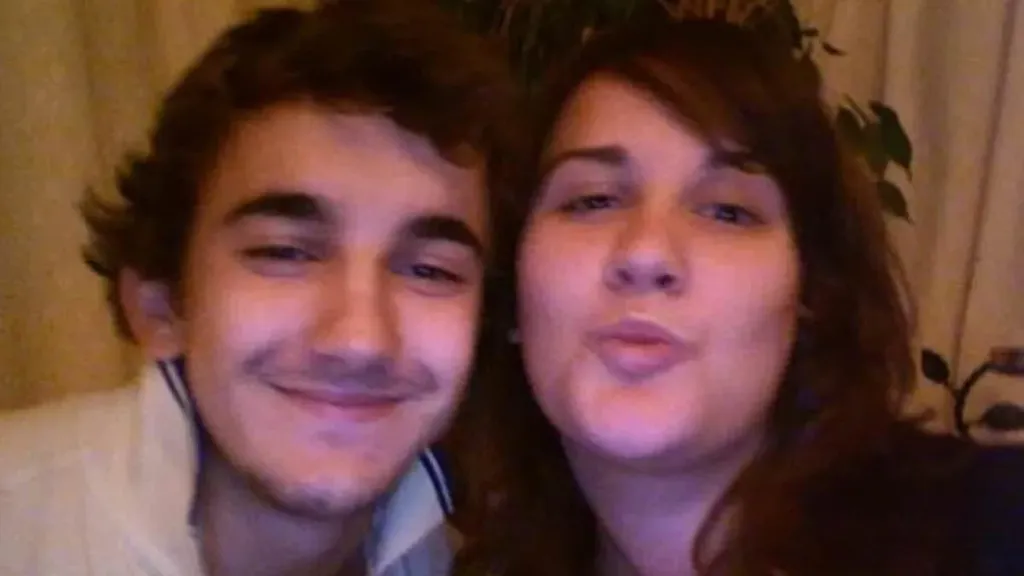
The last time I saw my younger brother in good health, he was setting off on an ambitious hike across England, all the way from Somerset to the east coast.
When I get the call from the police, they say he's been found somewhere near Hastings following an assault, unconscious and covered in his own vomit.
An ambulance has taken him to the Royal Sussex County Hospital in Brighton where surgeons are operating on his brain. The surgery will take hours.
By the time I get to the critical care unit, driving from my cottage in Somerset through tears, it is early morning.
A doctor insists on talking to me before I can see him. 'A very serious head injury,' he keeps saying. He says other things, too, but I can't take them all in: that my brother has suffered a ruptured brain aneurysm; that he is in a coma with pneumonia and infections.
The doctor asks if I am sure I want to see him and I am ashamed that, for a moment, I hesitate - afraid of the horror of how he might look.
I was nine years old when my brother Edward was born. Because he arrived the day after my birthday, I always felt he was a kind of gift to me. From the moment I saw him, a tiny baby in the hospital maternity ward, I thought of him as mine - even more so after our mother became unwell and I took on a lot of responsibility for him.
Now, even though he is a grown man of 34, I still see him through the eyes of a mother.
Officially he is Edward. But he has always been my Teddy.
In the unit I find him lying unconscious, surrounded by bleeping machines.
A ventilator rises and falls in his chest and a shunt leaks thick, pink blood from a large swelling on the front of his head.
Tubes run in and out of his body. He is a big bear of a man, but he looks so fragile I am frightened to touch him.
I sit beside him, gently stroking his hand with just a finger, desperate to believe this isn't happening.
In the sterile and silent unit, sometimes an alarm sounds - a sign that Teddy is struggling to breathe - and a nurse rushes over and uses a suction mechanism to remove gunk from his lungs, sending his weak body into spasms.
That first night I stay at the hospital until the nurses encourage me to go and sleep, then I lie in the hotel I have hurriedly booked, googling brain aneurysms. I learn that about 25 per cent of people who experience a rupture of this kind die within 24 hours. About 50 per cent die within three months due to complications. Of those who survive, about 66 per cent experience permanent brain damage. I cry until light comes up in the morning.
It is August 2024 and my brother survives the first 24 hours, but he cannot move or breathe for himself. I sit beside him whispering, 'Are you there?' His face slumps, drool falls from his mouth. My mother is here as well, which is not just strange but agonising since we have not spoken for ten years (another story).
The doctor says that until Teddy is out of the coma, they cannot assess the extent of his brain damage.
'Will he recognise me when he wakes up?' I ask. The doctor looks at me pitifully. When my brother wakes up, he explains, they will be looking for eye movements.
In the evenings, I lie in bed exhausted, sobbing. My body physically hurts; my cheeks are red raw with crying; the sadness is heavy in my chest.
My anxiety becomes overwhelming. Now my worst fear has happened; any horror feels possible. I jangle with nerves trying to drive; thinking I'll crash. I walk the dog imagining him running into the road. I wonder if I will ever feel peaceful or happy again.
For three weeks, Teddy lies in a coma. It is agonising to feel so helpless, to sit with this vast unknown future ahead of us, not knowing what it will mean for him or us.
The nurses support us to try to pull my brother out of his coma with familiar things - they play music and encourage us to make a memory board which we fill with family photographs. His aunts send him video messages and come to visit.
Yet Teddy picks up infections. He is taken for further operations on his brain. The doctors discuss performing a tracheotomy - a procedure to create an opening in his neck and insert a tube to help him breathe - and it is unbearable to think of him being assaulted in this way.
I don't want to leave Teddy's side, so I rent myself an Airbnb in the annex of a couple's home. When I explain the situation to them, they let me stay for free.
A friend of a friend also offers me a room in her home, and my aunts give me money to rent a flat. At the lowest moment of my life, I'm so touched by the kindness of other people it saves me not just practically but spiritually - a reminder that the world can also be a good place.
I focus my energy on willing Teddy to get better but, in the background of my mind lies the horror of his assault - the reason he is lying here.
From the outset I am in touch with the police, who call me regularly and seem genuinely concerned, asking for updates. Only later does someone suggest to me that their concern might centre on having to turn an assault investigation into one for murder.
But then, when it becomes apparent that Teddy will survive, they tell me there is no evidence of an attack - no CCTV footage - and they have ruled it out. This seems utterly extraordinary to me, but for now I am too exhausted and worried to find the energy to deal with it.
The day Teddy wakes up, three weeks after his assault, feels like a scene from a film. I enter the ward and he is propped up, smiling. For a moment it feels like we are all waking up, too. Then I hear the doctor ask him, ‘Do you know who this is?’ and Teddy looks confused.
My brother is conscious but it's hard to know what he understands. At school he was in the rowing team; now his slumped body is hoisted in a sling; strapped into a nappy; placed in a chair.
‘Do you want to face the window, Edward?’ the nurse asks him—but his soft face has collapsed, and his eyes don't register she is there.
‘It’s just a matter of time,’ doctors say kindly. ‘We won’t really know the full extent of his brain damage for a year.’
I am ashamed to admit it, but I wonder if there is something worse than him dying.
When Teddy is stable enough to be moved to a ward, he still can't talk or walk. Sometimes he strains to talk and I hold my ear close to his mouth. But it isn’t even clear if the sounds he is making are words.
I take him a book and he holds it, turning the pages upside down. Sometimes I tell him a joke and he giggles, his face lighting up like a child, and I feel a love for him beyond words.
I take him a comic book which only has pictures.
It’s hard to remember how we stumble through the next months as Teddy’s progress goes forwards and back. The days are so long and I am so exhausted and heartbroken; sometimes I can barely bring myself to go to the hospital.
But as the weeks pass, my brother begins to heal. He has age on his side. One day he walks. Slowly, he talks; still struggling to find words. The changes in him are so slight; I try not to torture myself looking for them; but slowly he is improving; even if every day feels like years.
On top of it all is the weirdness between my mother and I. We divide visiting hours between us; navigating each other in the corridor as if we are strangers; which is the best we can do to stay civil.
Six weeks later, relief: Teddy is moved to Bath, closer to me. My mother goes home but continues to visit.
The new hospital is disappointingly bleak. My brother is in a small room alone; receiving little rehabilitation and no occupational therapy. He spends his days pacing the ward until I can see him.
At first I am allowed to take Teddy for walks around the hospital; and then in the grounds.
Although he is often confused; repeating the same questions; forgetting our conversations from one moment to the next; we still laugh a lot. It reminds me of when my dad had Alzheimer's - except with Teddy a miracle is happening: instead of fading, he is coming back.
Two months after that first terrible night in August, Teddy is able to talk about the attack.
I record my brother's description of what happened as he starts to piece together his recollections, and he surprises us both by having a clear memory of where the attack took place and the man who punched him.
I email police the details he gives me about being on a road called The Ridge in Hastings when a smart dark-coloured car pulled up and driver got out - man early 20s clean shaven dark blonde hair. This was man who punched kicked him repeatedly.
The police reply that area in question not covered by CCTV and any case all footage would wiped after 28 days. They do not send anyone interview Teddy. I do not hear officers again although try reach out them repeatedly.
Teddy sits small room Bath four months almost care. Despite gratitude NHS complain - nothing done.
Just before Christmas moved Frome Community Hospital even equipped. told nurse need make beds available Bath.
I spend Christmas Day ward.
Eventually, first time almost six months allowed take hospital's grounds. Teddy excited overwhelmed quiet church watch stained glass windows wide-eyed. My brother stays hospital discharged shared house supported accommodation village hour-and-a-half away live. When visit first time, take modest room single bed then cry way home.
Teddy's memory very poor; although still bright clever; exhausted time struggles process information; making hard hold conversations. Coming terms new reality feels hardest thing.
I assumed; given life-changing nature injuries; brother entitled full Personal Independence Payment (PIP). But devastatingly; after waiting seven months; claim rejected.
I feel anger sadness think that Teddy's keenness put best face when interviewed -and own unawareness some issues- affected application. It seems those least able advocate themselves -or 'work' benefits system- are most cruelly unsupported it.
Only after support workers write lengthy appeal PIP approved.
Meanwhile; hear nothing police become angry their inaction. Having contacted repeatedly; send email -it's January 2025- demanding know why done nothing. But don’t reply.
I first write article happened Teddy October; that when police contact apologise failure act.
I learn then assault against him categorised grievous bodily harm. They now pledge ‘actively explore any new lines enquiry’ and ‘review our actions identify lessons learnt’.
At this point; not aware progress Teddy’s case.
Yet there have been positive shifts too.
Something in Teddy has changed -he's softer now more emotional -always hugging me. I think we both appreciate life more. An experience like this gives you a painful awakening of perspective.
Now I try not to worry about trivial things and appreciate the joys I'm lucky to have. I'm more aware than ever of how little time we have and how fragile we are.
Mostly, it's taught me that all that matters is kindness and love and our relationships.