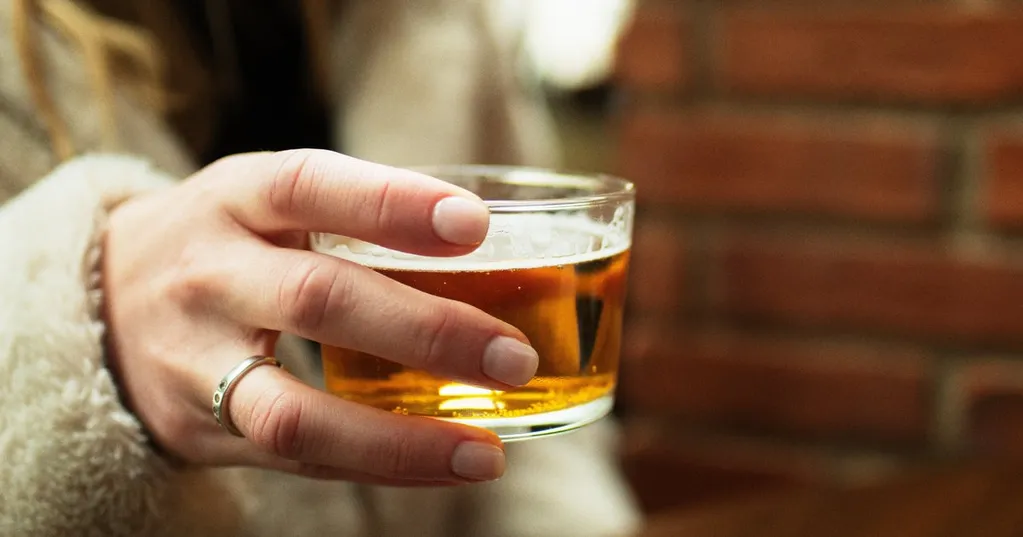
"It was a private promise to myself that I was never going to drink in this condo. I don't have to tell you that I didn't keep that promise."
In the fall of 2016, an old friend called to tell me she'd been sober for six months and hoped it was a down payment on forever. This was a woman with whom I joyfully drank during our junior year abroad in London. In our later years as mothers, we joked about drinking vodka -- aka "water" -- while our kids were in the bath.
My first horrified thought was Why on earth would she do something like that?! Almost immediately, I replied to myself: Oh, Kerri, that reaction has much more to do with you than it does with her.
I knew that my drinking was a problem. I was constantly making rules for myself that I always broke: Only drink on weekends, only one drink per night, only drink when out with friends. I could not get through a dry January without becoming an irritable jerk, then throwing in the towel by mid-month. I was drinking more than what it appeared, and my tolerance had skyrocketed.
I asked my friend how she managed to stop, and we began a dialogue that would completely change my life. At the time, she was listening to the "HOME Podcast" with Laura McKowen and Holly Whitaker, two authors whose work focuses largely on recovery and the culture of alcohol.
She also recommended Annie Grace's book "This Naked Mind," which I promptly devoured; I found unspeakable relief in the way Grace put the blame on alcohol, not the drinker. Alcohol is inherently addictive; of course so many humans become addicted!
I quit in October 2016, and while I was dedicated to being a non-drinker, I had a lot of trouble using the word "sober" because in my mind, "sober" equaled "alcoholic," and I could not bring myself to feel that I fit the cultural definition of alcoholic. After all, I'd never had a DUI; no one had flagged my drinking as a problem; I wasn't waking up in places I didn't remember getting to; and I was a high-functioning mother and writer.
A lot happened in the next 15 months. I got divorced, and it wasn't pretty. I was grateful every day during that grueling year of negotiations and emotional turmoil that I could see the process clearly, wake up every morning feeling sharp and show up for my kid in a way that was fully present.
Once the ink dried on my divorce papers in 2018, and I was living entirely on my own with my debut novel soon to be published, my life felt really, really good. So good that I thought to myself, Maybe the reason I was drinking so much was because I was unhappy in my marriage.
So I slowly started drinking again.
When I'd moved into my own post-divorce condo, gleefully decorating it exactly the way I wanted, I put a sticky note on my refrigerator that's still there. On it, I'd written, "Clear eyes, full heart, can't lose," Coach Taylor's mantra from "Friday Night Lights." It was my own private promise to myself that I was never going to drink in this condo.
I don't have to tell you that I didn't keep that promise.
I looked at that sticky note every day, and it stared back at me incriminatingly as I opened the door to reach for a bottle of wine at lunch -- just any old Tuesday lunch. I was back to my old habits.
By the spring of 2021, I knew I had to do something differently. Fortunately, both Laura and Holly's "quit lit" memoirs had made quite a splash in the "sober curious" world, and I was so inspired by the examples of two brilliant, successful women doing sobriety on their own terms. They rejected the language that I'd found stigmatizing like "addict" and "alcoholic" and dug deep into the personal work of recovery while also drawing attention to the ways that Big Alcohol targets and exploits consumers, women in particular.
I also began to notice how many of the creators I respected cited sobriety as foundational to their success, like Glennon Doyle, Anne Hathaway and Julia Cameron. I wanted to be as badass as they were, and I had the mounting sense that the sweaty 2 a.m. wake-ups, the brain fog, the wasted time and money were all keeping me from joining their ranks.
I'd done enough reading at that point to know that it was nearly impossible to get and stay sober alone. Serendipitously, new online recovery communities emerged during the pandemic, and I flirted with a few, including online 12-step meetings, but nothing felt right. I knew that a variety of free 12-step meetings were everywhere and had helped millions of people attain long-term sobriety but I didn't look long enough to find the right one for me maybe because I couldn't fully commit.
For about six months, I was sober-ish. I'd occasionally have a drink on the QT, then I would hate myself for it. Though I wasn't going to bed drunk or waking up hungover, I knew I was on a slippery slope.
I took comfort in one of the posts Holly regularly made to remind anyone reading: "You ARE doing it." The messy part where a person starts and stops and slips but is aware of what she is doing is part of the process. For me, it was a necessary part because it reminded me, daily, of all the reasons I had to stop drinking for good.
I had one final experience that I've only described in the rooms, from which I woke up actually wanting to be sober, to never have to feel the way I was feeling ever again. That night I got on a Zoom meeting at TLC (The Luckiest Club), a membership-based sobriety support community created by McKowen, and I knew right away that it was the right place for me to do the proverbial work.
I started going to specific meetings regularly and made friends I looked forward to seeing online every day. Plus I exchanged phone numbers with a few women, one of whom is now a ride-or-die friend with whom I've talked or texted nearly every day for more than four years.
As I said to a Zoom room full of familiar faces I'd grown to genuinely love and depend on, TLC was the community I'd been drinking for. These are people who understand my struggles and accept me without judgment. I've learned from their stories and gleaned so much useful information about anxiety and anger and acceptance that has helped me understand why I was drinking in the first place and why it is glorious to not just be "dry," but to be sober.
Because once I got over the desire to drink -- mercifully and miraculously, those cravings did eventually fade -- I learned that the real work is "emotional sobriety." For me, that meant healing my relationship with myself; taking a hard look at my finances; learning to regulate my emotions; forming healthier relationships with others.
Emotional sobriety, which I've come to see as synonymous with recovery, is a path I'll always be traveling. And I'm so grateful I now see it that way because it's been on this path that the magic has happened. I no longer look for opportunities to drink; I look for opportunities to connect, and this has made the time I spend with my people feel all the more fulfilling.
In my four-plus years in recovery, I've learned how to clear my eyes and fill my heart with the things that bring me lasting joy instead of a 20-minute high from a liquid in a pretty bottle. I read so much more now! I'm always available when my teen daughter wants to talk at bedtime. I'm grateful for the strength sobriety has given me to trust my inner voice and stand in my truth even when it's hard. The other sober travelers I've met along the way have shown me insights that have made me a better writer mother and friend. We are as we say in TLC sober badasses.
I feel enormously privileged that I am able to pay for my annual TLC membership. The cost and the vibe isn't for everyone but as we say at the start of every meeting we "respect all paths to recovery." Each of us has to find our own way and finding it is part of what makes sobriety stick.
Trust the process. However you do it being sober in an alcohol-drenched world is about as stick-it-to-the-man counter-culture as it gets. The work is not easy and I have to show up for it regularly but it's been the best gift I've given myself in the last decade.
Kerri Maher is the USA Today bestselling author of "All You Have to Do Is Call," "The Paris Bookseller," "The Girl in White Gloves" and "The Kennedy Debutante." Her next novel, "Summer of Love," is about sisters, daughters, mothers and friends recovering from secrets and shame and finding the path to their own best lives. It comes out July 7, 2026. Find out more about it at kerrimaher.com and subscribe to Kerri's Substack for all the latest news.