Kwame Anthony Appiah has been The New York Times Magazine's Ethicist columnist since 2015 and teaches philosophy at N.Y.U.
My sister has bipolar disorder and late-onset schizophrenia. About five years ago, she beat our mother so badly that she spent months in a coma. At the time of her arrest, my sister said she believed an alien had taken over our mother's body and was going to kill her. She had stopped taking her medication because she didn't like how it made her feel. Our mother died two years later, after a series of strokes that doctors linked to the brain injury.
While our mother was still in a coma, my sister's lawyers and psychiatrist negotiated an Alford plea with the prosecutor, allowing her to plead guilty while maintaining her innocence. My sister received a suspended sentence that included several years in a mental-health facility followed by supervised probation.
Those years passed quickly. My sister will be released soon, and I am simply beside myself. The trauma her actions caused is indescribable, especially to her children, who were teenagers, and my own children, who were very close to their grandmother. My brother-in-law divorced my sister, throwing their family into more upheaval. My life was upended when my mother was released from the hospital and needed round-the-clock care; I moved in to take care of her, which affected my marriage, though my husband was incredibly understanding. In the aftermath, our family -- including my brother-in-law, his wonderful new girlfriend, my husband and both sets of children -- has grown close. None of them ever want to see my sister again.
Now my sister's psychiatrist wants to reunite us so she will have "family" support after release, and says she will do better with a strong network. No one wants that, especially her children, to whom I've become a surrogate mother. If I help her, I could lose the family we have rebuilt. I love my sister and I want her to survive in society, but I cannot bear the thought of endangering the relationships that have carried all of us through this. If I refuse, her future looks shakier. If I help, my family, especially all the children, may never forgive me. What do you suggest? -- Name Withheld
I'm so sorry about what you and your family have gone through. It's understandable that you feel torn. The tensions you're experiencing aren't the kind to be easily resolved. The psychiatrist, whose main obligations are to this patient's welfare, points out that your sister has a better chance of successful reintegration if her family provides a strong network of support. After all, your sister, in the grip of delusion, thought she was acting in self-defense. And modern moral theories tend to focus on issues of intentions and control, as if this were all that matters.
In truth, harm has its own weight. The difference between homicide and aggravated assault could come down to how long it took for an ambulance to arrive. Yet there's a reason we punish the first more severely. For us, as for the ancient Greeks, the injuries you inflict matter, in ways separable from what you'd meant to do. It is "a mistake to think that the idea of the voluntary can itself be refined beyond a certain point," the philosopher Bernard Williams wrote in a classic work. "The idea is useful, and it helps to serve the purposes of justice, but it is essentially superficial."
In Sophocles' play "Oedipus at Colonus," Oedipus -- who, of course, married someone who turned out to be his mother and killed someone who turned out to be his father -- says: "I suffered my deeds more than I acted them." Williams's gloss is simple and powerful: "The terrible thing that happened to him, through no fault of his own, was that he did those things" -- that he was the one who brought about those harms. In your sister's case, her later, more lucid self can be the same person as her earlier self, the same bearer of an awful truth about what occurred, even when actions and intentions aren't readily aligned.
Your sister's case presents further complications. The fact that her lawyers went for an Alford plea suggests they thought that she wasn't morally responsible for what she did but that they couldn't persuade a court that she was legally blameless. And yet the issue of moral responsibility here isn't clear-cut. Some experts ascribe "meta-responsibility" to people whose control was diminished because of their own actions. The sober person who took the first drink isn't the same person, psychologically speaking, as the drunk who took the seventh -- and then took the wheel. Nor is the sober person who gets sentenced the same as the impaired driver who hit a pedestrian. A similar story arises with someone whose misconduct stemmed from methamphetamine-related psychosis. Yet self-induced incapacity isn't generally considered exculpatory.
There are differences and similarities when lucid people decide to cease the medications that keep paranoid delusions at bay (dysphoria is common with antipsychotics). Your sister didn't foresee what would happen when she made that decision. But she took a risk. And, as Williams observes, "in the story of one's life there is an authority exercised by what one has done, and not merely by what one has intentionally done."
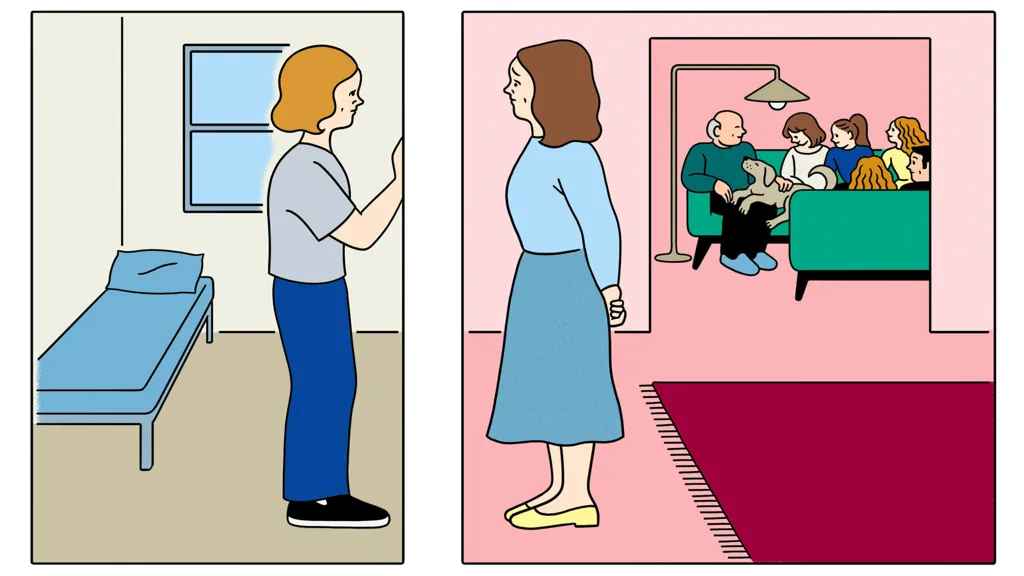
For clinicians, it's natural to consider family as a continuation of the institutions of care. Being part of a strong network of support could involve monitoring medications, late-night phone calls, transport to appointments, negotiating with landlords, providing emergency housing. But how to ask people to structure their lives around the person who destroyed the one they had?
Meanwhile, you have responsibilities to members of a traumatized family, yourself included. And you shouldn't agree to play a role that will leave you isolated from them. What you can do is talk with everyone in your new family about why you want to help your sister, and ask what, if any, emotional or logistical support they're willing to provide. The answer could be a little, or it could be none. The burden can't fall on one stressed sibling though. You care deeply for your sister. But you can wish her a better life without being in a position to help her build it.