There is no confusion about Donald Trump's intended endgame in Iran.
Tehran can do this the easy way -- wave a massive white flag of surrender -- or the hard way, enduring additional weeks of American-Israeli military and special operations designed to cripple its nuclear, missile and terror apparatus.
It is clear to me that this is what is in Trump's mind.
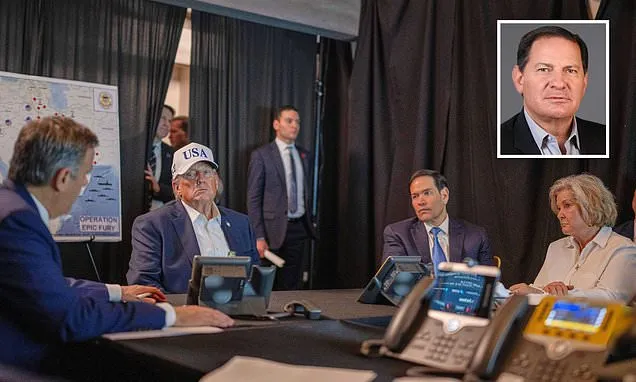
On Saturday, I spent about seven hours at Mar-a-Lago, moving between the lunch and dinner hours, watching the President circulate through the main dining room, conferring with senior advisers, listening to club members, and repeatedly disappearing into what has become an extraordinary feature of this presidency: a makeshift Winter Situation Room inside a gilded South Florida social club.
I have been there before during moments of consequence. This was unusual business as usual. Which is to say: Calm, focused, almost eerily steady.
There is a clear sense of purpose across this administration.
Destroy Iran's capacity to threaten the region and the United States and the planet with nuclear weapons, rein in its ballistic missile program, and neuter its terror network.
Regime change, in Trump's conception, is optional. If it happens, fine. If not, he will work with whatever 'regime 2.0' emerges -- much as he has tolerated unpleasant but transactional arrangements elsewhere.
On Saturday, I spent about seven hours at Mar-a-Lago.
An extraordinary feature of this presidency: a makeshift Winter Situation Room inside a gilded South Florida social club
It is hard to write this without sounding like a cheerleader. It is harder still to say it in this climate without being accused of violating journalistic norms. But the truth is the truth.
One of my closest friends -- a San Francisco Democrat who has long detested Trump with a kind of operatic intensity -- emailed me this weekend to say, half-jokingly, that the President belongs on Mount Rushmore. He used a word I never expected from him in reference to Donald Trump: 'hero.'
That is not a data point. It is an anecdote. But it captures something that could be shifting beneath the surface of our red-blue theatrics.
Beyond the partisan divide, there are real and legitimate questions about this conflict.
The failure to seek congressional authorization for what is plainly an act of war will be debated long after the smoke clears. The life-and-death stakes for innocent Iranians -- and for Americans and others who could be caught in reprisals -- are sobering. Escalation is not a cable-news abstraction; it is a human reality.
But those who insist this is a wag-the-dog adventure, a reckless spasm of ego, are missing three essential facts.
First, there is a broad swath of public opinion -- not unanimous, but substantial -- that believes Iran has pushed too far for too long.
Second, the president did not stumble into this. For months, he made clear that any agreement with Tehran must mean a genuine end to nuclear material production, along with ceasing its missile program and terror sponsorship. No enrichment sleight of hand. No diplomatic word games. As negotiations dragged and Iranian positions hardened, he concluded he was watching a familiar play: delay, deflect, deny.
And third, whatever one thinks of Trump, what unfolded over the weekend reflected planning, discipline and, yes, nerve.
Saturday night at Mar-a-Lago was a four-ring circus. In one wing, the president moved in and out of the Winter Sit Room, consulting military and political advisers. In another, a fundraising dinner for one of his campaign committees unfolded with the usual clatter of cutlery and donor small talk. On the lawn, a lavish wedding for the daughter of a club member shimmered under palm trees after a passing rain shower. And in the main dining room and on the patio, regular members ate Dover sole and discussed the fate of the Middle East.
It was Fellini meets Clausewitz.
Trump navigated all of it with the same measured demeanor. He did not look giddy. He did not look haunted. He looked settled, comfortable, and at home.
Which raises the inevitable question: Is that the composure of a sociopath or the steadiness of a man of steel?
His critics will say the former. His supporters, the latter. Watching him up close, I saw neither caricature. I saw a president who believed he had reached the end of diplomacy's road and had chosen his course.
He has resolved in this term not to spend four years playing whack-a-mole with Tehran -- reacting episodically to missile tests, proxy attacks, incremental advances. He wanted a reset, one way or another. Once he concluded that Tehran did not believe he would act, the decision, in his mind, made itself. This, for the president, is a war of existential necessity, not a war of choice.
History will decide whether this clarity was wisdom or hubris. Markets will render their own verdicts in the short term. Allies will posture, recalibrate, adapt. But there is no mystery about the goal.
No nukes. No proxies. No missiles. Negotiations if possible. Force continuing as necessary.
That is the off ramp for Tehran and, indeed, President Trump.
The rest is execution -- and fate.