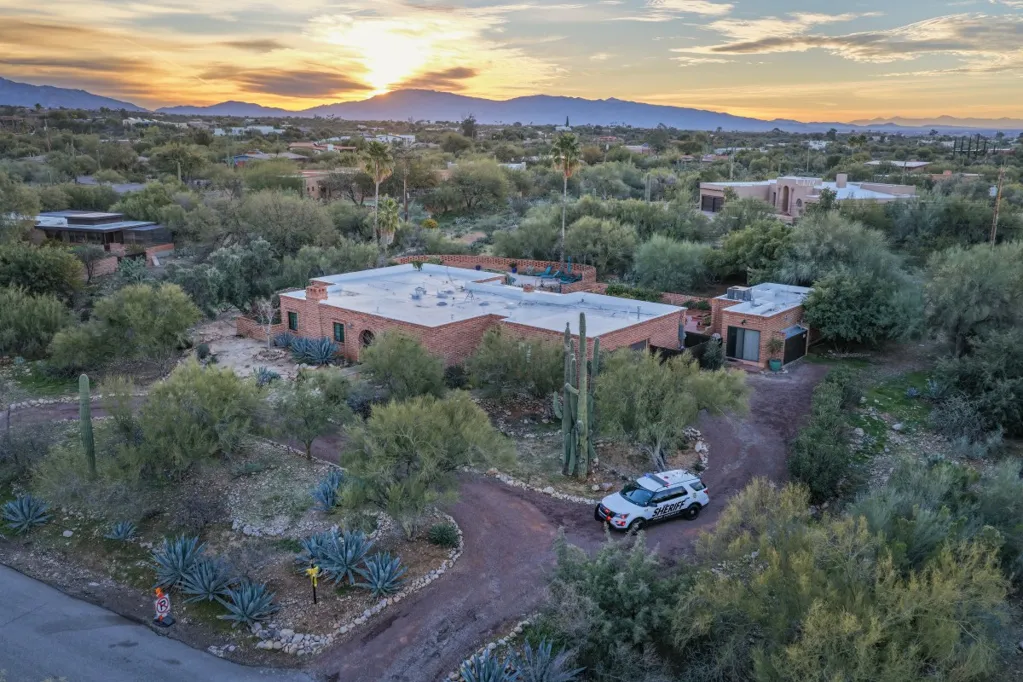
An expert on genetic genealogy has explained a significant issue that law enforcement face when using the investigative method to identify a suspect in the disappearance of 84-year-old Nancy Guthrie, the mother of Today co-host Savannah Guthrie.
The Pima County Sheriff's Office said last week that investigators were looking at inputting DNA evidence from the case into "genetic genealogy databases." That came after authorities said DNA from gloves found near Nancy Guthrie's home did not match any entries in CODIS, the FBI's national database.
CeCe Moore, the chief genetic genealogist at Parabon NanoLabs, told NewsNation on Sunday the DNA evidence in the case can only be uploaded to the smaller databases that allow law enforcement access.
She also noted investigative genetic genealogy, or IGG, would only lead to a suspect if law enforcement actually have a viable DNA sample from the suspect, which she said is a "big if."
"As long as you have a viable DNA sample, that you can create one that is workable for genetic genealogy from that, then it is eventually solvable. That person can be identified. Of course, there's a lot of caveats right now. Do they actually have the suspect's DNA or not? So that's a big if."
She was reported missing from her home on February 1 after spending the previous night with family, authorities said. Authorities believe she was taken against her will, and said her blood was found on her porch. Authorities have expressed concerns about her health because she needs daily medication.
On February 10, authorities released surveillance footage showing a masked man outside Guthrie's front door on the night she disappeared. The FBI later released a description of the person who they called a suspect.
IGG involved uploading DNA profiles to a genealogy database to look for possible relatives of the person whose DNA was found at a crime scene. Investigators can then build a family tree and identify possible suspects, as they did in the case of Bryan Kohberger following the slayings of four University of Idaho students in 2022.
Moore said that while more than 50 million people have taken consumer DNA tests, the three largest consumer DNA companies -- AncestryDNA, 23andMe, and MyHeritage -- bar law enforcement from comparing samples.
This limits investigators to three smaller databases -- GEDMatch, FamilyTreeDNA, and DNA Justice -- that together have under 2 million profiles.
"If they were able to get the DNA in those large databases with 25 million people, 12 million people, and so on, then it could be a very, very quick identification," Moore said. "In GEDmatch and FamilyTreeDNA, sometimes we get lucky, be quick, but it can also take a very long time."
Moore said most companies have never allowed law enforcement to access their databases, even in high-profile cases.
She predicted that if a warrant was served on the companies in either Nancy Guthrie's case or another, they "put up a fight to protect their customers' privacy."
Moore added those who have uploaded DNA to one of the larger companies can help in Guthrie's case by downloading their data and uploading it to a database that law enforcement can access.
"I'm trying to let people know if they want to help on cases like Nancy's, they need to download their raw data from those big companies and get them in one of the databases that we can actually access," she said.
Moore also said that identifying a suspect through genetic genealogy works fastest if they have deep roots in the country, since those populations are best represented in the accessible databases.
"Those are the people that have the most cousins in the database, right? Because their ancestors have been here for hundreds of years," she said. "So we're going to find a lot more of those second-, third-, fourth-, fifth-cousins and beyond than somebody who was born in another country."
As well as DNA recovered from the gloves, investigators also collected DNA from Guthrie's property that doesn't belong to her or those in close contact with her, the sheriff's department said.
Investigators also seized a Range Rover SUV from a restaurant parking lot near Guthrie's home. Former FBI agent Jennifer Coffindaffer previously told Newsweek investigators will be searching that vehicle for DNA evidence and seeking to match it to other DNA evidence in the case.
On Sunday, volunteer searchers reportedly recovered a backpack while searching an area not far from Nancy Guthrie's home.
The FBI said the suspect seen on the surveillance footage was a man about 5 feet, 9 inches or 5 feet, 10 inches tall with an average build. They said he was carrying a 25-liter "Ozark Trail Hiker Pack" backpack."
The Pima County Sheriff's Department said on Saturday: "All evidence from the crime scene and search warrant scenes has been submitted for analysis. Lab experts are working through that analysis. As with any biological evidence, there can be challenges separating DNA, etc. There are currently no updates regarding this process."
Savannah Guthrie said in a recent video posted on Instagram: "We still have hope and we still believe. And I wanted to say to whoever has her or knows where she is that it's never too late. And you're not lost or alone. And it is never too late to do the right thing. And we are here. And we believe in the essential goodness of every human being, that it's never too late."
Anyone with information is urged to contact 1-800-CALL-FBI (1-800-225-5324), 520-351-4900 or 88-CRIME or visit tips.fbi.gov.