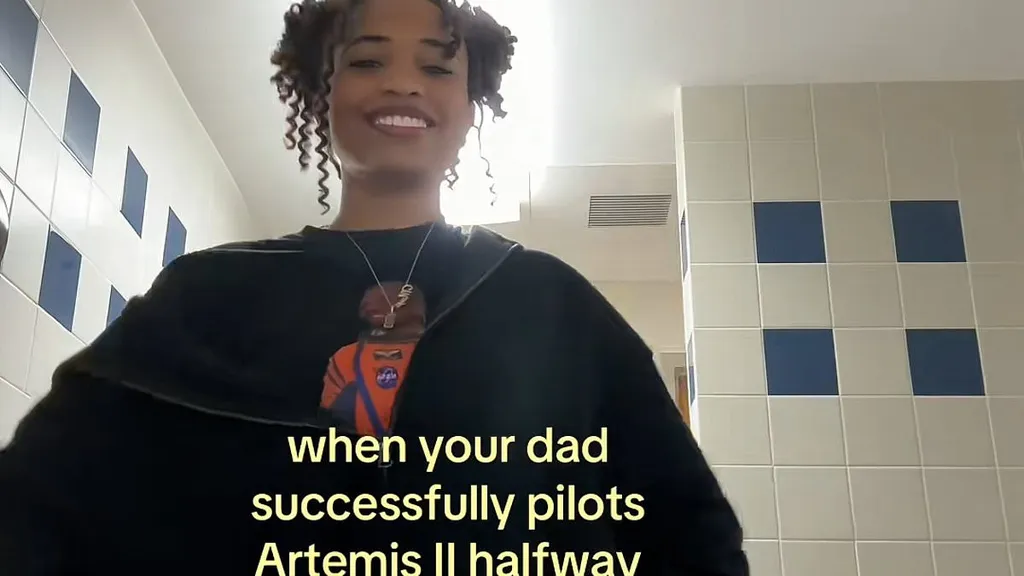
NASA Artemis II pilot Victor Glover's daughter has gone viral on TikTok after celebrating her dad's moon mission.
Mr Glover, alongside Reid Wiseman, Christina Koch, and Canadian astronaut Jeremy Hansen, is currently making the 250,000-mile (402,300 km) journey home after a successful lunar flyby.
In the video, his daughter, Maya Glover, 21, unzips a hooded jumper to reveal a T-shirt emblazoned with an image of her father before performing a dance routine.
She wrote: 'When your dad successfully pilots Artemis II halfway to the moon... & you forget the dance.'
In the caption, Ms Glover, who is currently a third-year architecture student at California Polytechnic State University, wrote 'supra astra, ad lunam' - which means 'above the stars, to the moon' in Latin.
The adorable tribute to her astronaut dad has now racked up 10.4 million views and over 12,000 comments on TikTok.
Space fans have rushed to express their support, with one asking how it felt to have 'the coolest dad in the Galaxy'.
Another added: 'When your dad says he loves you to the moon and back, he really means it!'
@mayalorinnn
Supra astra, ad lunam 💫 #VictorGlover #Artemis2 #NASA #fyp #trending
♬ original sound - Bellaa
Taking to her comments, gushing NASA enthusiasts have shared their love for Ms Glover's rocket man father.
'Your dad needs an action figure,' one commenter wrote.
Another added: 'Your dad is legendary. You officially win the coolest dad contest for all time.'
And one commenter chimed in: 'I wish my dad was this cool... mine just exists.'
Meanwhile, others shared their amazement over Maya's impressive claim to fame.
One impressed commenter joked: 'She wins two truths and one lie.'
One added: 'If my dad was an astronaut I would be insufferable.'
While another agreed, writing: 'Yeah, I would mention this in every conversation. You're going to the store? My dad went to the moon.'
Likewise, in an amazing show of support, some social media users even shared their own connections to the Artemis II mission.
'My cousin is Christina Koch so we lwk twins,' one commenter revealed.
'I thought it was pretty cool that my dad helped manufacture a part for the rocket,' added another.
While one commenter added: 'And my dad helped build the rocket he's on!'
In response, Ms Glover wrote: 'Tell your dad we said thank you!!'
Mr Glover has been married to his wife Dionna Glover for over two decades and has four daughters: Genesis, Maya, Joia, and Corinne.
During the buildup to the Artemis II mission, his family have shown their support by appearing at press conferences at the Kennedy Launch Centre, Florida, wearing matching shirts featuring their dad's picture.
This comes after the Artemis II mission completed its record-breaking lunar flyby and a nerve-jangling radio blackout.
Maya Glover (middle), 21, is currently a third-year architecture student at California Polytechnic State University
Over six hours, the Orion crew capsule passed around the far side of the moon at a distance of 41,072 miles (66,098 km) above the lunar surface.
Reaching a staggering distance of 252,756 miles (406,771 km) from Earth, the crew surpassed the distance achieved by the Apollo missions and set a new record.
However, the bulk of the moon briefly blocked our radio transmissions from Earth, causing a planned radio loss of communications with Earth for 40 minutes.
During the 'loss of signal', the astronauts continued along their pre-programmed flight path without real-time guidance from Mission Control, relying entirely on onboard systems.
Meanwhile, NASA's mission control, as well as friends and family back on Earth, anxiously waited for the capsule to reemerge.
Just before the crew disappeared behind the moon at 6.43 pm ET, Pilot Victor Glover shared a message for Earth: 'As we prepare to go out of radio communication, we're still going to feel your love from Earth.
'And to all of you down there on Earth and around Earth, we love you from the Moon. We will see you on the other side.'
Around 40 minutes later, the capsule reestablished a connection and, after a tense silence, NASA astronaut Christina Koch confirmed that all was well.
In a heartwarming first message after their short isolation, Ms Koch said: 'When we burned this burn towards the moon, I said that we do not leave Earth, but we choose it. And that is true.
'We will explore, we will build, we will build ships, we will visit again. We will construct five outposts; we will drive rovers; we will do radio astronomy; we will found companies; we will bolster industry; we will inspire.
'But ultimately, we will always choose Earth; we will always choose each other.'
Having passed the moon, the Orion crew capsule will now ride the tug of Earth's gravity back home over the coming days, with splashdown expected on Friday.
Their final ordeal will be a blazing re-entry into the planet's atmosphere as the capsule hits the atmosphere at around 25,000 miles per hour (40,200 km/h) before deploying its parachutes and landing in the Pacific Ocean.
Artemis II: Key facts
- Launch date: April 1
- Mission objective: To complete a lunar flyby, passing the 'dark side' of the moon and test systems for a future lunar landing.
- Total distance to travel: 620,000 miles (one million km)
- Mission duration: 10 days
- Estimated total cost: $44billion (£32.5billion)
- NASA Space Launch System rocket: $23.8billion (£17.6billion)
- Orion deep-space spacecraft: $20.4billion (£15billion)
Crew:
- Commander Reid Wiseman
- Pilot Victor Glover
- Mission Specialist Christina Koch
- Mission Specialist Jeremy Hansen
Mission Stages:
- Launch from Kennedy Space Centre Launch Pad 39B
- Manoeuvre in orbit to raise the perigee using the Cryogenic Propulsion Stage
- Burn to raise apogee using the Cryogenic Propulsion Stage
- Detach from Cryogenic Propulsion Stage and perform translunar injection
- Fly to the moon over four days
- Complete lunar flyby at a maximum altitude of 5,523 miles (8,889 km) above the moon's surface
- Return to Earth over four days
- Separate the crew module from the European Service Module and the crew module adapter
- Splashdown in the Pacific Ocean