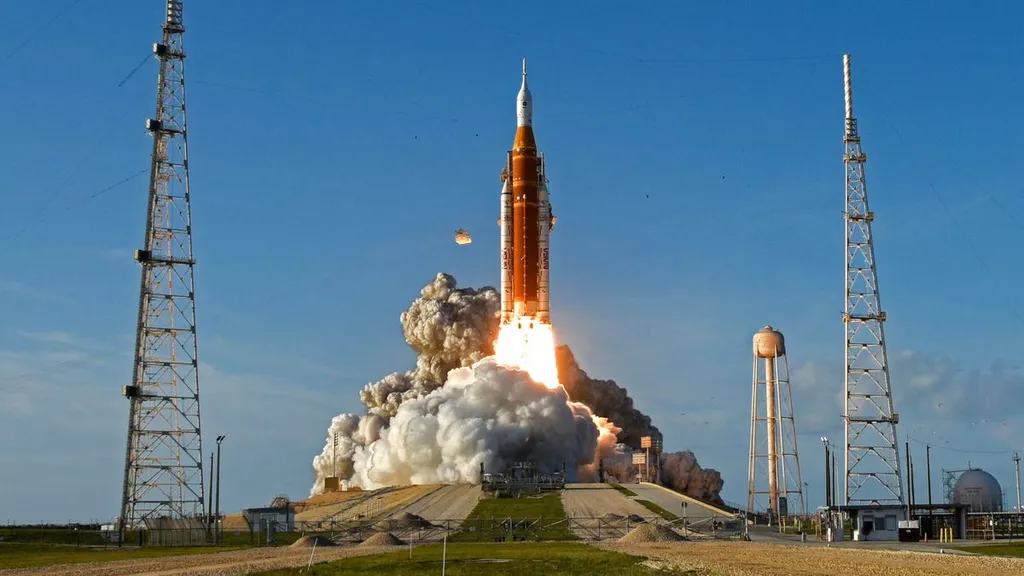
NASA's Artemis II astronauts were treated to a view of the full crescent phase Earth hours after the spaceship launched from the Kennedy Space Center in Florida.
The Artemis II mission is set to be on the far side of the moon within the next 24 hours, marking a trip further into space than anyone has ever gone, NASA Administrator Jared Isaacman told CNN.
The mission, which launched on April 1, aims to orbit the moon and circle its far side, which permanently faces away from Earth. Isaacman said during an interview that the lunar flyby is on track to happen on April 6, which USA TODAY previously reported will occur in a roughly six-hour window when the sun, moon and Orion spacecraft are aligned. It should give the crew a view of the moon that can't be seen from Earth.
NASA's Reid Wiseman, Victor Glover and Christina Hammock Koch, and Canadian Space Agency's Jeremy Hansen, are aboard the Orion spacecraft's 10-day flight, which will also help officials plan future Artemis program missions.
"I'd say we're focusing very much on the ecosystem, the life support system of the spacecraft. This is the first time astronauts have ever flown on this spacecraft before," Isaacman told CNN on April 5. "That's what we're most interested in getting data from. That's what's going to help inform subsequent missions."
Artemis III, planned for 2027, will send a crew of astronauts on the Orion spacecraft to test operations with one or both of the lunar landers being developed by Elon Musk's SpaceX and Jeff Bezos' Blue Origin, according to NASA. Officials will also use the mission to test space suits, known as extravehicular activity suits, for astronauts on the lunar surface.
Artemis IV includes a moon landing due to take place as early as 2028.
While the purpose of the current Artemis mission is to orbit the moon, CNN's Jake Tapper also asked Isaacman about a sci-fi favorite during the interview - alien life.
"Does the prospect of alien existence factor in at all into how we plan NASA missions?" Tapper asked.
"Our job here is to go out and try and unlock the secrets of the universe. And one of those questions is, are we alone?" Isaacman replied.
"So, I would say that is inherent in every one of our scientific endeavors or exploration endeavors," he added. "Even building the moon base on the South Pole of the moon, at some point, we'll be able to incorporate telescopes that will help us continue this great search, not to mention all the subsequent telescopes that we're going to launch."
Isaacman added that he hadn't encountered aliens in his two trips to space or seen anything to suggest the intelligent life forms visited Earth. However, he noted that the universe is vast.
"When you think about it, we got two trillion galaxies out there, who knows how many star systems within each of it?" Isaacman said. "I would say the odds that we will find something at some point to suggest that we are not alone are pretty high."
Artemis II toilet troubles resolved, NASA administrator says
NASA's Isaacman also reiterated that the toilet on the spacecraft is working normally following reports that the crew's onboard waste system briefly suffered "a controller issue."
The Artemis II crew is the first to have a toilet system on board a spacecraft set to orbit the moon; modern space toilets were not available during the Apollo missions, so those crews used a plastic bag to collect their fecal waste.
"Throughout the history of human space flight, going from the Mercury, Gemini, Apollo program(s) to...Orion, the toilet working is almost a bonus capability," Isaacman said. "We can do a lot of extraordinary things in space right now, but nailing this capability is one that we need to certainly work on."
There are "backups" built into the waste system, Isaacman explained, including different lines to ensure that it keeps working in case of an issue.
"Even when we have an issue with some freezing on the primary, the secondary has been working," Isaacman said. "So, believe me, the astronauts, they're okay right now, and they were well prepared for this situation."