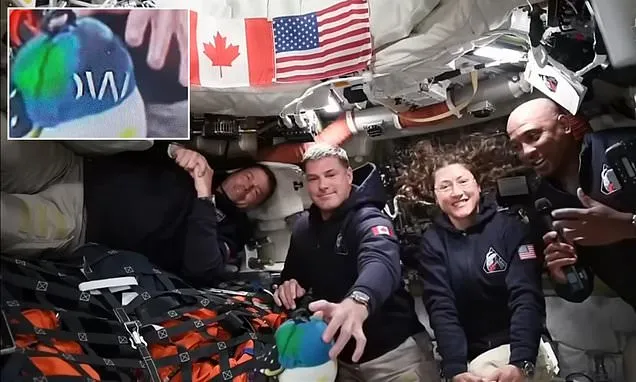
A NASA video has sparked a firestorm online, with conspiracy theorists claiming it 'proves' Artemis II is staged.
The crew gave a live interview to CNN over the weekend to discuss their journey to the moon while a plush toy named 'Rise' floated around the capsule as a zero-gravity indicator.
The video in question, filmed from a television screen by a smartphone, appeared to show unusual visual distortions with fragmented white text, including partial letters such as 'TAN' and 'OW,' flickering across the toy's head and body.
And some viewers quickly seized on it as supposed evidence of digital manipulation. 'It's fake. NASA has been misleading the American public since the '60s. Fake Apollo moon landing. Fake Artemis 2,' one user shared on X.
The viral clip, however, was not digitally altered but recorded from a television display with chromakey overlay processing active. Chromakey, commonly known as the blue- or green-screen effect, is routinely used by broadcasters to insert graphics, captions and lower-third text into live footage.
Live interviews routinely include graphic overlays added by the network, such as name banners, logos, and scrolling captions, which are digitally layered over the video in real time.
During the NASA interview, CNN likely displayed standard on-screen graphics identifying the astronauts and the mission.
When the viral clip was recorded from a television screen rather than taken from the original broadcast feed, the phone camera captured both the video and those graphics at slightly different refresh rates.
That timing mismatch can cause fragments of on-screen text to briefly overlap with bright or moving objects, such as the colorful plush toy, creating the illusion that letters were appearing directly on it.
The video in question, filmed from a television screen (RIGHT), appeared to show unusual visual distortions with fragmented white text, including partial letters such as 'TAN,' flickering across the toy's head and body
The Daily Mail has reached out to NASA for comment.
The strange letters likely came from standard on-screen graphics, such as name banners and captions, that networks routinely layer over live interviews.
When the clip was recorded from a television screen rather than taken from the original broadcast feed, the camera captured both the video and those graphics at slightly different refresh rates.
That mismatch can cause fragments of the on-screen text to briefly overlap with bright or moving objects, such as the colorful plush toy.
The original NASA and CNN footage shows the toy floating normally, without the flickering letters or distortions seen in the viral clip.
The Artemis II crew, which includes NASA astronauts Reid Wiseman, Victor Glover and Christina Koch, and Canadian astronaut Jeremy Hansen, is on their final approach to the lunar surface ahead of this evening's flyby, which will see it break the record for the farthest distance ever travelled by humans.
As part of the mission, the team will take photos and videos of the moon and record their observations.
But there will be a tense 40 minutes when the lunar surface blocks radio signals needed for the Deep Space Network to connect with the spacecraft.
During this time, there will be a communications blackout between mission control and the astronauts.
And it means that if something goes wrong, there is no way the astronauts can contact Earth for help.
'When we're behind the moon, out of contact with everybody, let's take that as an opportunity,' Artemis pilot Victor Glover previously told the BBC.
'Let's pray, hope, send your good thoughts and feelings that we get back in contact with the crew.'
At around 1.56pm ET, the crew is expected to surpass the record previously set by the Apollo 13 mission in 1970 for the farthest humans have ever travelled from Earth.
While the Apollo crew travelled 248,655 miles from Earth, Artemis II will reach a maximum distance of 252,757 miles.
The team will then commence seven hours of moon observations and will be able to get a close look at both the near and far sides of the moon.
Since room at the windows is limited, the crew will divide into pairs with two observing for 55 to 85 minutes while the other pair exercises or works on other tasks.
The most terrifying moment will come at 6.47pm ET when mission control will lose communication with the crew as Orion passes behind the moon.
During this time, the astronauts will make their closest approach to the moon. At this distance, it will appear about the size of a basketball held at arm's length.
NASA's mission control should re-acquire communication with the astronauts at 7.27pm ET
The crew will have another two hours of flyby observation before they begin transferring imagery and data to the ground.