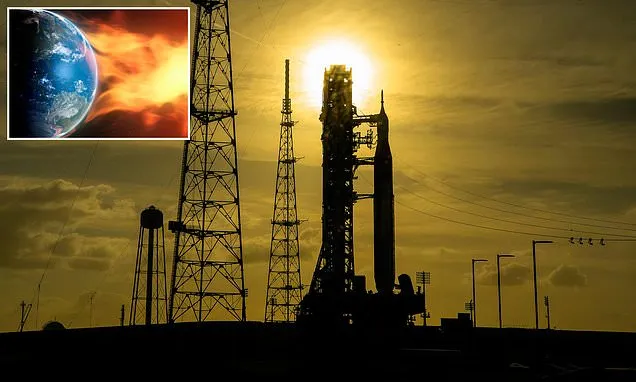
The threat of a solar flare interfering with the historic Artemis II moon mission is being monitored by NASA, which warned that extreme radiation could postpone the launch.
NASA's weather officer, Mark Burger, revealed on Tuesday that the sun has been unusually active lately in recent months, causing more moderate and strong flares to erupt without warning.
A solar flare is a sudden, powerful burst of radiation and light expelled from the sun's surface. These flares often come with coronal mass ejections (CMEs), which are huge clouds of charged particles that blast out into space at high speeds.
When these particles erupt in the direction of Earth and strike the atmosphere, they can damage power grids and cause blackouts, interfere with satellites and disrupt communication systems like GPS.
For a spacecraft launching into orbit and towards the moon, the flares create solar particle events, which act like a dangerous radiation storm that could strike the rocket, affecting onboard technologies and the crew.
Burger said that a strong solar flare erupted on Monday, but it would have 'no or minimal impact' on the Artemis II flight on Wednesday night.
Still, the space agency warned that there is a ten percent chance of a strong 'X-class' solar flare causing a sudden spike in radiation levels that would violate NASA's safety limits for an on-time launch.
Currently, the National Oceanic and Atmospheric Administration's Space Weather Center projects a 55 percent chance of minor to moderate flares on April 1, and a 15 percent chance of a solar radiation storm potentially affecting the launch.
A recent study discovered a massive shift in solar activity which scientists weren't expecting in 2025 and 2026.
Even if a solar radiation storm were to develop over Earth, NOAA said it would likely be an 'S1,' meaning the weakest level that only causes a small increase in radiation exposure. That would not force any kind of launch delay or endanger the crew.
However, solar flares are unpredictable and can send out clouds of high-energy protons that arrive minutes to hours later.
Currently, the sun is in the middle of an unexpected peak in its 11-year cycle of solar flare activity. Scientists have described this cycle as the sun's natural rhythm, where it slowly becomes more active for several years and then calms down again.
More activity means more sunspots, solar flares and potentially hazardous ejections of highly-charged material from the sun.
A previous study by NASA's Jet Propulsion Laboratory in California revealed that it appeared as if the sun was 'slowly waking up' after a long period of low activity.
After a weak cycle (number 24) from 2008 to 2019, the study published in the Astrophysical Journal Letters found the current cycle (number 25) was showing noticeably more activity.
'Solar forecasting makes terrestrial forecasting look easy, the sun is an entity that almost has a mind of its own,' Burger said during the NASA pre-launch press conference on Tuesday.
'The sun has become a little bit more active here over the last day, and we had a solar flare erupt. Should there be additional ones that will be something that we will have to monitor?'
Burger added that even if more solar activity was detected before Artemis II's scheduled launch at 6.24pm ET, NASA has a 'pretty high bar' to reach before radiation levels would scrub the moon mission.
Once Artemis II sets off for the moon, however, NASA said the four-man crew - NASA astronauts Reid Wiseman, Victor Glover and Christina Koch, and Canadian astronaut Jeremy Hansen - will be at risk if they encounter hazardous weather in space.
The Artemis II mission will be most sensitive to solar radiation storms once the Orion spacecraft leaves Earth's protective magnetic field.
The astronauts will have less natural shielding from those high-energy protons coming from the sun on the roughly four-day trip to the moon, and the four to five days it will take to return to Earth.
In the unprotected void of space, high radiation levels could raise the crew's lifetime cancer risk or even cause immediate health issues if a solar storm is strong enough.
The radiation can also damage spacecraft electronics or disrupt communications.
NASA and space weather experts, including NOAA, will be closely monitoring the sun for further eruptions this week. Moreover, the space agency has prepared the crew’s Orion spacecraft with built-in radiation shielding in case a storm disrupts the journey.
If a major solar storm is detected while the Artemis crew is in space, they can quickly build a temporary ‘storm shelter’ inside the capsule by moving stored equipment and supplies to create extra mass that blocks incoming particles.
NASA plans for the four-member crew to conduct this safety drill regardless of any space weather that may develop on the journey to the moon.
Emily Nelson, the mission’s chief flight director, said: ‘One of our test objectives is actually to set up the radiation shelter, so we’ll be doing that anyway, even without a radiation event.’
‘Basically, we’ve got a section of the spacecraft that we would set up for the crew to stay in that area until we give them the all clear that the radiation event has passed.’