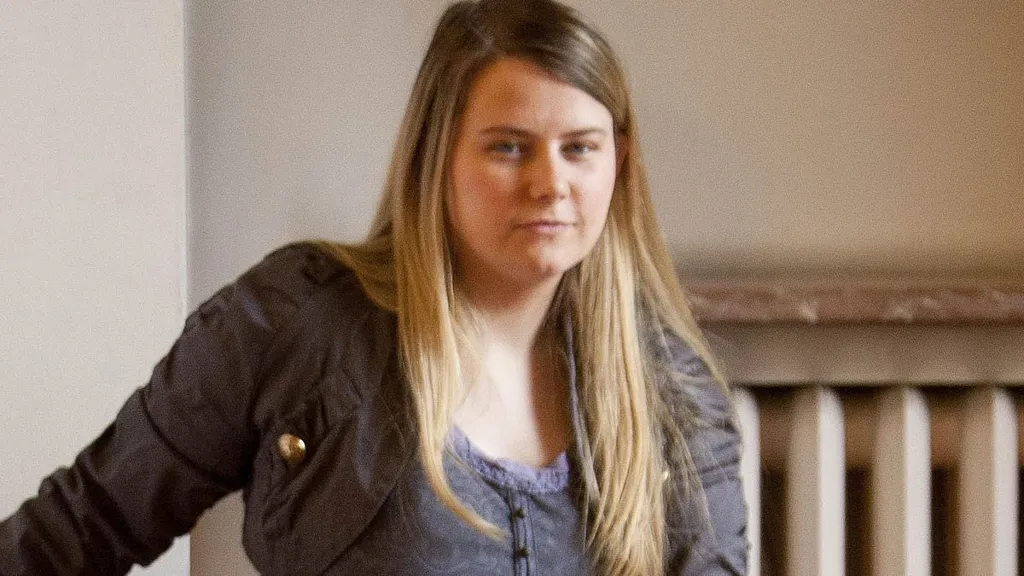
Natascha Kampusch was just ten years old when she set off for school, her mother watching her from the balcony as she always did to wave her goodbye.
It was the last time her mother would see her for eight years.
Natascha never made it to school. Instead, she was abducted on the street, shoved into a white van and taken to a basement dungeon by a paedophile who kept her locked up in his mother's home in Strasshof, a quiet suburb of Vienna.
Wolfgang Přiklopil, a technician in his 30s, beat, raped and starved her, keeping her in darkness in a five by five metre windowless cell beneath a garage.
The kidnapping took place on March 2, 1998, the very first time she walked to school alone.
In the decades after she escaped Natascha pieced back her life, but her family tragically revealed she is now suffering from serious health problems which have left doctors 'overwhelmed'.
Looking back on the fateful day years later, she recalled: 'I thought I don't want to pass him. I thought "that's strange, why is this person waiting there?" It didn't make sense.
'That's when I wanted to switch to the other side of the road just to be safe. But then I thought "no, I have to do this" so you can say, "Okay, you had the courage to walk past him."'
Natascha Kampusch was abducted aged 10 in 1998 by Wolfgang Přiklopil while walking to school in Austria and held prisoner in a secret basement cell.
Přiklopil, a technician in his 30s at the time who lived in his mother's home, jumped in front of a train at a nearby station after learning she had escaped.
As she lay in his van, she asked him what size shoe he wore.
'What was his shoe size? How old was he? Was he married with children? Why didn't he have children? I fired these questions at him,' she said.
'I knew from watching Aktenzeichen XY... ungelöst [an Austrian crime show] that you must get as much information about a criminal as possible.'
Recalling her first night, she wrote: 'I asked him to put me to bed properly and tell me a goodnight story.
'I even asked him for a goodnight kiss. Anything to preserve the illusion of normality. And he played along.'
Over the next eight years she attempted multiple suicide attempts as she was kept in the concrete cell, beaten up to 200 times a week until she heard her own spine snap and tied to Přiklopil while they slept together in his bed.
She was sexually assaulted, made to clean the house naked, beaten up if she spoke before being spoken to and repeatedly humiliated.
He shaved her hair, forced her to cook and hurled heavy objects at her.
Natascha was emotionally manipulated and told her parents refused to pay a ransom to take her back.
She was ordered to call Přiklopil 'My Lord' or 'Maestro' and kneel in front of him.
Reflecting on her captor, who wanted her as a 'beautiful Aryan servant', she believed he was craving attention.
Natascha pictured aged 10 before her kidnapping in 1998. Since her escape, she has recounted her ordeal in a book titled 3,096 Days which was adapted into a movie of the same name.
In her memoir, Natascha described the night he bound her wrists together and pulled her towards her in bed.
She thought she was about to be raped but instead, 'the man who beat me... wanted to cuddle'.
She described him as a 'loner' with 'no friends, no workmates; only his mother, and me', adding he was looking for 'a perfect woman or wife and a perfect life. He wanted to realise this dream with me'.
Přiklopil told her he would kill her if she tried to escape but she hatched a plan two years into captivity after having a vision of her 18-year-old self.
She told herself: 'I will get you out of here, I promise you. Right now you are too small. But when you turn 18 I will overpower the kidnapper and free you from your prison.'
Natascha was taken on 13 day trips, mostly to an empty rental flat, in her near decade imprisonment. They also went skiing at an Austrian resort and visited a chemist and a hardware shop.
And despite dreaming of breaking out she admitted she regressed to the age of a 'dependent toddler,' asking to be tucked in and read bedtime stories, unable to escape.
It wasn't until August 2006 that she fled, while Přiklopil took a phone call.
She sprinted from the house and begged passers-by to call the police. At first she was ignored until she banged on the door of a neighbour.
Realising she was gone, the rapist confessed to a friend before laying in front of a train track.
His headless corpse was later found on a railway line.
'I feel guilty because I brought about his death because of what I did,' Natascha later admitted, revealing she felt an affinity to him in what was branded Stockholm Syndrome by observers.
'I mourn for him,' she told the Guardian after his death. 'Had I met him only with hatred, that hatred would have eaten me up and robbed me of the strength I needed to make it through.'
Despite yearning for freedom for so long she struggled with the outside word and the attention from 'unpleasantly curious people'.
Years after her escape she bought the Strasshof house she had been locked up in as she wanted to stop it becoming a 'shrine for crazy fans'.
Despite the horrors of her captivity, she struggled to adjust to normality and was harassed by a stalker, sent hate mail including marriage offers and even abused by an old woman in the street in the years which followed.
Natascha was the victim of countless conspiracy theories claiming she was responsible for her imprisonment and accused of profiting financially.
Authorities investigated her kidnapping five times, with the help of the FBI, while her mother was dragged in front of court, accused of being complicit in her abduction.
One private investigator even accused her mother of murder.
'I had fled from an enemy and suddenly had tens of enemies, even thousands in some internet forums,' she revealed.
'For some people... I was a provocation. Possibly because they couldn't handle how I dealt with my kidnapping and imprisonment,' she wrote.
'Of course I was sexually abused, but the fact that I have spoken and written about it obviously isn't enough... Some people seem to think I have to recount every single detail,' she wrote.
'[Society needs] supposed monsters like Wolfgang Přiklopil to give the evil that lives in them a face.'
'They need pictures of cellar dungeons in order not to see all the violence hidden behind a bourgeois front and all those well-tended facades and front gardens.'
Her kidnapping was far from the only tragedy she has faced and she later revealed her parents would slap and insult her while she was a child.
She was a compulsive eater, depressed and lonely aged 10 and was dreaming about suicide in the moments before she was kidnapped.
It prompted the head of the commission investigating her capture to claim she had a better life in captivity than before.
Ludwig Adamovich was fined €10,000 for his comments after her mother sued him for defamation following his claim that her in the dungeon 'was always better than what she had known until then'.
And her mother Brigitta later admitted she considered suicide herself following allegations she was involved in the kidnapping.
But Natascha, now 38, pieced her life together.
The kidnap victim pictured in a recreated version of the small room where Přiklopil kept her for nearly a decade
She wrote a book about her kidnapping, was the subject of a film and even presented her own TV talk show - although she admitted freedom felt like a 'cage'.
But she is now in 'her own world' as she suffers from mental health issues leaving doctors 'overwhelmed', according to her family.
As her 20th anniversary of freedom beckons, she appears to be 'in a kind of prison again', her sister Claudia Nestelberger said.
In a new documentary, produced by Austria's public broadcaster ORF, she added: 'Everyone knows how Natascha used to speak in front of the camera. That's completely gone now.'
Her psychiatrist Ernst Berger admitted she has now regressed to a similar state to how she was immediately after her escape.
'Just as we, as her support team, made the decision back then to cooperate with her, that's how I see the situation now,' he said.