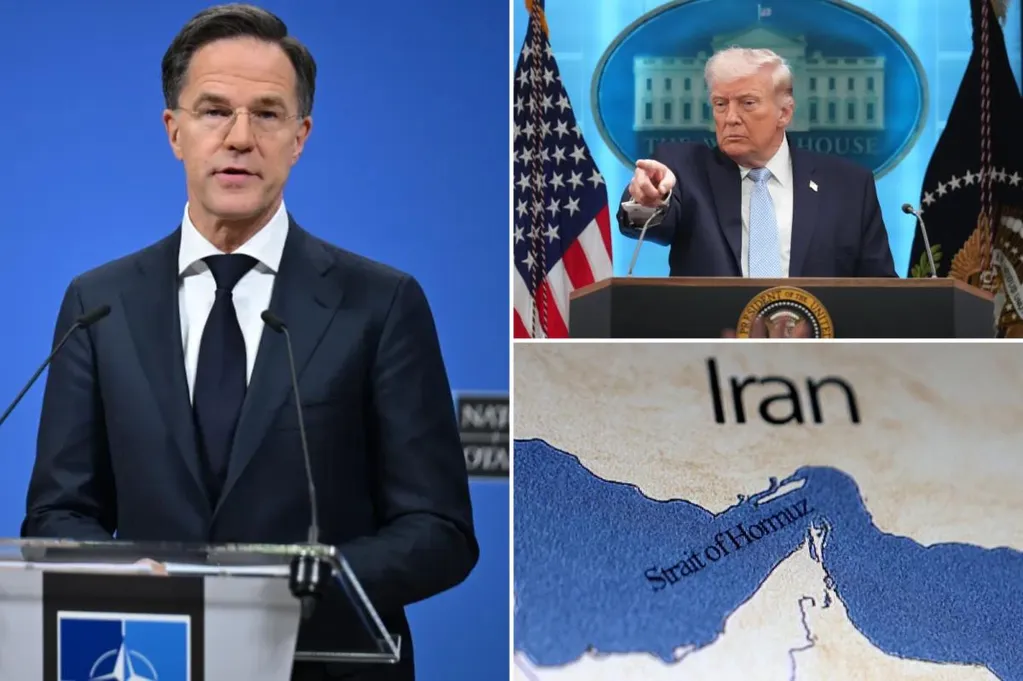
WASHINGTON -- NATO Secretary General Mark Rutte called out European allies for having an "unhealthy codependence" on the US dating back decades in a spirited address at the Reagan Institute's Center for Peace Through Strength.
Fresh off his "frank and open" conversation with President Trump on Wednesday about tensions within NATO, Rutte, 59, acknowledged that European powers rested on their laurels when it came to defense.
"[Some] European allies shifted away from decades of investing and conventional military partnership with [the] United States during the Cold War, in favor of an unhealthy codependence," Rutte said.
"[They were] so convinced that peace was permanent and didn't demand the investment we now know is essential," he went on. "Western European forces shrank and defense budgets shriveled into irrelevance over [reliance on] the notion that security was just a new norm and the United States would take care of any threats."
Rutte noted that Russian tyrant Vladimir Putin's provocations have been a major wake-up call and touted the steps that European countries have taken since the war in Ukraine to beef up their defense spending.
The so-called "Trump Whisperer" acknowledged that "everyone in this room [has] a knot in their stomach about the future of the transatlantic alliance," but tried to reassure the audience that positive change is coming.
"This alliance is not whistling past the graveyard," Rutte declared. "I recognize we are in a period of profound change in the transatlantic alliance. Europe is assuming a greater and fair share of the task of providing for its conventional defense."
Following his meeting with Trump, 79, on Wednesday, Rutte confided in European allies that Trump is expecting NATO allies to make solid commitments on assisting with reopening the Strait of Hormuz within days, Reuters reported.
"The Secretary General is in contact with Allies about his discussions in Washington," NATO spokesperson Allison Hart said in a statement to The Post.
"It's clear that the United States expects concrete commitments and action to ensure freedom of navigation in the Strait of Hormuz."
Since the crisis around the critical oil chokepoint began, Trump has publicly called on "countries of the world that do receive oil through the Hormuz Strait must take care of that passage."
"NATO WASN'T THERE WHEN WE NEEDED THEM, AND THEY WON'T BE THERE IF WE NEED THEM AGAIN. REMEMBER GREENLAND, THAT BIG, POORLY RUN,PIECE OF ICE!!!" Trump fumed in a signed Truth Social post on Wednesday.
"None of these people, including our own, very disappointing,NATO, understood anything unless they have pressure placed upon them!!!" he lamented Thursday.
Trump's broadsides against NATO are just the latest flashpoint in friction with the 32-member bloc, following tension earlier this year over the president's pressure campaign to acquire Greenland, which is controlled by Denmark, a member of the group.
Rutte acknowledged that Trump has been "disappointed" with NATO allies for not being more helpful during the crisis in the Strait of Hormuz, where over a fifth of the world's seaborne oil flows through annually.
But he also contended that the bulk of the alliance has been helpful with assets such as minehunters, frigates, and radar technology.
"NATO will be willing to play a role in a possible Strait of Hormuz mission if it is able to," Rutte said.
The NATO honcho who went viral last year for referring to Trump as "daddy" after the president lashed out at Israel for striking Iran.
"On the daddy thing, this is a language problem," Rutte said. "I was not calling him my daddy, but saying -- but of course, 'daddy' has also a special connotation, and I have to stay with this for the rest of my life."
"Yeah, you make mistakes. And this is [what happens] when you are not a native speaker," he added. "I have to live with this for the rest of my life."