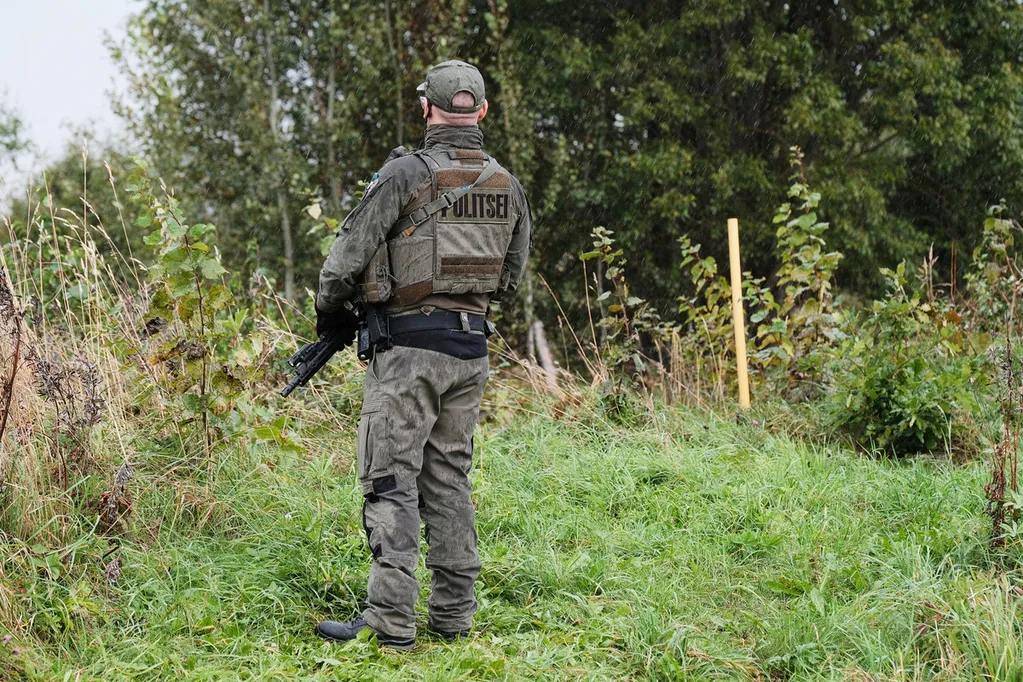
NATO nation Estonia has doubled down on longstanding pledges to defend its territory if Russian troops set foot on alliance soil.
"When the 'green men' cross our border, we shoot at them," Jonatan Vseviov, a top official in Tallinn's foreign ministry, told Germany's Welt newspaper. "It's simple."
Newsweek has reached out to the Russian Foreign Ministry for comment via email.
The term "green men" was coined shortly after Russian troops, dressed in green uniforms, were spotted in Crimea in 2014 as Russian President Vladimir Putin moved to annex the peninsula from Ukraine.
Russia initially denied the soldiers, armed with Russian weapons and heard speaking with Russian accents, were its own troops and said they had joined local "self-defense groups." Russian President Vladimir Putin then claimed roughly two weeks later that the "recent events in Crimea" had showcased Russia's military prowess.
NATO countries on the eastern flank are generally more worried about the prospect of an attack by the Kremlin than alliance members further away from the Russian border and have fervently backed Kyiv in its war effort against Moscow since February 2022.
Some NATO officials and public intelligence assessments have suggested Moscow may try to take territory from a Baltic state in a small-scale land grab to test how NATO responds, particularly if a future peace settlement is reached in Ukraine. Russia has dismissed suggestions it has plans to invade other European countries as "nonsense."
Estonia, which spent decades under Soviet rule, has stormed ahead with defense spending to beef up its armed forces and is expected to dedicate more than 5 percent of its GDP to the military this year while other countries in NATO wrestle with reaching the alliance's much lower target.
NATO members have agreed to spend 3.5 percent of their GDP on military kit by 2035, plus an additional 1.5 percent on related costs like making sure roads and bridges can bear the weight of tank convoys.
But the Baltic states -- Estonia, Latvia and Lithuania -- are already building bunkers and laying obstacles designed to stop Russian military vehicles near the border, as well as issuing pamphlets on how the public should react in wartime.
"We are not a big country, but we are preparing," Vseviov said. "We will do everything in our power to keep the allies on our side to defend every inch of Estonian territory."
"It's also about making it clear to the other side: If you come, we'll shoot, and if you shoot with big weapons, then you'll hit all of us, including our allies," Vseviov said.
NATO members are collectively obliged to treat attacks on any member country as an assault on the whole alliance. This is meant to deter any adversary nations from attacking a part of NATO because it would have to face a response from all the alliance's 32 members.
Since the start of Russia's full-scale invasion of Ukraine more than four years ago, Ukrainian and Russian drones have violated the airspace of at least six NATO nations, including Estonia.
Russian drones and missiles entering NATO airspace have not been treated as attacks on the alliance so far.
Tallinn has accused Russian fighter jets of breaching its airspace on at least three occasions in the past year, most recently in March.