An elite team of Royal Navy divers is on standby to deploy to the Strait of Hormuz to help defuse Iranian mines blocking shipping lanes.
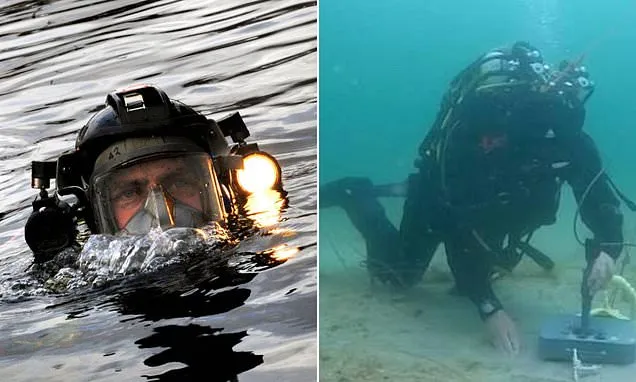
The divers are members of the Diving and Threat Exploitation Group (DTXG) and have one of the most dangerous jobs in the Armed Forces.
One of their roles is to clear mines and improvised explosive devices, which might be booby-trapped, deep underwater, often using only torchlight.
The highly trained divers can deploy into the area via boat, parachute, or in mini-submarines. The subs can carry up to six divers and have a range of up to 30 miles.
They also use a docking system attached to a Royal Navy Astute submarine.
The divers work closely with the Special Boat Service and are trained in counter-terrorist operations.
The divers have been on standby since the start of the conflict five weeks ago. Iran is believed to have placed up to a dozen mines in the strait.
Hundreds of ships are now effectively stuck in the area, through which around 20 per cent of the world's oil passes.
Members of the DTXG have also worked with Ukraine and the United States to help keep the Black Sea safe.
Iran has around 5,000 mines packed with up to 260lbs of high explosive, all of which are capable of destroying passing ships.
Some of the sea mines are detonated by contact, while others explode when a ship passes close by after detecting either a magnetic or acoustic signal.
Most of the mines are moored to the seabed on long cables and will float to just below the surface when they are activated.
Iran also has rocket mines, which are fixed to the seabed but will fire an explosive warhead into a ship passing over it.
Some of the Iranian mines can be fitted with a delayed activation, meaning they will not become operational for up to 30 days after being placed on the seabed.
US President Donald Trump has threatened to 'walk away' from the Strait of Hormuz.
Mr Trump said countries which get their oil from the Gulf region should take responsibility for the waterway, adding: 'That's not for us... that'll be for whoever's using the strait.'
A Royal Navy source said: 'It is unknown at this stage whether Iran has mined the strait but we need to be prepared for the worst-case scenario.
'Mine clearance is one of the DTXG's primary roles, so if necessary they will be used.'