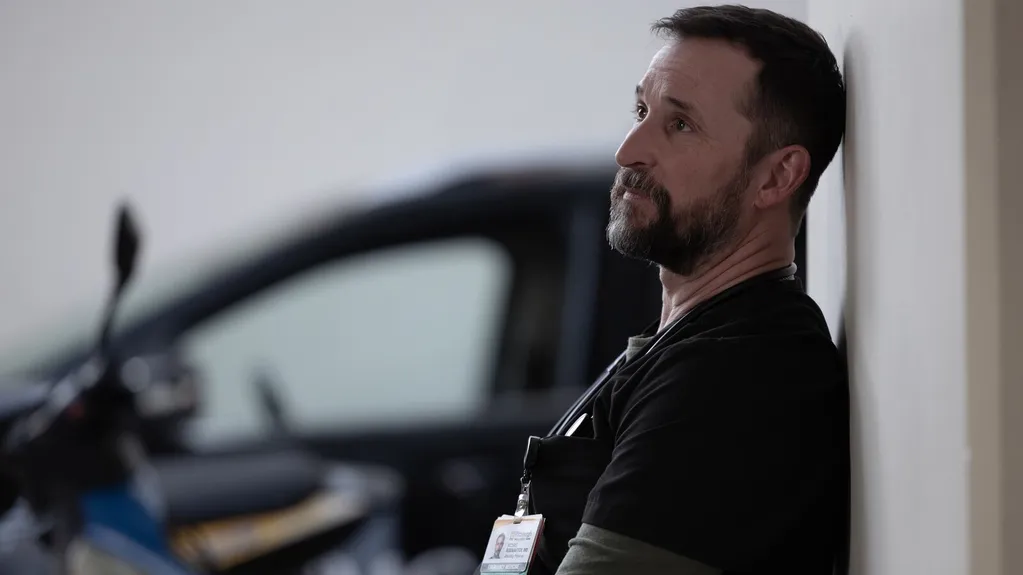
On top of the daily toll of treating patients, the show's medical providers bring their own scars to the E.R.
[This article contains spoilers for the Season 2 finale of "The Pitt."]
On the HBO Max hospital drama "The Pitt," the emergency room is a place for cowboys with "brass balls."
Take a risk and take charge. Reveal vulnerability? No.
So it's especially powerful when, in the Season 2 finale, the chief attending physician, Dr. Michael "Robby" Robinavitch (Noah Wyle), admits to Dr. Jack Abbot (Shawn Hatosy), a co-worker and longtime friend, that working in the E.R. is "killing me."
"I've seen so many people die that I feel like it's leaching something from my soul," Dr. Robby says. "I'm tired of feeling like I'm drowning every day."
For any devout follower of "The Pitt," it becomes clear over the course of Season 2 that Dr. Robby and other characters are struggling to "dance through the darkness," as Dr. Abbot would say. They are grappling with the aftereffects of moral injury, burnout and repeated exposure to death as well as the trauma that they've endured in their personal lives.
Dr. Robby appears to be experiencing post-traumatic stress disorder, or PTSD. And his intense, all-consuming job at the Pittsburgh Trauma Medical Center seem to be one of the ways he copes with the pain.
"What we're seeing in 'The Pitt' is all these characters who are suffering silently and not telling people that they are suffering," said Dr. Kayla Simms, an emergency psychiatrist and a lecturer at the University of Ottawa.
The thing about trauma is that no matter how you might try to squelch it, the old wounds keep resurfacing like an emotional Whac-a-Mole.
In a blink-and-you'll-miss-it moment this season, viewers see evidence that another character, Dr. Trinity Santos (Isa Briones), has scars on her thigh from self-injury (later in the season we see her stealing a scalpel from a supply closet).
In Season 1, viewers learned that Dr. Santos was sexually abused as a child along with a close friend, who died by suicide. Although Dr. Santos typically comes across as prickly and bold during her residency, inside she is consumed by feelings of guilt, shame and anger.
People who cut themselves often believe "that they're bad, they need to be punished, there's something awful about them," said Dr. Eric Bender, a psychiatrist with a private practice in San Francisco who has worked in psychiatric and medical emergency rooms.
Dr. Santos doesn't seem to have another outlet for her suffering. This type of quiet anguish is threaded throughout the DNA of the show.
Dana Evans (Katherine LaNasa), the charge nurse, feels unsafe at work after she is assaulted by a patient, but instead of addressing her fears, she remains constantly on guard, carrying a sedative in her pocket just in case another patient gets combative.
To avoid painful memories and anxiety stemming from trauma, people may also distract themselves with their jobs, said Dr. John M. Oldham, a professor emeritus of psychiatry at Baylor College of Medicine in Houston. Their work can bestow a feeling of self-worth.
"There's an insecurity that's sometimes lurking, that's sort of being overcome every day when you succeed at the next crisis," he said.
Dr. Robby, for example, is hesitant to walk away from his job despite the stress because the E.R. is the only place where he feels like he can function. For people like him, stillness can create anxiety. For those who have experienced prolonged trauma, the brain "starts to expect chaos," Dr. Simms said.
Dr. Robby has a long history of trauma and uncertainty. The audience learns for the first time in the season finale that he was 8 years old when his mother abandoned him.
And it's easy to forget that Dr. Abbot and Dr. Robby first appear together in Season 1 on the roof of the hospital, where Dr. Abbot is considering jumping. That night Dr. Abbot tried to save a veteran who was hit by a drunken driver in a crosswalk, only to watch him die in the E.R. We later learn that Dr. Abbot, himself a military veteran, is also grappling with other sources of trauma, like the death of his wife and the amputation of his leg.
"I must have had a reason at one time to keep coming back," Dr. Abbot says. "But I can't think of it right now."
"Because this is the job that keeps on giving," Dr. Robby replies. "Nightmares. Ulcers. Suicidal tendencies."
It's a foreshadowing of what's to come, starting with Dr. Robby's flashbacks, a hallmark symptom of PTSD. In Season 1, his mind abruptly shifts to memories of treating patients during the height of the pandemic and not being able to save his mentor, Dr. Montgomery Adamson, who died from Covid.
Throughout Season 2, Dr. Robby is dropping hints that he doesn't want to be alive. He's riding his motorcycle without a helmet, being purposely vague about when he'll return from his sabbatical -- if at all -- and confesses to Duke Ekins (Jeff Kober), his friend and also a patient, that "I don't know if I want to be here anymore. I don't know that I want to be anywhere anymore."
Even so, things end on a hopeful note.
Standing in a darkened room, cradling a baby who was abandoned in the hospital earlier that day, Dr. Robby speaks to the child as though he is addressing himself. Only this time, his narrative is one of kindness, not judgment.
"You're OK, you're safe," he says. "Yeah, you're not alone."
"I got abandoned too," he adds. "But I got through all of that, and so will you. I've got a good feeling that you're going to be just fine. Everything is going to be just fine."