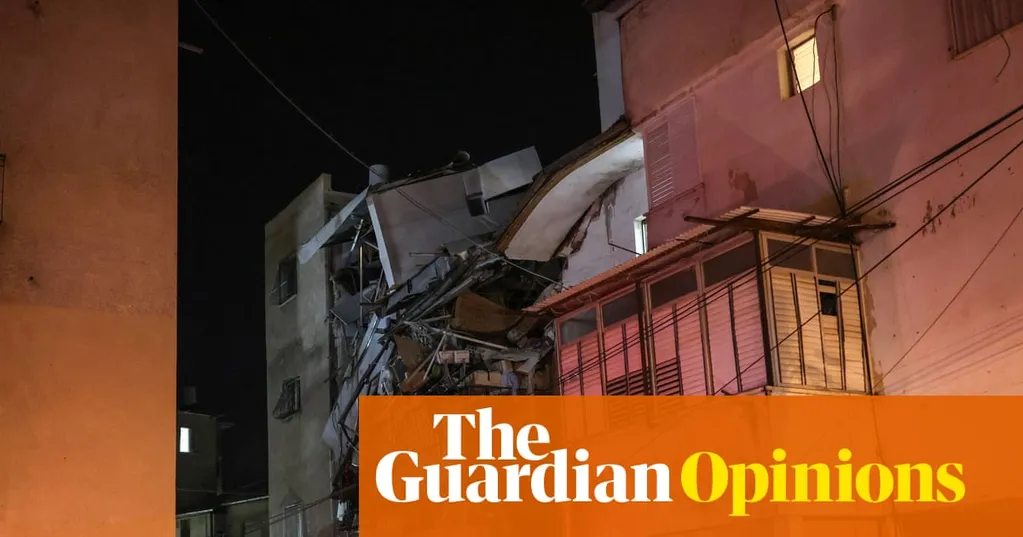
As Israelis grow weary of sheltering from missile attacks, their prime minister is using the war to distract from the Palestinian issue.
An opinion poll conducted in Israeli two weeks into its war on Iran, prosecuted together with the US, demonstrated what looked like euphoria: surveys by thinktanks such as the Israel Democracy Institute and the Institute for National Security Studies (INSS) show that nearly 80% of the public supported the war. Among Israel's Jewish population that figure rose to 91%.
The true picture is more complicated. The INSS also found that among Arab citizens, who are predominantly Palestinian and make up about 20% of the Israeli population, about two-thirds were opposed to the war. And reality is always more complex than polling figures: from Tel Aviv, I can see that the Jewish Israelis driving the sweeping support are simultaneously exhausted after what is now more than three weeks of running from missile attacks day and night, and by the economic, social and physical damage of the war.
There is also uncertainty about which war aims are realistic. In the first week, an INSS survey found that 22% of all Israelis thought the war would "completely collapse" the regime - in the second week, just half that number (the rest believed the war would cause moderate or low damage to the regime).
But beyond these daily difficulties and uncertainties, there are big, overarching reasons why Israeli Jews are so supportive of the war. First, there is a general, and typical, "rally round the flag" effect. But in the current situation, many Israelis also believe or hope that it is this war that will redefine their reality.
Israelis have been told repeatedly that Iran is a backer, funder and arms supplier of all threats to Israel - Hamas, Hezbollah, Houthis. Indeed Benjamin Netanyahu would have Israelis believe that Iran is actually the source of all hostility to Israel (and a threat to the world at large). There is little nuance to this view, which the Israeli government portrays in increasingly reductionist terms: Iran started all this hostility against Israel due to religious fanaticism and inexplicable hatred. Destroy the Iranian regime, and the threat to Israel is over. Commentators and analysts regularly tell Israeli media that both Hamas and Hezbollah will be irrelevant shadows of their former selves once the Iranian regime falls.
Netanyahu has always preferred to focus on Iran, a stance that allowed him to prosecute Israel's case on the global stage, engage in geopolitics with great power leaders, and position himself as a credible statesman in the eyes of the Israeli people. Given that the Islamic Republic truly is a regime that sought to export radicalism, terror, destabilise and undermine neighbouring states, he had a case.
But Netanyahu's embrace of the Iranian threat always served a double purpose, as a conscious and permanent deflection away from Israel's occupation of the West Bank and Gaza, and Palestinian right to national self-determination. He does not believe that either of these things exist. At best, in his view, Palestinians are not a nation with political rights, but a security problem to be contained.
In a press conference during this war (and in his highest-profile speeches well before that), Netanyahu reiterated that Iran "built an 'axis of evil' with terrorist armies of Hezbollah, Hamas, the Houthis, the Assad regime, and others". Again, Iran certainly cultivated these actors, but portraying Hamas as merely an extension of Iran reinforces the Israeli tendency to pretend there is actually no Palestinian issue - just hostile external anti-Israel actors.
In addition to Netanyahu's conscious framing, the war against Iran and against Hezbollah in Lebanon is helping Israelis deflect away from the Palestinians, simply by omission. The war is all consuming in the media, between the military analysis of both fronts, speculation about the US's next steps, and sober coverage of the home front, from missile damage to civilian hardships.
In underground shelters in homes, hotels, malls, train stations, the national theatre and the Tel Aviv municipality, Israelis of all kinds hide from barrages at all hours. In these shelters, I have rarely heard any discussion of politics - highly unusual for politically gregarious Israelis. People seem too sleep-deprived, too focused on getting through the next barrage, their business losses, or juggling jobs while children have no school, to think about the issues that will remain long after the war with Iran is over.
And under the cover of war, Israel is making the situation for Palestinians far worse. Capitalising on the fury in Israel after 7 October, and current wartime distraction, Israel's own religious fundamentalists and their ultranationalist fanatic political partners in government, backed by the army, have gone wild in the West Bank. Last week, Israeli border police mowed down a family, killing the parents and two children in front of the two surviving kids; settlers allegedly terrorised a Palestinian village, beat women and children and sexually assaulted a village man. Week after week, settlers and the army steal hundreds of sheep - the livelihood for the poorest Palestinians in the region.
Gaza is stuck in purgatory; Israel occupies more than half of the land, and the rest is controlled by a resurgent Hamas, battling armed gangs supported by Israel. More than 100 children had been killed since the ceasefire began last October and January; but Israelis had convinced themselves the war had ended.
The Palestinian issue will not go away. Until Israelis see through the convenient perspective that toppling Iran's regime will solve all of its problems, and refocus on addressing actual Palestinian claims to self-determination through diplomacy, no stunning outcome in Iran will give Israel the peace it claims to want.
Failing that, even crushing Iran's capacities will not end the ongoing cycles of violence in Israel and Palestine, nor change the fact that suppression, crackdowns, violence and denial of a national group's existence will make them cling to it with greater determination. This makes their struggle more enduring, and drives greater willingness to suffer losses until they achieve recognition and self-determination.
No one can claim that Palestinian statehood will somehow solve all problems. But ending this miserable cycle through the natural right to self-determination for Palestinians, enjoyed by other nations of the world, will go a very long way to ending the greatest source of hostility against Israel, right here at home.