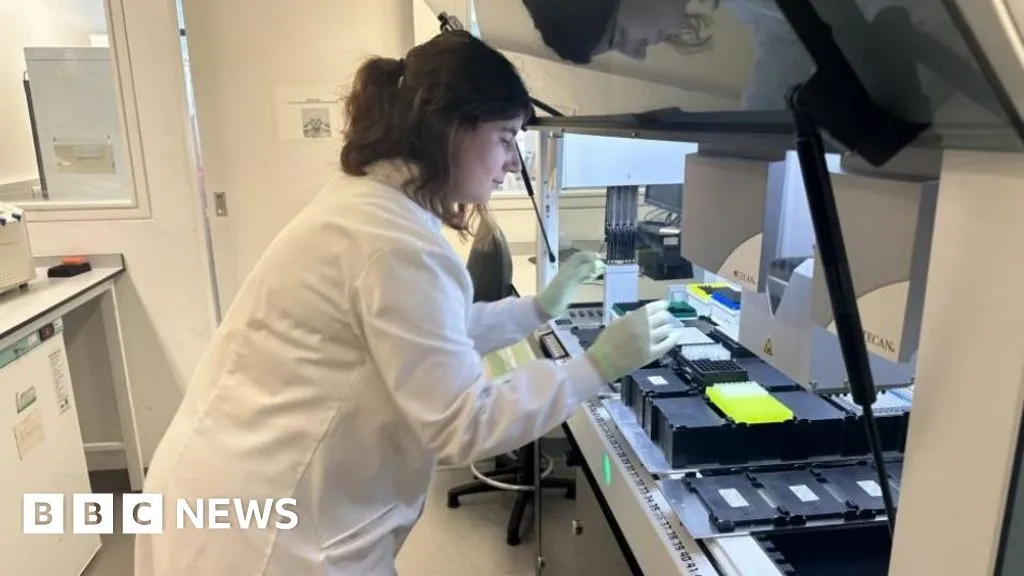
A pioneering test is improving early diagnosis for people with hereditary cancer caused by a genetic condition.
Just over 30 years ago, Carol Coughtrey was diagnosed with bowel cancer and a blood test found she had Lynch Syndrome - an inherited condition linked with cancers, some of which can show no symptoms.
She went on to take part in a pilot programme involving a urine test and designed to spot faulty DNA, and a number of other cancers were revealed for which she received treatment.
Sir John Burn, professor of clinical genetics at Newcastle University where the test was developed, described it as a "revolution" which could save hundreds of thousands of lives.
"We bring in the urine sample, extract the DNA, it goes into the machine, amplifies the bits we are interested in, puts them in the computer and bingo, you have a result," he explained.
"If we do this test at the same time as people are having their bowel checks we can send them a postal kit.
"Then from anywhere in Britain they can send us a urine sample which has got preservative so it will travel for at least a week in the post and we can extract DNA from the urine and we can check to see if there are any cancers in the urinary tract."
Sir John liked cancers to "criminals in our body".
"They are misbehaving cells dividing and just as we catch criminals by picking up their fingerprints so we're beginning to pick up cancers because they leave DNA behind," he said.
Carol took part in the pilot programme, and even though she had no symptoms the urine tests found signs of new cancers.
"I had to have a scan and they didn't know where the tumour was until that and it was on the kidney. I had the kidney removed.
"Then they did another test after that - bladder cancer," she said.
Further monitoring revealed she also had a lung tumour. All three cancers were identified because of her initial urine test.
Carol is not the only patient with hidden cancer which was successfully treated.
Sir John said: "One of the four people we treated was a man in his 40s.
"We found a small tumour in the tube connecting his kidney to his bladder and they went and destroyed it with a laser without damaging the tube."
He described the new tests as "the beginning of the liquid biopsy revolution".
"In the future we'll be extracting DNA from saliva, from urine, from blood and checking for cancers," he said.
"The point is finding these things when they're tiny, when they haven't spread, when they can be fixed without a major operation.
"One in two of us are going to get cancer - most of those cancers are inside where you can't see them, so this is part of that revolution of finding them before they get to you."
For Carol, taking part in the test has given her years with her family she might not have otherwise seen.
"I'm still alive to see my grandchildren growing up," she said.
"If I hadn't had this study done and detected I wouldn't be here.
"What else can you say apart from it saved my life?"