Pubs in Newcastle say they are seeing more and more artwork they believe to be designed using artificial intelligence (AI) from breweries - and have refused to display it. What does the rise of AI mean for independent artists who rely on design work for income?
Simon Hubbard runs The Mean Eyed Cat in Newcastle city centre and says he noticed "a spate of breweries who are just coming out with this absolutely dreadful AI slop", mainly the older and more established ones.
"You can just tell, it looks overly polished, overly perfect," he says.
"Hands always look really weird on it."
And Hubbard is not the only one.
Following conversations with the Free Trade Inn, in Ouseburn, the two venues came together to announce on social media they would no longer be accepting AI art, including on bottles and pump clips, in order to try to protect local artists from losing out on work.
Hubbard says it is one of the most viewed Instagram posts the pub has made.
"Who are you going to offend? The robots?" Hubbard laughs.
"People are going to be put out of work because of it.
"And I know AI is doing that to a lot of jobs, but you would really have thought the creative sector would always have a space for creative people and ingenuity."
Hubbard says artists such as Drew Millward helped him work through his thoughts about AI and its impact on creatives.
From north-west Yorkshire, Millward has worked with breweries all over the world and has been working with Leeds-based Northern Monk for the better part of a decade.
"It will have an impact on our livelihoods collectively within the creative sector," he says.
AI software is trained on millions of human-made images scraped from the internet, which artists argue leads to the software stealing and regurgitating their work.
Millward adds while he is yet to see his own work fed back to him by AI, he has friends who have been forced to defend their work because AI has been trained using it.
"Call it what it is, stolen artwork," Millward says.
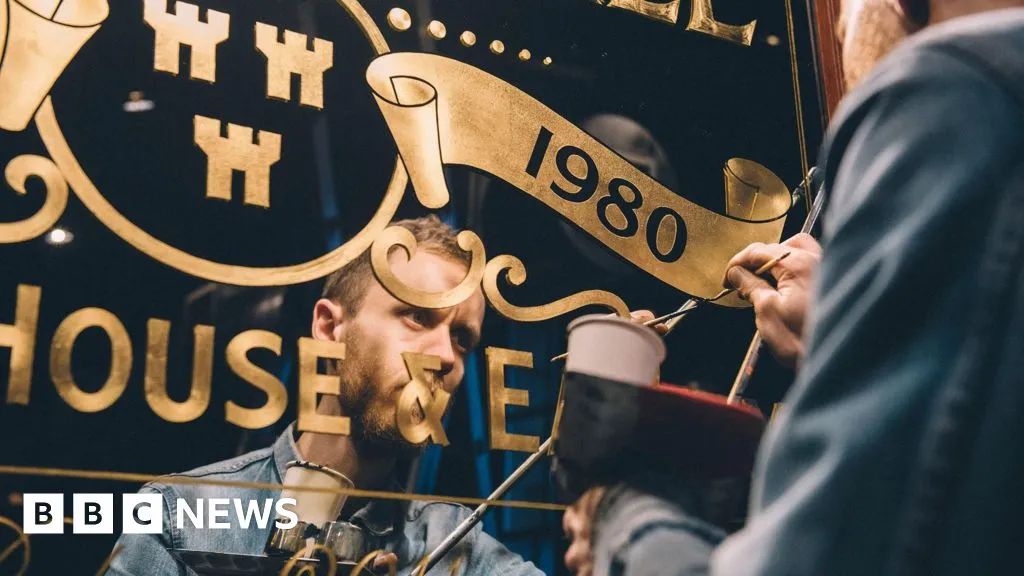
Durham-based Ashley Willerton has worked as a lettering artist for about 12 years, often working with pubs including Town Wall in Newcastle and Bridge Vaults in Sunderland.
While Willerton acknowledges there is a rise in the amount of AI he is seeing, he believes there will always be a demand for independent artists, no matter how much cheaper the alternative is.
"I feel like there's hope because of that, but there's also the aspect of hope because I've had really amazing clients to this point that have chosen me, when they could have got a much easier solution and potentially cheaper solution," he says.
Willerton argues establishments which have always "cut corners" will continue to do so, but independent businesses will carry on supporting artists.
"It doesn't matter how good AI gets, that's not the point," Willerton says.
"The point is it will always lack a human touch, it might be technically better than a human can produce, but it doesn't mean it's going to be as meaningful.
"It's not me saying that it's definitely not going to ruin the industry, but I do have that hope that art has prevailed this long, I just don't think AI is a big enough match to win."
Reece Hugill owns the Newcastle-based brewery Donzoko and believes using local artists is about being part of a community.
"If I was to use ChatGPT for my designs rather than our designer Sean, that’s taking money out of the local area into the hands of a multibillionaire," he says.
"That is removing value from the local community and local artists [and] into the hands of some of the richest people in the world]."
Hugill adds local people know about local tastes, how the people in Newcastle like to drink and what they like.
"A computer does not know that, as much as they pretend," he says.
But for Hugill, it also raises the question of quality across a business.
"If you're cutting corners in how things are presented, where else are you cutting corners? Is it the ingredients, as well is it the way you pay your staff?" he asks.
Since putting out the Instagram post with the Free Trade Inn, Hubbard is hopeful for change.
"The outreach has been pretty big and if it's made one or two breweries think or rethink what they're doing, that's a good thing," he says.
And Millward thinks more businesses should be putting out similar statements of intent.
"It shouldn't be on the consumer to have to interrogate every single image that they see," Millward says.
But he adds, "I have huge amounts of hope for the future, in as much as you can see that it's crumbling already".
And it is a sentiment shared by Willerton.
"I have to believe that good art will prevail."