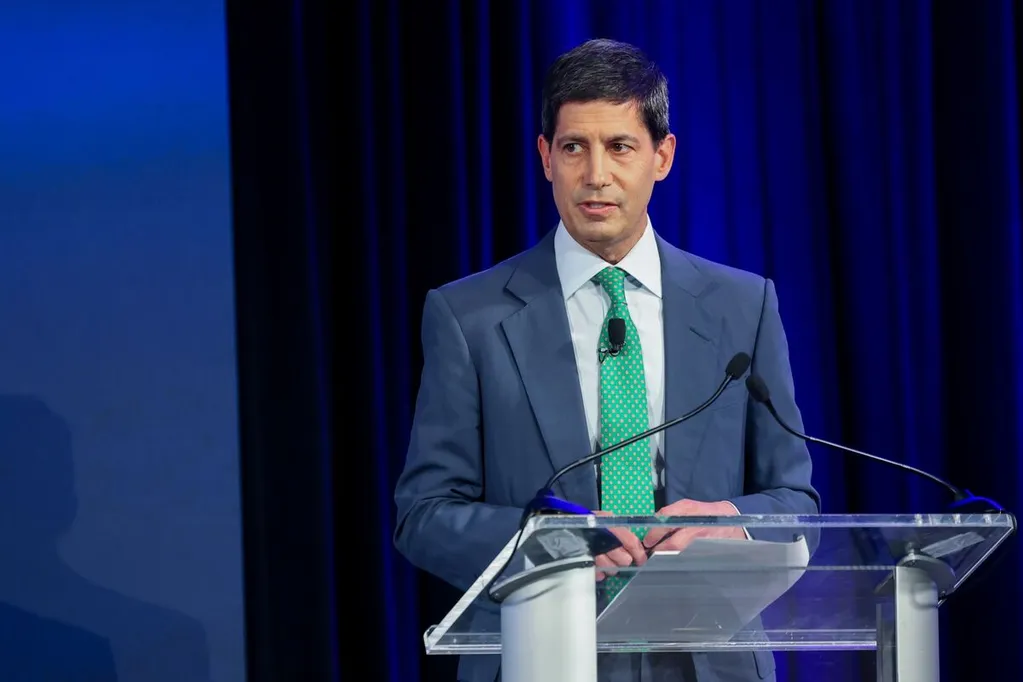
Warsh's views on inflation and employment will be closely watched, with some investors expecting him to prioritize inflation over employment, while others see him as potentially supporting lower interest rates due to rising productivity.
Bond traders who've grown more optimistic about an end to the Iran conflict see their next catalyst coming from Capitol Hill, where Kevin Warsh will face questions as President Donald Trump's pick to lead the Federal Reserve.
A brief reopening of the Strait of Hormuz and the promise of renewed US-Iran peace talks sparked a rally in Treasuries to end last week, with traders boosting their expectations for a Fed interest-rate cut by year-end. The US two-year yield, which had been trading above the central bank's current ceiling of 3.75% amid the war-related surge in oil, once again dipped backed below it as crude receded.
The big move Friday was "justified because the rates market was still pricing in higher energy prices amid an above target inflation backdrop which would constrain the Fed," said Priya Misra, portfolio manager at JPMorgan Asset Management, which has been adding inflation-sensitive longer-dated securities to portfolios. "If oil prices continue to fall, the market can start pricing in gradual Fed rate cuts."
Even as developments in the Middle East continue to set the tone for Treasuries -- including new uncertainties around the status of Hormuz that arose over the weekend -- Tuesday's Senate confirmation hearing for Warsh has market-moving potential.
Just before the US-Israeli attack on Iran in late February, Treasuries had been rallying in part on the prospect that Warsh -- who voiced support for lower interest rates before gaining Trump's nomination at the end of January -- would push for easing monetary policy later this year.
Any sense that he'd be inclined to stick to that view and look through the war-driven energy shock may further juice wagers on cuts, and boost rate-sensitive short-dated Treasuries. Caution on inflation, though, might spark a reversal.
"A key question for markets is how heavily Warsh will advocate rate cuts," said a Morgan Stanley team including Michael Gapen and Lingdi Xu.
Calming Down
Yields on US Treasuries had settled into a range in recent weeks after shooting higher in the first weeks of the Iran war amid the spike in oil prices. A ceasefire and rising hopes for a peace deal have tempered those early losses, sending US 10-year yields drifting just under 4.25%.
Volatility has steadily eased, sending one measure of bond turbulence broadly back to near pre-war levels.
After pricing out expectations for 2026 rate cuts at the peak of hostilities, swaps as of Friday indicated roughly 50% odds of a change in Fed policy through year-end. That's still quite a contrast to the more-than-two cuts penciled in before the conflict.
Given this setup, bond investors will be keenly focused on whether the Fed under Warsh's watch is going to prioritize inflation over employment. For some investors, the rise in oil, coming at a time when inflation is already above the Fed's 2% target, justifies keeping rates higher for longer -- even as pressures ease.
"The Fed should be on the sidelines for the rest of the year, unless we get a negative employment surprise," said Jack McIntyre, portfolio manager at Brandywine Global Investment Management, who has been underweight Treasuries. "It wouldn't be a good look for Warsh to come in with dovish guns a-blazing and very few to join along" on the rate-setting policy committee, he said.
Hawk or Dove?
Warsh has said rising productivity supports lower rates. But his reputation as an inflation hawk during a stint as a Fed governor from 2006 to 2011 suggests he won't minimize that part of the equation, said George Catrambone, head of fixed income at DWS Americas.
"He's going to be very attentive to inflation and that's exactly what the market will want to hear," he said. Catrambone favors shorter-dated Treasuries such as two-year notes, which still yield more than the fed funds effective rate.
Before Friday's rally, strategists at Wells Fargo & Co. warned that Warsh's comments at the hearing "could easily disrupt the prevailing view that he is a rate dove," noting that options markets are underpricing potential moves around the hearing, setting the stage for volatile trading in Treasury yields.
What Bloomberg strategists say ...
"A Warsh-led Fed would ideally reinforce downward pressure on terminal rate expectations, supporting duration and rate-sensitive assets over the medium term. Yet in the near term, persistent inflationary pressure looks set to keep front-end yields elevated and limit the pace of any bull steepening, particularly if incoming data fail to meet the high bar currently required to justify deeper cuts."
At Vanguard, Brian Quigley, a senior portfolio manager, says the firm added to their Treasury holdings due between two and 10-years amid last month's peak in yields.
"As long as you're confident the Fed's not likely to hike, owning two's is attractive," he said, adding that Vanguard's modest overweight in Treasuries out to the 10-year area can work in the event of either a resolution or escalation of the conflict.
Weighing Risks
Speaking last week, Cleveland Fed President Beth Hammack said interest rates are well positioned and she saw "risk that we might need to be more accommodative, or more restrictive, depending on how the data comes out." New York Fed President John Williams said high uncertainty should prevent policymakers from providing any strong guidance on the future path of rates.
On Friday, Governor Christopher Waller said the Fed may need to stay on hold for a prolonged time "if the risks to inflation outweigh those to the labor market," due to the energy shock triggered by war in Iran.
Morgan Stanley's Gapen reckons Warsh will probably keep the door open to rate cuts later this year, citing the current de-escalation of the Iran war as creating only a temporary uptick in inflation.
"That said, we do not believe he can be too dovish on the path for interest rates given the concern it may provoke over Fed independence," Gapen said. "Every new Fed chair feels some degree of pressure to prove their inflation-fighting credibility, and Warsh will likely be pressed on situations that he believes would warrant higher policy rates."
What to Watch
- Economic data:
- Apr. 21: ADP weekly employment change; Philadelphia fed non-manufacturing index; Retail sales; business inventories; pending home sales
- Apr. 22: MBA mortgage applications
- Apr. 23: Chicago Fed national activity index; Initial jobless claims; S&P Global US manufacturing, services and composite PMIs; Kansas City Fed manufatcuring index
- Apr. 24: Bloomberg April US economic survey; U. of Mich sentiment and inflation expectations survey; Kansas City Fed services activity
- Fed calendar:
- Federal Reserve observes external communications blackout ahead of April 28/29 policy meeting
- April 21: The Senate Banking Committee holds a confirmation hearing for Kevin Warsh, President Trump's nominee for Federal Reserve chair
- Auction calendar:
- Apr. 20: 13-, 26-week bills
- Apr. 21: 6-week bills
- Apr. 22: 17-week bills; 20-year bonds