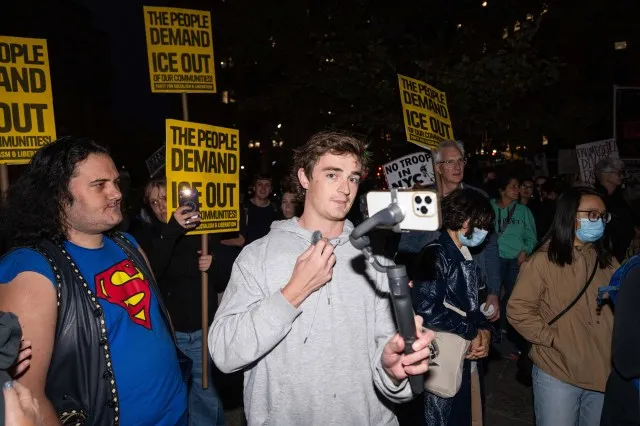
It is hard to believe that a young independent journalist could produce content that would lead to weeks of news coverage and dramatically change the conversation in both the social media and traditional media worlds. But Nick Shirley has done it. Beyond the stories Shirley has uncovered, his reporting provides a glimpse into how journalism may be conducted in the years ahead.
Shirley's reporting about possible fraud in Minnesota's day care industry helped initiate the flood of federal immigration officers into the state. That in turn led to days of demonstrations, the shootings of two protesters, and fraud investigations. It also led to Minnesota politicians such as Gov. Tim Walz (D) and Mayor Jacob Frey (D) turning up the rhetorical heat against federal law enforcement, sounding much like 1861 Confederates in the process.
Trump administration officials have also engaged in fiery speech, further exacerbating the confrontation. And now leading congressional Democrats are threatening to cut funding for the Department of Homeland Security because of perceived overreach by ICE enforcement officers.
All of this news because of one enterprising, independent storyteller who was unafraid to take on a story that touches on the multiple flashpoints of immigration, ethnicity and government ineffectiveness.
Shirley's reporting has undoubtedly uncovered important information about fraudulent use of taxpayer money. It has also exposed the inability or unwillingness of politicians and government bureaucrats to prevent or even stop the abuse.
Shirley's disclosures have sparked sociopolitical conflict that is uncomfortable for the nation to monitor, forcing to the surface debates about immigration enforcement, citizen protests, and federal versus state jurisdiction. This has made for real news -- exactly the kind of watchdog news expected when the nation's framers created a free and independent press.
Shirley, at just 23, would seem an unlikely person to change the course of the nation's news agenda. He has no apparent training in journalism. His formal education ended at his high school graduation. His venture in Minnesota was not his first endeavor into activist journalism; he has been on the scene at protests in Portland, drug dealing in New York City, and various other ICE operations. Shirley even participated in a White House roundtable last fall discussing antifa.
But Shirley's work in Minnesota generated the most traction, demonstrating the increasing power of social media journalists. For his efforts, he is now the target of threats and has had to hire security to protect himself.
He has also been criticized in some established media circles for his lack of credentials and whether he is qualified to engage in real journalism. The First Amendment, however, allows all Americans essentially to be journalists. The free press right is not confined to journalism school graduates or traditional reporters with official press cards. Any citizen can contribute to the public sphere of information, which Shirley and countless other contributors are now doing through various digital means.
In fact, a report by the Poynter institute indicates that one-third of America's journalists are now considered "creator journalists," posting self-publishing content independent of established news outlets.
These self-publishing content providers may lack brand names, but they bring an independence that would be difficult to muster working under the direction of media executives in corporate towers. Providers such as Shirley are on the ground interacting with real people and, indeed, changing the trajectory of the nation's news. That independent streak resembles America's early days when patriots, such as Samuel Adams and Thomas Paine bypassed colonial authorities' pressures to fuel America's dialogue for independence.
Establishment media outlets no doubt wring their hands about the increasing toehold of independent journalism creators. But the corporate media establishment should consider its own missteps that prompted citizens to leave the news audience, thus opening the door for alternative information sources. A Gallup survey late last year showed Americans' trust in traditional news outlets has dipped to a new low of 28 percent.
The influx of independent journalists such as Shirley will certainly add to what is already a sort of "wild west" in today's reporting landscape. News consumers will have to up their media literacy game to carefully scrutinize news content and sources. The expansion of the reportorial terrain, though, is perhaps what America needs in what is becoming a "post-news" era, so people such as Shirley can broaden a news agenda that once was the purview of only mainstream news outlets.