The spreading violence is moving ever closer to Lagos, which is responsible for around a quarter of the country's output, and surrounding states that have largely been spared from extremist attacks.
Nigeria's security crisis is moving southward toward the country's commercial capital, with jihadists and armed gangs threatening parts of the West African nation as yet largely untouched by decades of roiling violence.
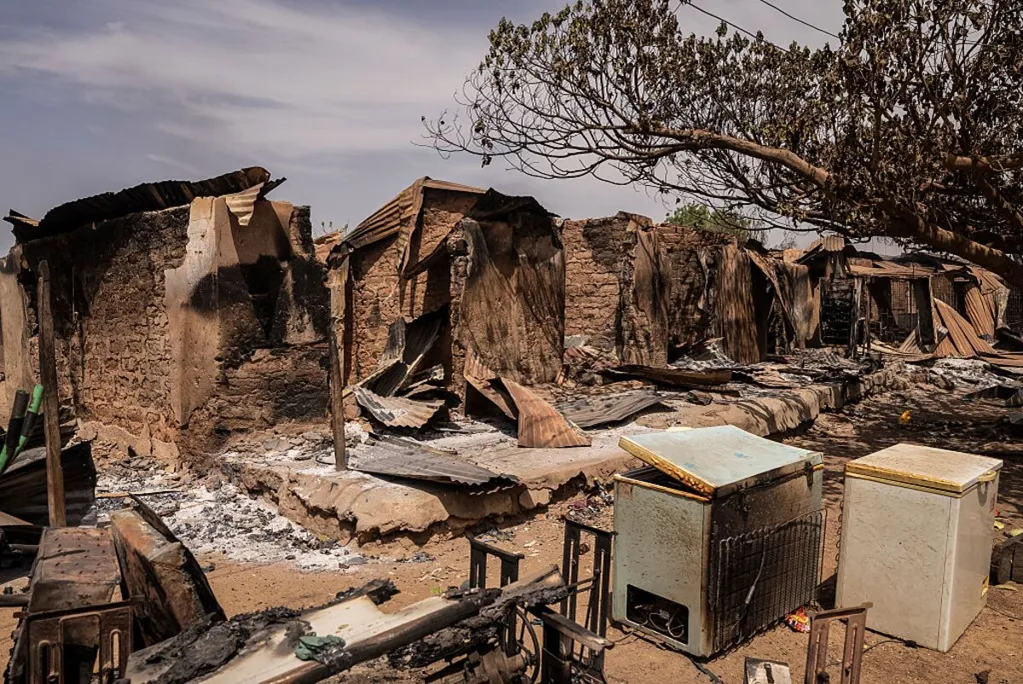
The gruesome murder of more than 160 people in a village in the central part of the country last week highlighted the fundamental shift in the nature and geography of the insecurity crisis facing Africa's most-populous nation. The increased attacks come even as President Bola Tinubu declared a security emergency and the US deployed troops to the nation after it conducted a series of strikes on Christmas Day.
"This multi-front security environment is stretching the military and security agencies thin," said Fola Aina, political scientist at the University of London's School of Oriental and African Studies. "The result is a reactive security posture rather than a preventive one. Armed groups are exploiting mobility, local networks, and governance gaps faster than the state can respond."
Nigeria's insecurity has tended to be regional in nature -- jihadists in the northeast, bandits in the northwest, separatists in the southeast and communal violence in the center. But now those groups -- particularly the Islamists and bandits -- are converging in the central region, traditionally a buffer zone that now threatens the commercial capital Lagos.
It's also embroiling neighboring Benin, a vital trade artery in the region, as Nigerian extremist groups increasingly converge with those that have wreaked havoc in Mali, Niger and Burkina Faso for more than a decade.
Benin now "risks developing into a third pole that connects the Lake Chad conflict and Sahel conflict," said Kars de Bruijne, researcher at Clingendael Institute, a Dutch think-tank, referring to the Nigerian region where Boko Haram and other jihadist groups are active. One implication is that "extremist groups are likely to grow further" and will pose long-term threats to both countries, he said.
Like the Boko Haram insurgency in Nigeria's northeast that grew out of an ungoverned forest area, the myriad groups in the central region have commandeered a national park that stretches into neighboring Niger in the north and Benin in the west. All of the groups have taken advantage of gaps in the Nigerian state, which doesn't fully control large swathes of the country.
Security incidents in and around the Kainji National Park surged to 151 events in 2024 from just nine four years earlier, according to the Clingendael.
The spreading violence is moving ever closer to Lagos, which is responsible for around a quarter of the country's output, and surrounding states that have largely been spared from extremist attacks and the kidnapping-for-ransom crisis engulfing the country. Earlier this year, bandits thought to be involved in illicit mining killed five park rangers in Oyo state, near Lagos.
"If insecurity continues to move southward into Nigeria's economic heartlands, the implications will be significant for national stability and growth," said Aina, the political scientist.