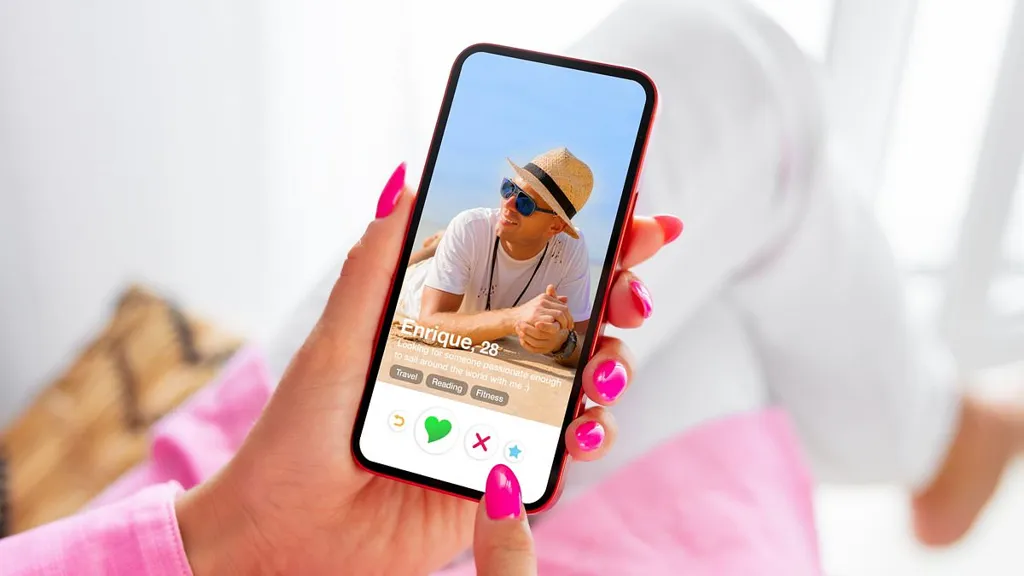
If you've been struggling to find a match online, you'll be happy to hear that scientists have pinpointed where you might be going wrong.
One of the most tempting tactics is to list all your best qualities - for example, being 'kind, outgoing, funny and dependable'.
While removing these from your profile might sound counterintuitive, scientists say you should do just that.
Instead, they suggest the secret to finally bagging a date is including a story on your profile.
Telling a tale about yourself creates empathy and connection and attracts more interest from potential dates, the research says.
'We are fascinated by stories, yet we write our dating profiles like shopping lists,' author Gurit Birnbaum, a psychology professor at Reichman University in Israel, said.
'It's not height or ambition that makes someone fall for you, it's your entire story. But people can't feel that from bullet points.'
Telling a story can make you be seen 'as a fellow human being' rather than a 'mere commodity', the researcher added.
Scientists say that storytelling, rather than simply listing facts, can help get you noticed on apps like Tinder.
For their study, the team recruited 594 participants who were shown a range of dating profiles.
The profiles were either narrative and told a story, or were non-narrative and more list-like.
The first experiment involved showing two types of text profile. One included bare facts - that the person plays guitar, studies economics and likes to travel.
Meanwhile the other wove those facts into a story, describing how the person's grandfather had given them a guitar as a child and music became an important part of their life.
In the second experiment, participants viewed photo profiles. In the non-narrative profiles, the photos were taken in neutral settings, like a park or a street.
In the narrative condition, the photos showed the person going about their daily life, doing things like exercising, studying and spending time with friends.
In the third experiment, participants both read text and saw photos of potential dates.
Analysis revealed that, overall, participants had more empathy for the potential dates when they read or viewed the narrative profiles. This, in turn, predicted greater romantic interest.
As part of the experiment, participants viewed photo profiles. In the non-narrative profiles, the photos were taken in neutral settings, like a park or a street.
In the narrative condition, the photos showed the person going about their daily life, doing things like exercising, studying and spending time with friends.
Tips for singletons
- Rather than listing facts on your dating profile, weave them into a tale
- Don't use bullet points
- Include photographs that show you going about your daily life - for example exercising, studying or spending time with friends
Professor Birnbaum said the findings are good news for people who feel burned out by the transactional nature of online dating.
'By humanizing profiles and encouraging genuine emotional engagement, storytelling actively counters the objectifying nature of online dating platforms,' she said.
'It can motivate date seekers to view potential dates as fellow human beings rather than mere commodities and foster a sense of connection in an otherwise detached medium of online dating.'
The study, published in the journal Psychology of Popular Media, was inspired by the success of storytelling in advertising.
'These findings demonstrate that the inherent self-promotion in dating profiles, similarly to product marketing, is substantially enhanced by incorporating storytelling -- a strategy that fosters deeper initial connection and perceived closeness between potential partners even before they contact each other,' it concludes.
The researchers explained that when people become absorbed in a story, they are transported from their present existence into the narrative plot.
During the 'critical' initial stage of dating, when people are browsing profiles, they are forced to navigate an overwhelming number of options.
'Profiles that can distinguish themselves and favourably capture attention are more likely to transition to actual contact,' they said.
Your browser does not support iframes.
They added that storytelling in profiles can convey intelligence, creativity and willingness to invest in a relationship.
'Our research reveals that how people present themselves may be as crucial as what they choose to reveal, especially when it offers and more authentic alternative to problematic self-promotion strategies,' they said.
'By humanizing profiles and encouraging genuine emotional engagement, storytelling may actively counter the objectifying nature of online dating platforms, motivating date seekers to view profiled individuals as fellow human beings rather than mere commodities.'
Last week, a separate group of scientists revealed that your choice of profile photo on dating apps can have implications for how you're perceived.
Some of the photo types are obvious - those who choose photographs where they are out and about in nature are hoping to convey an active, healthy lifestyle, the researchers said.
The 'casual poser' photo, which shows someone looking in a different direction, can make you seem spontaneous and friendly, they explained.
Meanwhile someone wearing glasses might be trying to conceal a part of themselves, by using them as a form of protection. Those who use a generic 'screensaver' picture - for example an image of a quote or landscape - are likely to be older.
However the ones who use 'nothing to hide' images, which feature a high degree of nudity, could unwittingly be signaling a desire for casual hookups.
How did online dating become so popular?
The popularity of mobile dating apps such as Tinder, Badoo and more recently Bumble is attributable to a growing amount of younger users with a busy schedule.
In the 1990s, there was a stigma attached to online dating as it was considered a last-ditch and desperate attempt to find love.
This belief has dissipated and now around one third of marriages are between couples who met online.
A survey from 2014 found that 84 per cent of dating app users were using online dating services to look for a romantic relationship.
Twenty-four per cent stated that that they used online dating apps explicitly for sexual encounters.
The rise in smartphone use has also gone hand-in-hand with online and app-based dating, making it more acceptable.