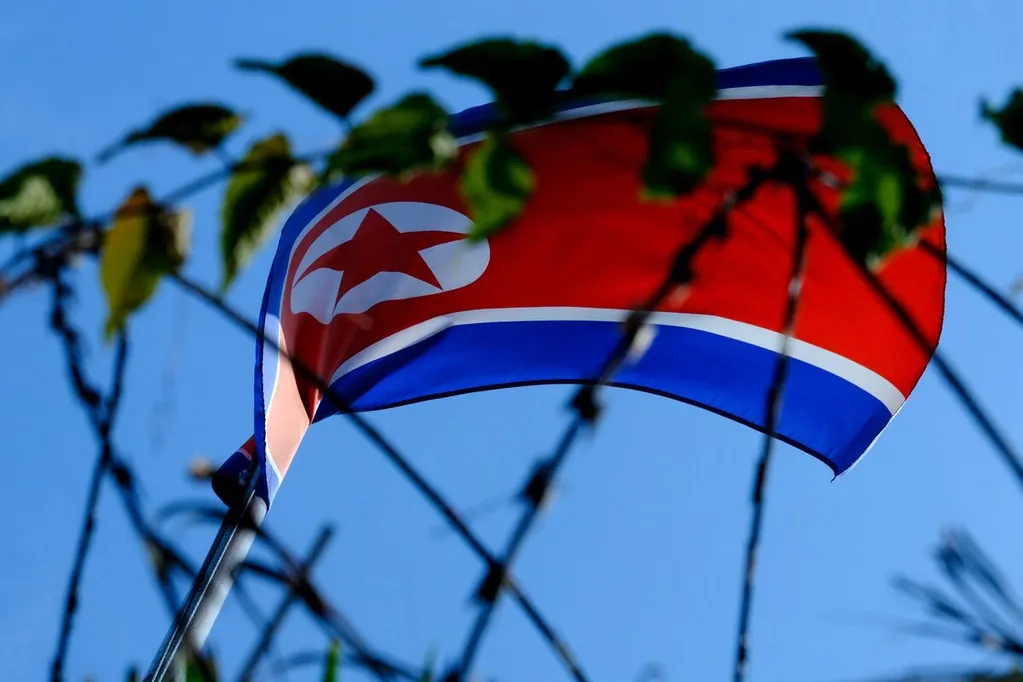
North Korea launched an unidentified ballistic missile eastward, Yonhap news agency reported, citing the South Korean military.
Yonhap did not elaborate further on the nature of the launch in its report. North Korea launched multiple short-range ballistic missiles toward waters off its eastern coast on April 8.
Leader Kim Jong Un has pushed for improvements of North Korea's arsenal including missiles and other weaponry -- a push he has characterized as a deterrent to US aggression.
President Donald Trump said Iran has agreed to suspend its nuclear program indefinitely, fueling optimism that a deal to end their war is in reach after Tehran announced the Strait of Hormuz was open again.
In a Friday phone interview, Trump asserted that any moratorium on Iran's nuclear activities would not expire, saying it would be "unlimited."
Balance of Power
"Most of the main points are finalized. It'll go pretty quickly," Trump said. He also denied that the US would release any frozen funds to Iran -- a key demand of the regime that he and his supporters have long decried.
Details of any potential deal remained murky and Iran has yet to comment on Trump's claim, which is virtually certain to go against its longstanding insistence that it has the right to enrich uranium.
At the same time, momentum built throughout the day toward an agreement. Leaders in Tehran said that Hormuz is open for commercial shipping after Israel agreed to a ceasefire in Lebanon. At least eight oil tankers that had been stuck in the Persian Gulf raced toward the strait afterward in an apparent willingness to test the announcement.
Returning to Washington from a Phoenix event late Friday night, Trump offered more optimism about the discussions, telling reporters aboard Air Force One that he had received some "pretty good news" that pertained to Iran, without sharing details. Trump said that negotiations would continue "over the weekend."
"I just think it's something that should happen. It's something that only makes sense to happen. And I think it will. We'll see what happens," he said. "I think that is going to be very beneficial. And the main thing is that Iran will not have a nuclear weapon."
But the president also floated the threat of resuming strikes on Iran once the current ceasefire expires next week. "Maybe I won't extend it, so you have a blockade, and unfortunately we have to start dropping bombs again," he said.
Trump's comments and Tehran's declaration marked the latest signs that the two sides are working behind the scenes on a deal to bring an end to the war that began in late February when the US and Israel launched attacks across Iran.
Those strikes prompted Iran to retaliate against US bases around the region and hit oil and gas infrastructure belonging to American allies in the Persian Gulf, setting off a global energy crisis.
Oil, fuel and natural gas prices plunged on hopes that the latest developments would mean an end to the war and more energy supplies could transit safely through the strait. Brent crude traded 9% lower at around $90 a barrel by 2:09 PM New York time and wiped out most of the gains that came since the onset of the war. Diesel prices in the US and Europe were also lower.
In a notable shift, real-world oil prices also eased significantly alongside headline futures prices. On Friday, Dated Brent, the world's most important physical price, fell below $100 a barrel for the first time since March 11.
Stocks extended their rally on speculation the war would soon end.
While markets responded positively, reaching a deal with Iran could be politically perilous for Trump. The contours of the pact resemble the 2015 Joint Comprehensive Plan of Action, which imposed time limits on Iran's nuclear program in exchange for sanctions relief.
Trump withdrew from the Obama-era agreement in 2018, calling it the "worst deal ever." He said it amounted to a massive financial giveaway that didn't eliminate Iran's ability to build a nuclear weapon or limit its ballistic missiles and support for proxy groups.
"If there is a deal with sanctions relief and cash transfers, that's a huge risk because the president campaigned against this kind of stuff," said Behnam Ben Taleblu, senior director of the Iran Program at the Foundation for Defense of Democracies.
"The question is not how does a deal undercut the president's rhetoric?" he said. "It's how does a deal potentially undercut the president's declared strategy."
One proposal under discussion is for the US to release $20 billion in frozen Iranian funds in return for Tehran giving up its stockpile of enriched uranium, Axios reportedBloomberg Terminal, citing two US officials and two additional sources briefed on the talks whom it didn't identify.
Trump pushed back on that idea in the phone interview, repeatedly saying "no" when asked if he would release the $20 billion. Some of his supporters, including Republican Senator Lindsey Graham of South Carolina, have voiced concern about Trump entering into an arrangement that resembles the one former President Barack Obama agreed to.
"I have every confidence that President Trump will not allow Iran to be enriched by tens of billions of dollars for holding the world hostage and creating mayhem in the region," Graham posted Friday on X. "No JCPOAs on President Trump's watch."
An earlier round of ceasefire talks in Islamabad, led by Vice President JD Vance, failed to produce a deal. Pakistani and US officials suggested another round was in the works. Asked if he would travel to Pakistan to sign an agreement, Trump said, "I may."
Many traders and analysts remain skeptical that meaningful crude flows can resume quickly. The US has said the blockade imposed earlier this week on ships traveling to and from Iranian ports remains in place. Iran's foreign ministry saidBloomberg Terminal it considers a blockade to be a violation of the ceasefire agreement with the US and pledged Tehran would take action if it persists.
In the phone interview, Trump said the US-Iran discussions are a "totally separate deal" from the Lebanon ceasefire. Still, Israel's military campaign in southern Lebanon against Hezbollah, an Iranian proxy, had been a major impediment to a broader deal. That ceasefire was holding on Friday.
Israeli Prime Minister Benjamin Netanyahu's office on Friday said the military had "not yet finished the job" against Hezbollah. The goal is to dismantle the group and "this will not be achieved tomorrow," it added.
The Israeli military has occupied large parts of southern Lebanon during the campaign, which local authorities say has killed more than 2,000 people and displaced a million more.
"We're going to get along hopefully with everybody, and we're going to straighten out Lebanon," Trump said. "We're not going to be bombing the hell out of Lebanon, not going to let anybody do that."